
Episode 118
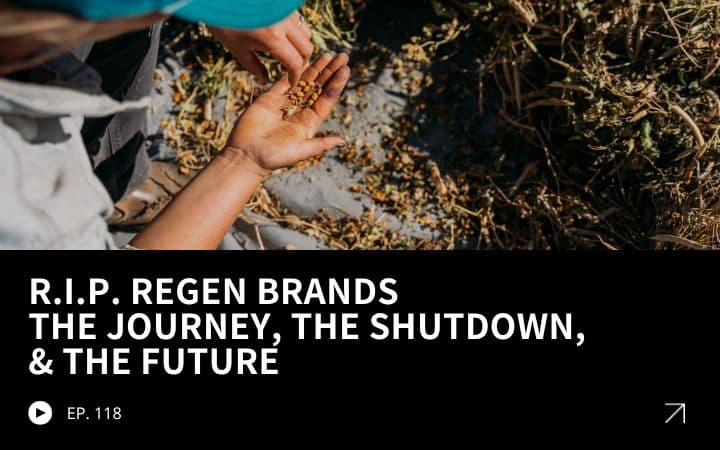
R.I.P. ReGen Brands - The Journey, The Shutdown, & The Future
After 119 episodes, the ReGen Brands podcast has reached its final chapter.
In this special in-person conversation, Anthony Corsaro and Kyle Krull sit down together for the last episode of the show.
What started as a casual idea grew into one of the most visible platforms documenting the rise of regenerative consumer brands. Along the way, the podcast explored everything from supply chain innovation to farmer transitions, from certification debates to the harsh realities of building regenerative CPG companies.
This final conversation reflects on that journey – celebrating the wins, honestly unpacking what didn’t work, and offering a clear-eyed view of where regenerative CPG goes next.
From Idea to Movement
The story of ReGen Brands began in June 2022, when Anthony and Kyle were both living in Bend, OR and searching for ways to contribute more meaningfully to the regenerative agriculture movement. Podcasting felt like a simple experiment – a way to surface conversations about brands supporting regenerative agriculture and the people building them.
Neither host knew exactly what it would become. But over the next three years, the show grew into a trusted forum for founders, investors, retailers, and farmers to openly discuss the challenges of building regenerative businesses.
Almost 120 episodes later, the results were tangible: a growing audience, nearly 100,000 podcast plays, and millions of impressions across various channels.
“We were kind of right in the sweet spot — early adopter right before the boom.”
– Kyle Krull
Perhaps more important than the numbers, however, was the role the show played in helping people understand regenerative CPG – a topic that can easily become overly technical or abstract.
By keeping conversations honest, curious, and accessible, the podcast helped bring the movement closer to the entrepreneurs and operators trying to build it.
The Wins We’re Most Proud Of
Beyond the podcast itself, the ReGen Brands platform expanded into something much bigger.
Anthony, Kyle, and many collaborators launched two nonprofit organizations – the ReGen Brands Coalition and the ReGen Brands Institute – to support regenerative brands through collaboration, education, and shared resources.
The coalition became the first trade association dedicated to regenerative consumer brands, launching with 31 inaugural member companies. Over the course of its first year, those brands participated in working groups, knowledge-sharing sessions, and collaborative marketing experiments.
One of the most visible successes was the “I ❤️ Regen” campaign, a certification-agnostic marketing initiative that brought regenerative brands together around a shared message. It demonstrated that collaboration could create real momentum – even in a competitive category.
“That was the first real cohesive marketing campaign amongst regenerative brands that was certification agnostic - ever.”
– Anthony Corsaro
For an emerging movement that often struggles with fragmentation, those moments of collaboration showed what might be possible.
Why ReGen Brands Is Shutting Down
Despite those successes, the organizations behind ReGen Brands ultimately faced a reality that many mission-driven startups encounter: ambition outpaced resources.
The coalition model relied heavily on brand participation – both financially and operationally. But regenerative CPG companies are often small, resource-constrained businesses already navigating difficult retail environments and supply chain challenges.
The expectation that dozens of startup brands could collectively fund and actively operate a collaborative organization proved difficult to sustain.
“My biggest takeaway from the entire failure is we just tried to do way too much, way too fast, without a lot of resources.”
– Anthony Corsaro
At the same time, the non-profit institute depended on philanthropic funding to support the media, research, and educational content produced by ReGen Brands.
While the community contributed generously – raising tens of thousands of dollars in donations – it wasn’t enough to build the infrastructure required to sustain the organization long term.
Add in broader macroeconomic uncertainty, tightening retail margins, and growing operational demands, and the path forward became increasingly difficult.
Ultimately, the decision was made to dissolve the organizations while preserving the work and lessons they created.
Where Regenerative CPG Stands Today
So where does the regenerative CPG movement stand today?
In some ways, the progress has been remarkable. More brands than ever are making regenerative claims, more certifications are emerging, and more retailers are expanding their regenerative assortments.
But many of the structural barriers to scaling regenerative products remain unresolved.
Retail buyers still struggle to identify and properly incentivize regenerative products. Consumer education remains fragmented and ineffective. And perhaps most importantly, regenerative brands still carry higher costs without clear economic incentives to offset them.
“I’m concerned that we’re losing some of the momentum in transition at this stage in the game.”
– Kyle Krull
That dynamic creates a difficult reality: regenerative brands are effectively paying a premium to produce food in a better way, without the systemic support needed to make that model competitive at scale.
Until those economics change, the movement’s growth will likely remain slower and more uneven than many hoped.
How We Get Regenerative Brands to 50% Market Share by 2050
Looking ahead, both hosts remain optimistic about the long-term potential of regenerative agriculture – even if the path forward is more complex than originally imagined.
The next phase of growth will likely depend on three key shifts.
First, retailers, certifiers, and brands must collaborate to develop clearer path-to-purchase strategies that help consumers understand regenerative products and why they matter.
Second, the industry must create real economic incentives for regenerative products – from merchandising support to promotional advantages.
And third, collaboration across brands, certifiers, retailers, and investors will be essential to align messaging and scale demand.
If those systems evolve, regenerative agriculture has the potential to move far beyond its current niche – becoming a mainstream approach to producing food that restores soil, supports farmers, and strengthens supply chains.
And while the ReGen Brands Podcast may be ending, hopefully the conversations it sparked will continue across the industry.
Because the future of regenerative food is still being written.
This ReGen Recap was written by Anthony Corsaro with the help of ChatGPT
Subscribe to future episodes of the ReGen Brands Podcast on Apple Podcasts, Spotify, or YouTube. You can help support our mission of growing regenerative CPG brands with a 5-star rating!
Stay engaged in the conversation by subscribing to our weekly newsletter, The ReGen Brands Weekly, and connecting with us on LinkedIn: ReGen Brands and AC