
Joe Miller @ Kalona Supernatural
Regenerative, “Almost Raw” Milk From A 19-Entity Ecosystem
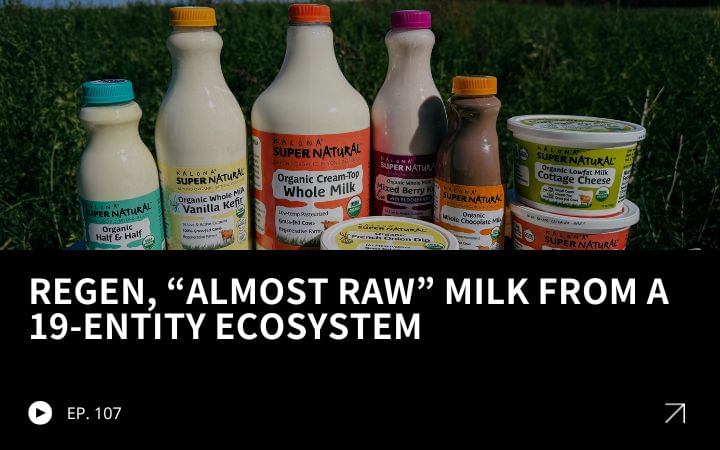
On this episode, Anthony speaks with Joe Miller, a 20-year veteran of the dairy world and a passionate advocate for organic and regenerative farming. Joe is a Managing Partner and Sales Director at Kalona SuperNatural, which supports regenerative agriculture through its dairy products made from small and mid-sized farms across Iowa, Missouri and Illinois. Kalona SuperNatural has over 15 SKUs including milk, yogurt, kefir, cottage cheese and sour cream, which can be found in grocery stores in all 50 states.
From Creamery Collapse to Regenerative Comeback
“If you go back to our founding, it was all about saving the small family farm.” – Joe
Kalona SuperNatural began as a rescue mission for organic farms in the heart of Amish and Mennonite country in Kalona, Iowa. Many of these farms had been operated organically for generations—some for over 150 years—but faced collapse in the early 2000s as multinational, corporate milk brands flooded the market with cheap milk. In response, a group of local farmers opened a small creamery in 2004. Soon after opening, the farmer group worked with Bill Evans, a local accountant and consultant, to start a marketing and sales arm – Kalona Organics.
Inside Kalona’s Ecosystem: 19 Entities of Impact
Kalona SuperNatural is supported by a uniquely interconnected ecosystem of businesses designed to uphold its values and ensure long-term viability for small family farms. After starting the sales and marketing company, Bill launched an independent distribution and trucking operation so they could distribute not just Kalona SuperNatural products, but also serve other partners and maintain flexibility. The production side—Farmers Creamery—was originally farmer-owned but later sold to Bill, who consolidated operations under his holding company, Open Gates. Today, the broad network is comprised of 19 entities in total, including two production facilities, warehousing, a local distributor serving Iowa retailers, an ingredient sales business, the CPG brand, and local cheese and coffee shops. There are also additional for-profit and nonprofit entities to support farm management and improved agronomics. A farm management business supports dairies with contract oversight, while non-profit Kalona Regenerative Network provides farmer education and supports regenerative transition. The Network serves as a Savory Hub and supports farms inside and beyond Kalona SuperNatural’s supply chain to become Land to Market verified.
Why “Almost Raw” Milk Is a Standout Strategy
“I believe milk is one of the most nutrient-dense foods available to us. And the more you process it, the less your body recognizes it... we're doing the best by the milk.” – Joe
Kalona SuperNatural’s milk is as close to raw as you can find on a grocery store shelf. From the beginning, the team made a conscious decision to process their milk in the gentlest way possible using vat pasteurization (the lowest temperature legally allowed) and avoiding homogenization. As Joe explains, they weren’t interested in maximizing shelf life or efficiency; they were committed to “doing right by the milk”. Their approach preserves the flavor, texture, and nutrient integrity of the milk, delivering a sensory experience that tastes like what farmers enjoy right on the land.
Retailers, Not Consumers, Are Driving Regenerative Demand (For Now)
Kalona SuperNatural is Land to Market certified on all of its Iowa-based SKUs. Joe explains that while many of their farmers were already following regenerative practices, the certification process has helped formalize continuous improvement and build farms’ long-term resilience.
“We're not trying to take 50 unique farms and make one homogenous farm. We're helping each farmer see where they can improve and how to build resilience.” – Joe
He and Anthony both share their appreciation for the Land to Market verification process, which provides farms with data and educational support to help improve soil health, biodiversity, and drought resilience over time. Kalona SuperNatural covers the costs of certification for their farms, which can be particularly costly for small-scale operations with 8-10 cows.
While consumer understanding of regenerative is still growing, Joe says Land to Market certification helps them differentiate themselves in the dairy case and highlight that their product is rooted in environmental integrity. As Joe puts it, in a world where dairy often gets blamed for environmental harm, he wants consumers to pick up a bottle of Kalona milk and say, “Not my milk!” The back of every eligible package includes a simple explanation of the certification, reinforcing the idea that choosing Kalona means choosing better for the land, the farmer, and the consumer.
Rebuilding a Broken Dairy Landscape
The U.S. dairy landscape has shifted dramatically. In 1970, there were over 648,000 farms with an average herd size of 19 cows and today, there are fewer than 25,000 farms averaging 330 cows. Kalona SuperNatural supports the small and mid-scale farmer, sourcing from farms with an average of 35 to 40 cows. In a system increasingly dominated by CAFOs and consolidation, Kalona proves that small-scale, pasture-based dairy is still possible. Joe also shares how building a proof point and system that supports regenerative dairy is important for the social fabric of farming. He recalls a farmer who transitioned from conventional to regenerative practices and saw his neighbors’ attitudes change – they experienced less odor, less dust, and took more pride in living near a farm. Joe highlights that the long-term viability of the dairy industry is going to require everyone to have more trust and enthusiasm in dairy farming, from the famer, to their neighbor, to the consumer at the grocery store.
“America's gonna have to value their dairy farmers, and dairy farming has to become as exciting of a profession and a fulfilling profession for families—not just the venture capitalist… We need to see a revival of appreciation for our family farms.” – Joe
How We Get Regenerative Brands to 50% Market Share by 2050
Joe believes brands must take ownership of their supply chains and commit to showing consumers why their food choices matter, not just for the environment, but for flavor, nutrition, and community resilience. That means going beyond transactions to build relationship-based, place-based food systems like Kalona’s. Regenerative can’t just be a label. It has to be experienced in the taste, felt in the trust, and understood through education.
Joe describes how we don’t need every consumer overnight, but we need a tipping point—a critical mass where choosing regenerative becomes the norm and anything else feels out of step. Anthony agrees and adds that when brands like Kalona SuperNatural take the bold step of owning their impact, the rest of the system, including retailers, investors, and service providers, must be ready to show up and support them.
“If you can get us further down that line, suddenly we’ll be looking back years from now and going, when did that happen? Like, everyone’s demanding [regenerative] now… and anything else feels out of step.” – Joe
This ReGen Recap was written by Katey Finnegan
You can check out the full episode with Joe Miller @ Kalona SuperNatural HERE
Subscribe to future episodes of the ReGen Brands Podcast on Apple Podcasts, Spotify, or YouTube. You can help support our mission of growing regenerative CPG brands with a 5-star rating!
Stay engaged in the conversation by subscribing to our weekly newsletter, The ReGen Brands Weekly, and connecting with us on LinkedIn: ReGen Brands and AC