
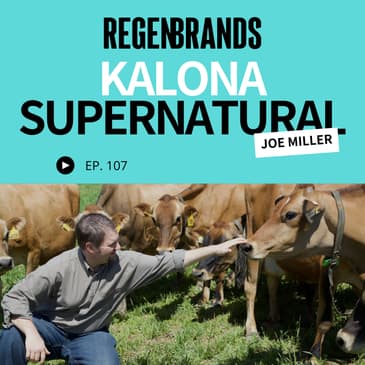
On this episode of the ReGen Brands podcast, we're joined by Joe Miller from Kalona SuperNatural — a 20-year veteran of the dairy world and a passionate advocate for organic and regenerative farming. We dig into Kalona’s unique vertically integrated ecosystem (that includes 19 different businesses!), the brand’s deep partnerships with family dairy farms, and all the ways regenerative is shaping their efforts from soil to shelf.
Joe shares the story of how a group of farmers took matters into their own hands when the local co-op abandoned the organic market — and why practices like low-temp pasteurization and non-homogenization are helping differentiate their “almost raw” dairy offerings.
We also discuss the challenging questions — how regenerative dairy can thrive and scale in a landscape dominated by consolidation, consumer confusion, and razor-thin margins. And Joe gives a heartfelt case for why organic and regenerative matters more than ever — to the land, to the farmer, and to the person drinking the milk.
Episode Highlights:
🌱 Kalona was born to save organic dairy farms that got left behind
🚚 Their Iowa-based ecosystem includes 19 different entities
📍 Buying from small family farms, many with just 35–40 cows
🌾 Leveraging Land to Market certification for agronomic improvement
🥄 “Almost Raw” milk via low-temp pasteurization & non-homogenization
📊 How regen affects their marketing efforts in-store and post-purchase
🧠 Scaling to national distribution while maintaining local and regional impact
📈 The rise, stall, and hopeful revival of organic dairy in America
🤯 648,000 to 24,000: Why 95% of U.S. dairy farms disappeared
🥛 How regenerative agriculture can help make family dairy viable again
Links:
If you find this content valuable, please consider donating to support our work
Follow ReGen Brands on LinkedIn
Subscribe to the ReGen Brands Weekly newsletter
Episode Recap:
ReGen Brands Recap #107 - Regenerative, “Almost Raw” Milk From A 19-Entity Ecosystem - (RECAP LINK)
Episode Transcript:
Disclaimer: This transcript was generated with AI and is not 100% accurate.
Anthony Corsaro - 00:00:13
Welcome to the ReGen Brands Podcast, the place for brands, retailers, investors, and other food system stakeholders to learn about the consumer brand supporting regenerative agriculture and how they're changing the world. I'm your host, AC. Thanks for tuning in. Now let's get into today's conversation. On this episode of the ReGen Brands Podcast, we're joined by Joe Miller from Kalona Supernatural, a twenty year veteran of the dairy world and a passionate advocate for organic and regenerative farming. We dig into Kalona's unique vertically integrated ecosystem that includes 19, yes, I said 19 different businesses, the brand's deep partnerships with family dairy farms, and all the ways Regenerative is shaping their efforts from soil to shelf.
Anthony Corsaro - 00:00:46
Joe shares the story of how a group of farmers took matters into their own hands when the local co op abandoned the organic market and why practices like low temp pasteurization and nonhomogenization are helping differentiate their almost raw dairy offerings. We also discussed the challenging questions, how regenerative dairy can thrive and scale in a landscape dominated by consolidation, consumer confusion, and razor thin margins. And Joe gives a heartfelt case for why organic and regenerative matters more than ever to the land, to the farmer, and to the person drinking the milk. Let's go. What's up, everybody? Welcome back to another episode of the ReGen Brands Podcast. Very excited today to have our friend, Joe, from Kalona Supernatural joining us. So welcome, Joe.
Joe Miller - 00:01:47
Anthony, it's great to be part of the ReGen Brands after having listened to it for about a 100 episodes now. It's great to be part of this.
Anthony Corsaro - 00:01:56
Let's go. Well, we're we're excited to have you, and I'm especially excited as someone that is absolutely addicted to Kalona Supernatural Sour Cream. That is definitely my favorite SKU. Avid avid purchaser at Sprouts in my area. But, Joe, for those that may be unfamiliar with the brand, what products do y'all produce, and where can people find them today?
Joe Miller - 00:02:18
Yeah. We're an artisan dairy product company, minimally processed organic dairy products sold in all 50 states now. Admittedly, in some states, very light, but in all 50 states, primarily in the natural and specialty food stores with a little bit in crossover stores, such as Hy Vee in the Midwest, Raley's in the West on the West Coast, etcetera.
Anthony Corsaro - 00:02:45
Nice. And I'm I'm excited to have you on, Joe, especially because to me, you're you're a dairy lifer or, like, you've been in dairy for most, if not, excuse me, all of your career. And so I think that gives you a really unique perspective to share kind of about the brand itself, but also about dairy at large and also Regen Dairy and regenerative organic dairy. So excited to to dive into all that with you. But before we do, the the origin story behind the brand is very interesting to me. The website does a nice job of kind of encapsulating it as well. But from my understanding from from reading that and previous conversations with you and and other team members is basically a local coop slash creamery kinda had gotten out of organic, and, the group behind Kalona kinda stepped in and made sure that didn't happen and created a market and a ecosystem of various businesses to keep some Amish and Mennonite farmers locally there in Iowa and then also, eventually in some of the surrounding areas of the Midwest, pumping good regenerative organic dairy through through that facility.
Anthony Corsaro - 00:03:17
So share share that story with us if you don't mind.
Joe Miller - 00:03:48
Yeah. Well, it helps if I go back to the early nineties, to share this. And well before that, but I don't I haven't lived that experience before that, though I've had the privilege of interacting with some of the the stalwarts behind organic and those that were instrumental in developing those early standards. But organic was somewhat of a free for all. The certifications were wide open, and people were generally labeling things as organic based on their own understanding of organic. In the nineties, as part of the I believe it
Anthony Corsaro - 00:04:33
was part of the farm bill, they passed, the legislation to enact organic certification, allowing the federal government to take charge of
Joe Miller - 00:04:46
the word organic, the organic certification, and that became law in the early two thousands. It became throughout the nineties, there was a lot of debate on what the that law should be, what that law, what the requirements would be around that. In the early two thousands, it became the law of the land, and the national organic program came under the USDA organic. Yep. Well, if I take if I go back now to the history of our farmers, it goes back even further. Farmers that have been on their farms for generations. Some of our farms have traced their farms back over a hundred and fifty years in their family. Some eighty to a hundred years in their family. Wow.
Joe Miller - 00:05:27
So we have a lot in our community there, we have a lot of farmers that have been certified organ or let me change that. Have been farming organically Yeah. For decades upon decades. Mhmm. You come up to the eighties and nineties, and they started marketing the products as organic. Some local co ops took advantage of that, and we're able to sell this organic product.
Joe Miller - 00:06:01
But there wasn't a strict federal legislation around the separation of organic versus natural
Anthony Corsaro - 00:06:14
Mhmm.
Joe Miller - 00:06:14
Or versus the conventional milk they had in there. There weren't the legislation wasn't strict. When you come into early two thousand, suddenly that legislation becomes strict, becomes codified into the law. And some of the local co ops go, this is this is too much. We're we're no longer going to be buying organic dairy. Wow. And that affected our region right there with quite a few farmers. And it was actually the farmers that came together and said, we would love for to continue This sure.
Joe Miller - 00:06:44
They had been farming this way before it became a thing, before it became trendy, but they wanted to continue this process and wanted to continue getting this value out to the community. So they partnered with some local business people and themselves. They put money into it. They drove the process. And in 02/2004, they started the process of opening a creamery there in Kalona, Iowa, actually, right outside of Kalona, Iowa to buy local farms farmers' milk and process organic products. In that process, I like to tell people, you know, we're in Iowa.
Anthony Corsaro - 00:07:37
Mhmm.
Joe Miller - 00:07:37
The whole Field of Dreams movie build it and they will come, that was kind of the concept that was behind it. Hey. We start processing this. We put it out there. We'll sell it. It'll get sold. Yeah. That, needless to say, is not a key for success. And that's the process that brought Bill Evans, a local account and business per a business consultant in to support. This has been twenty years ago now.
Joe Miller - 00:07:55
We launched our products in 02/2005, so we are celebrating our twentieth anniversary this year. And they brought Bill Evans in to to support them in the sales and the business development. And then later, several years later, as president of the company and manager, or president of the company and managing the whole the whole operation. Bill developed this is where it started the supporting organizations. So what Bill's agreement with the the group was, you have the processing. I want I wanna partner with you on that.
Joe Miller - 00:08:44
I want to be a part of that, but I will start up a sales and marketing arm, which we call Kalona Organics. Right. I wanna start up a a sales and marketing arm that will take care of sales and marketing of your dairy products. That was step one. Along the way, for the longest time, we had distributors taking up the products at our warehouse. At some point, the distributors go, you're too raw.
Joe Miller - 00:09:09
You need to bring it to us. Yeah. So Bill looked around the landscape and said, well, if I start up a trucking company, let's start it up independently so that it can haul other people's products as well, not just our own Mhmm. Going into these warehouses we're going into. So that's an independent organization under the larger organization of Open Gates, which is his his solely owned company, but that owns these individual entities such as Kalona Organic, so which owns the Kalona Supernatural brand, markets and sells the products, Farmers Creamery, which is our production arm. And by the way, the farmers still maintained equity into that in that production facility up until the late twenty tens where they sold the last of their shares to Bill and went back to doing what they were doing back in the nineties.
Joe Miller - 00:10:00
It was farming on their own. We still buy from the same farmers that were part of the startup, but, it's all under Bill Evans' ownership and leadership there at Open Gate. Mhmm.
Anthony Corsaro - 00:10:31
So it's basically a parent company, a creamery company, a sales and marketing arm which owns the brand. It's just those three things. Is there the trucking company you also said, and then is there anything else besides that?
Joe Miller - 00:10:45
I think today we have 19 entities underneath it. Wow. Wow. Yeah. Wow. It is let me try it. It is a warehousing Okay. Arm. It is our own local distributor. We have a local distributor called Kalona Direct, which delivers in the Iowa area, Central Iowa region, and delivers our products and some other people's products locally there in Iowa. That was just we had a lot of accounts, retailers, even some, convenience stores coming in and picking up products at our docks. Yeah. And we needed to simplify that. And Bill said, well, they're all coming in here.
Joe Miller - 00:11:27
We also know some other local food processors, one being Oasis, which is a local hummus company that is delivering out there. Let's just consolidate all that, and then we'll have our own little van trucks going out and making these deliveries. Another one's provision ingredients, which is our ingredient sales arms that used to be all under Kalona Organics, but as I'm sure many of your listeners know and you've you've heard many times is just buying the ingredients can be a separate challenge compared to selling the packaged goods. So we we set up a separate business that can just manage and focus on that high touch ingredient sales. We have we just, of several months ago, opened up a coffee shop Mhmm. That uses a high quality roasted coffee, but then, of course, our organic milk as as part of it. We have a little cheese shop there.
Joe Miller - 00:12:32
We have two production facilities. One which does yogurt and some contract manufacturing. The other does all of our bottled milk product. Wow. That's kinda an overview. We also do a little bit of farm management. If you go back to our founding Yeah.
Joe Miller - 00:12:55
It was all about saving the small family farm, and I know we're gonna get more into the farming side of it. And so yeah, I'll save talking about that till later, but saving small family farms is a big part of this. And throughout the years, they saw an opportunity to support more family farms around the country and helping manage their contracts for large dairies. So there's a little bit that we have our hands in helping other dairies with managing their farms for them with our farm team. Mhmm. Nothing to do with the brand, nothing to do with our company, and it's just helping helping small family farmers in other regions outside of our own.
Anthony Corsaro - 00:13:53
Super cool. I mean, a ton of complexity there, but it sounds like a lot of necessary complexity and very impactful complexity. I love just, like, the visual in my head is this, this, like, blossoming scale and impact, local, regional, national, right, to have, various parts of that business ecosystem and the enterprises focused locally, regionally, or nationally, but they all exist in symbiosis. So,
Joe Miller - 00:14:21
you know,
Anthony Corsaro - 00:14:21
kudos to you and Bill and and all the team that are working on on stewarding that. There was one there was also one thing, Joe, that I thought was unique that I actually learned about from talking to a young lady that does grant writing and other, kinda grant work in the space. I think y'all also have, like, a nonprofit that supports the farmers in a in a unique way. Is that true? And could you talk about that a little bit?
Joe Miller - 00:14:44
Yeah. So not owned under Open Gates, but it's something we support and is off to the side of our company. Mhmm. And that's Kalona Regenerative Network. And that, the sole mission of that is to support regenerative farms. We are a savory hub under Mhmm. Land to market or supporting land to market certification. Yep. And that or we aren't. Kalona Regenerative Network is. Right.
Joe Miller - 00:15:09
And the whole idea with that is to support farmers with education, support farmers transitioning to regenerative, support them in their process of regenerative. And, yes, our own farmers, but also other farmers in the region greater region that have interest and want to lean into regenerative.
Anthony Corsaro - 00:15:39
Yeah. I think that's super cool and and super smart. I think it's really cool because we need more brands and or entities connected to brands. I realize it's not owned by you all. I mean, it's a nonprofit. It really couldn't be
Joe Miller - 00:15:53
anyway. Yeah.
Anthony Corsaro - 00:15:54
But the the foresight and the wherewithal and the commitment, I think is really exemplified by that. And it's just really smart business because, ultimately, a lot of that work is unprofitable, hard to make profitable, hard to internalize into a for profit business, but deeply necessary, and totally valid to do in a nonprofit structure because of the societal benefit that it creates. So it's just a beautiful example of actually the American tax code and corporate structure possibilities working for the benefit Yeah. Of people, which I find that a lot of time, it it actually doesn't. So that that gets me fired up, and I I just love that y'all are doing that.
Joe Miller - 00:16:35
Well, it also is a big benefit to the the nonprofit side because we have all the data around regenerative that we're working on. We have the data of what consumers are saying so we can feedback on that and marketing support to the regenerative network to help lean in on what what's gonna dry so whenever they're going out and talking to a farmer about the benefits of becoming regenerative verified or moving their farm this direction, there's a whole financial benefit to the farm, the environmental benefit to the land and the community. But then there's also the benefit to the consumer side that we can we can highlight from our aspect for the farmers to be able to catch a vision for why why not only is this beneficial for your farm, but why is this beneficial externally?
Anthony Corsaro - 00:17:40
Yeah. You and I have had some some good conversations there, so we'll just go there because I think that was a good segue of y'all have land and market certification, I believe, on every SKU or close to every SKU. Correct, Joe?
Joe Miller - 00:17:51
So we have it on every SKU that's fed out of our local area. Okay. Out of Iowa. We also get prod organic dairy products processed in Wisconsin. Our sour cream that you mentioned and the cottage cheese and our organic French onion dip. Those products, because they come from a combined, dairy source or a commingled dairy source, we have not put the verified seal on those products or the regenerative claim on those products. Because although we know what farms we've worked with up there, it's a commingled dairy source. And so out of Yeah. Transparency and respect for the consumer Mhmm. We don't wanna call that out on those SKUs.
Anthony Corsaro - 00:18:42
Yeah. I appreciate that.
Joe Miller - 00:18:44
On what the opportunity is to do that.
Anthony Corsaro - 00:18:47
Yeah.
Joe Miller - 00:18:49
But it's one of the challenging areas in this. You know? We're already asking any co processor we use. Thankfully, the two main ones are our own processors, so we can do this. Yeah. But this is a challenge in any co processor. They're asked to keep conventional separate from organic, separate from maybe they have a non GMO line. Yep. And now you're saying, okay.
Joe Miller - 00:19:05
But I want for us, we wouldn't do, regenerative without organic. So we want organic, but now we need to keep it segmented and just this. Yeah. It's doable, but it's a challenge. And so this is why we don't have it on on a few of our products.
Anthony Corsaro - 00:19:33
Yeah. And I can realize the business conundrum of that from just an operational perspective, from an identity preservation deal at the processor. And also, you know, we know dairy margins have been compressed, very strongly over the last few years. And so, you know, continuing to to hold margin while doing extra steps like that, I'm sure can present a challenge. But y'all do have it on a ton of your revenue slash skews. And I think you've you've made some interesting points to me that really, yes, you are telling that story to the consumer. There's stuff on your website. There's stuff on social media.
Anthony Corsaro - 00:20:07
You have the seal on claim, but you actually see the greatest value, on the farm for regenerative and also more so probably with the retailer in terms of getting into stores versus, like, the end consumer right now. So we'd love to hear you just kinda speak to to your your point of view there.
Joe Miller - 00:20:26
Yeah. That's a great challenge. I imagine that's one that you're hearing quite a bit as Yeah. You talk to brands looking at going regenerative or even continuing to make the case to Mhmm. Either their shareholders or internally. Why why should we go to the extra work of being regenerative or being regenerative verified? And, you know, that's taking a step further. And you one of the things that's it's very much the case. Our farmers are doing this, doing these following these farming methods for decades before we verified them.
Joe Miller - 00:20:53
So it was one of the conversations we had internally. It's like, okay. Our farmers are already doing this. We didn't talk much about our herd size, but I'd like to just highlight that is Yeah. We have an average herd size of 35 to 40 cows. So very small herds, we have a a lot of them. So now we have we have farmers with eight or nine cows. Wow.
Joe Miller - 00:21:23
And we have to one of our agreements with our farmers is a certification like this, we're gonna pay for it. We're gonna pay them Love that. For the certification or verification side of it. Mhmm. But that when they have eight or nine cows, it's almost the same cost as a farmer that has a 100 cows. Yeah. Yeah.
Joe Miller - 00:21:48
The challenge when you go back to justifying it. Mhmm. And then in most cases, many of our farmers were already doing this. That's not a that wasn't a big challenge. But one of the things is everyone has areas for improvement. Everyone has areas that if they adjust, it would make a difference. And I've had this I don't know how much I want hey.
Joe Miller - 00:22:17
We wanna get right now into our farming into our farmers. But Yeah. Please. One of the one of the conversations that we've had in talking to consumers, we'll get questions about what's your policy or what's your process for this or that. You know, they everyone has their unique area when a consumer's reaching out to you that they wanna focus on. And I've had the conversation in email and in person with different consumers who I share with them.
Joe Miller - 00:22:52
We're not trying to take 50 unique farms and make one homogenous farm out of them. They're each individual operators that have their own way of doing things and rightfully so. So our goal isn't to take a lot of independent, passionate farmers, passionate in their own right in what they're doing, and make them all like one large farm. Yeah. Yeah. We want and we want to highlight the uniqueness of different farmers. So how do you achieve that when you're going in and saying, okay.
Joe Miller - 00:23:30
We want you to be regenerative. And what does that mean for your farmers? Well, one of the areas going back to your question now, one of the areas for farmers was to lay out look. If you approach your farming this way, if you take steps in some of these practices, you will be improving your soil. You'll be improving the vitality of your land. Your land may be able to support another cow or two.
Anthony Corsaro - 00:24:10
Yeah. Right.
Joe Miller - 00:24:11
What and even not that going back to your setup or what you staged it as a at the beginning, you know, we support a lot of Amish and Mennonite family farms. Right. It's not exclusive we're not a Amish and Mennonite exclusive dairy. We have some non Amish and Mennonite farmers, but the vast majority of them are the Amish and Mennonite farmers who their goal is to pass this on to their their children and their children's children. The farm's already been in their family for generations. They wanna pass it on to generations. So how can we showcase to them that you're doing excellent job?
Joe Miller - 00:24:41
Your soil granted right now is biodiverse in bug life and plant life, but maybe it's not in plant life. Maybe it isn't bug life. Maybe you're doing the right things by not spraying herbicides and pesticides. But if you could incorporate more of these native plants in there, you would be more drought resistant for every year. You know? You you go into the year.
Joe Miller - 00:25:04
I had one farmer tell me at one point, you plan for the worst and you hope for the best. Yeah. But what can you do to mitigate the, the worst? That's the financial case that you're making to these farmers. And then you know how it is. We we've been together at various food shows around the country, and you get all the retailers or the different brands together, and they're talking about what's exciting them right now.
Joe Miller - 00:25:35
It's no different with independent farmers. You get them together in a room. You do a training around what we're learning or bring someone in around a specific aspect that they could be doing differently. But then the real interesting part starts whenever you step back and the farmers start talking. Gets they roll the food out, get them sitting around tables, get them talking together Mhmm. And challenging each other. Yeah.
Joe Miller - 00:26:07
So that was really one of the areas around regenerative that we felt was helpful, bringing in the education, showcasing to farmers, not only how what they were doing had value, but maybe on some adjustments they could make for the long term. And then on the brand side, we had to find a reason why this was beneficial to pay the extra cost to make this happen. And a lot of that happens with the retailers. Getting the retailers to go, look. I want to showcase that I have exceptional products in my dairy set. I'm gonna carry the wide variety of of dairy products.
Joe Miller - 00:26:58
But what can I showcase that as a retailer that we are doing different and that we are highlighting having sustainable products for our community? And sustainable, as we all know, has totally lost all meaning. Yeah. So what can we do? And and regenerative filled that gap for us. Regenerative filled the gap of saying we have a value here of that we carry to the core of our farming
Anthony Corsaro - 00:27:39
Mhmm.
Joe Miller - 00:27:39
To improve not only products, but the environment and our community, AR farming community. That's really what it came down to. And then I don't know. Do you have any question around that? I'd love to speak to the consumer side just a bit because to me, that's where it really got exciting when when we really started looking at the difference it made for consumers. Mhmm.
Anthony Corsaro - 00:28:01
Yeah. Definitely touch on the consumer side. I would just add, like, one little, point on the agronomic piece, which is that is my favorite thing about land to market and really the savory EOB program is, you know, yes, it ends up as a binary pass fail, get a certification on pack, but I don't even remember how many data points. Like, the mass amount of data points and the actual, like, agronomic value that, that hopefully the farmers will receive from going through that certification process and the fact that it isn't just a standard check the box check the box thing. I just feel like that has so much value, and I love that they've kind of intertwined those two together in in their program.
Joe Miller - 00:28:43
They really have. They really intertwined education Mhmm. And dataset to help show the farmer, not just tell the farmer Right. Where they might be lacking. But if you can you can go out there and show the farmer, hey. Here's the areas that you have improved on. Here's the areas that continue to need work. The other thing I really liked about the savory EOB is process is the continuous improvement. Mhmm. I don't care how far you've come along.
Joe Miller - 00:29:03
And I know there's there's people even on our team that go, can they really keep improving ten years from now? I mean, you know? Yeah. Yeah. Okay. The improvements might be ever so much more minuscule at that point. The gains you see might be ever so much more minuscule.
Joe Miller - 00:29:25
But we gotta keep we gotta keep looking at it. Right. We gotta keep showing, working at how can we be better tomorrow Mhmm. Than we are today. Mhmm. Because that's really what keeps driving us and our planet forward and not being not being comfortable with where we are today. Yeah.
Joe Miller - 00:29:46
And that's really kinda what it comes back to my passion around consumers with regenerative. Consumers buy for a lot of for a myriad of reasons. I think right now and, AC, I'm sure you've looked at the data a lot more than I have around regenerative because this is your passion, your life. Yeah. But I don't see a lot of consumers walking into a grocery store looking for regenerative verified products. Right. I live, work, and breathe dairy.
Joe Miller - 00:30:20
And if you look back over the last twenty years, dairy has been hit hard on its effects on the environment. And in some ways, justifiably so. Mhmm. It it has gotten a bad rep from multiple areas of environment abuse, not paying attention to the runoff in the streams. Definitely, when you go to the nonorganic side, the Right. Herbicides and pesticide use, the farming of the land waste. Yeah.
Joe Miller - 00:31:00
There's been a lot of challenges, and I it it hurts to see the bad rap, especially whenever I see some of the replacements they're suggesting being no better for the environment than what dairy is. Dairy is still I believe that intersection of animal and land is still the best thing we can do. And then the nutritional benefit you get out of dairy is unmatched by any other analog that you might try to replace it with. That being said, one of the things and I wish, you know, if I come better prepared, if I was a professional in this, I would have a bottle of our milk that I could hold up. But the reality is
Anthony Corsaro - 00:31:58
I think you're pretty prepared, brother. Don't be too hard on yourself.
Joe Miller - 00:32:01
The reality is I want one of the things as I got digging into this is what's the benefit for consumers? And that is when they try when they're drinking milk, they love a good glass of cold milk. Maybe they love milk with their cereal, or there's no good replacement for using buttermilk to make biscuits or to make your favorite marinade. Yeah. And today, you know, cottage cheese is extremely popular as a high protein, low calorie, diet piece that actually tastes extremely delicious, at least from the right manufacturers Yeah. But or the right brands. That being said, what I really have seen regenerative make possible for consumers is when they read the latest article that says I'm sorry, but cow farms are destroying the environment.
Joe Miller - 00:32:44
Yeah. You know? Right. Or you pick up whatever cause is being pushed today.
Anthony Corsaro - 00:33:08
Right. We can't have any cows on planet Earth if we're not gonna have climate change.
Joe Miller - 00:33:13
When they when they see that, I want them to pick up their glass of milk and say, not my milk. Mhmm. Right. And that's when they get confident about, damn, I'm doing the right thing. I love this milk. I love, I love to enjoy dairy products, and I don't have to feel bad whenever somebody's knocking them down. Mhmm. They might not even buy our products all the time. Mhmm. But I want to give them that outlet to whenever they're feeling like, I just really want milk.
Joe Miller - 00:33:38
And I want to know that it's that I don't have to feel bad when I read the latest article, it gives them that confidence. I I don't want that to be the only reason they're buying our milk. There's a lot of other reasons I want them buying our our dairy products. But that ability for them to go, I feel good about what I'm doing. I don't have to I don't have to cower when I read the latest article. It doesn't even matter the science about it. We don't have to get into the science behind what they're saying.
Joe Miller - 00:34:19
It's that feeling of confidence, that feeling of feeling good about what you're doing is what we're Yeah. What we're aiming for.
Anthony Corsaro - 00:34:33
Yeah. I mean, and it's like, don't overcomplicate it. Right? Like, if you sell something, you want people to feel good about buying it, and you wanna feel good about their consumer experience, eating it, drinking it, enjoying it, whatever that may be. And we probably don't do and I'll just maybe I'll just speak for myself. Maybe I don't do a good enough job all the time of maybe, bifurcating those two things. Right? Like, the psychology around buying the product off the shelf is actually different than the psychology of consuming and the post purchase journey of the product.
Joe Miller - 00:35:04
Mhmm.
Anthony Corsaro - 00:35:06
And it does seem like we've highlighted that, as of right now, regenerative does seem like more of a loyalty and retention marketing tool than a purchase driving marketing tool. And that's basically what you said in a nutshell, which is, like, I wanna give my consumer as many reasons to feel good about the fact that they bought and consume this product as possible, and this is just another one of those. And and for y'all, it's really from an environmental perspective. But I also do wanna touch Joe on. I think the work that we both agree, like, still hasn't happened and needs to happen, and we're all working on it in our various ways. We've talked about it on the show. The the ways we're working on it here and and via the coalition, the trade association.
Anthony Corsaro - 00:35:41
But I I wrote down a quote that you shared with me the last time we talked, which was consumers buy because what it means for them, and they don't have the picture of what regenerative means to them yet. So I was just curious if you could elaborate on that a little bit.
Joe Miller - 00:36:00
Yeah. It's it's a definition problem. You know? It is it regenerative is is in some ways a analog at this moment for sustainability. Yeah. But too many consumers equate this both to the same thing.
Anthony Corsaro - 00:36:29
Mhmm.
Joe Miller - 00:36:30
And they're going, okay. Great. It's sustainable. Why should I care? Yeah. Why whenever I am struggling to make my food budget stretch across the month Right. Why should this make a difference to me? And this is where I know you've had a lot of discussions and several really good conversations lately around the the nutritional value Yeah. And how we can maybe stretch into that. I'm really interested in more that it's it's a difficult it's a difficult conversation because Yeah. There's there's a lot of legal sides to that as well. Yeah. Mhmm.
Joe Miller - 00:37:13
This is why on our packaging, we went and put on the back of any packaging that we had the space. We put a statement that says, land to market verified I got it here somewhere. I should I should know this by heart, but land to market verified proves that our farms are improving environmental or ecosystem health in biodiversity, clean water, soil health, and carbon storage. Yeah. It's to bring in the value to consumers. Mhmm. And to me, I think regenerative means so much more than sustainability.
Joe Miller - 00:37:50
And maybe that's because sustainability has gotten washed out so much, but I would sure hope that our goal as a regenerative community is not to just be sustainable and sit where we're at. It's to actually start reversing some of the trends that we've had. Mhmm.
Anthony Corsaro - 00:38:22
Yep. Yeah. And I think it's like if we do bifurcate the post purchase from the purchase drivers, the purchase driver, we we believe, I think, as a community right now is nutrition and nutrient density. And then maybe the poach the post purchase plays more on the sustainability and the kind of do good, do no harm ethos of of the products. Mhmm. And, you know, we're kind of there on the sustainability stuff. Right? Like, we have enough certification verification, definition, marketing materials to where we can say there's there's a lot of brands and products, like, making that claim and probably being understood by consumers, how well it's understood and how much it's resonating.
Anthony Corsaro - 00:38:47
We we probably don't know. But I think the the frontier, the unknown is is the purchase driving nutrient density stuff, which question there, Joe, is, like, are y'all investigating that at all? Are you doing any testing? Are you kind of doing anything there yet? And then I definitely wanna talk about some things I know you all you are doing on the unique processing side as well from a nutrition perspective.
Joe Miller - 00:39:24
Yeah. Testing wise is not an area that we have
Anthony Corsaro - 00:39:28
Mhmm.
Joe Miller - 00:39:29
Leaned in on or going down the route when it comes to this. It's been our focus has continued to be on when we started this, it was about how is benefiting the farmer. And then it's the use case of how is it benefiting the brand. And it really came to I love I love the breakout that you're doing as pre and post purchase. Mhmm. I was doing the same thing, but in a very long complicated process to get there.
Anthony Corsaro - 00:39:59
It's easy when you go second, brother. It's easy when you go second. You team me up for it.
Joe Miller - 00:40:04
Oh, it's it's so good. And, admittedly, all of our focus has been on post purchase.
Anthony Corsaro - 00:40:13
Yeah. What Joe, can you talk about the low temp pasteurization and the nonhomogenization practices that y'all do in processing? Because, I think there are other folks in the space that are doing that, but I think y'all are featuring it the most prominently that I've seen from a brand. I I could be wrong. There could be some folks I haven't seen. So I'm I'm just curious to hear, like, what is that, and what do you think it means to consumers, retailers? Like, talk to us about that.
Joe Miller - 00:40:43
Mhmm. Thank you. Yeah. I mean, there's where our work prepurchase comes in. Yeah. Yeah. Because this has been something hey. We're amongst friends here. No one else is listening. Right? I can I'll say I'll say this out loud. When we started in 2004 02/2005, I guess, when the the product line launched.
Anthony Corsaro - 00:41:09
Yeah.
Joe Miller - 00:41:11
It was about delivering a simple but excellent product to the marketplace. Organic certification was the was the baseline. Mhmm. When we did nonhomogenize, it was because we didn't have to spend money on a homogenizer. That pasteurization was unique, and that was a conscious decision in saying, we really want to find the the lowest processed way to deliver this milk to a consumer. And one of those comes from once you start enjoying raw milk, you realize how delicious it is Mhmm. I know there's could be those that disagree with me, but I'll point out that there are challenges and concerns around raw milk too. Very real ones, whether they're overplayed or underplayed, depends on which side of the fence and who you are. But we knew that we wanted to be able to deliver outside of the state.
Joe Miller - 00:42:13
We wanted to deliver a product that could be consumed by a wide, a wide swath of people. So we chose that pasteurization. It's the lowest temp allowed by law, and it does the least amount of damage to the milk. And we could deliver something to consumers that tasted like what we enjoy drinking it any other any other way or what our farmers enjoy. I would say for our community, our our, our team, we believe in what we're doing. It's the it's the right thing for the milk.
Joe Miller - 00:42:54
But it is the
Anthony Corsaro - 00:43:08
low temp between that and regular pasteurization is just the temp. There's not, like, a different machine. There's not, like, a different process. It's basically No. Just just a temp.
Joe Miller - 00:43:16
It is a different machine.
Anthony Corsaro - 00:43:18
Okay.
Joe Miller - 00:43:19
It is so different from The low temp vat pasteurization is done in a vat. Just stepping through the process, the milk is heated gently up to a 145 degrees and then held there for thirty minutes.
Anthony Corsaro - 00:43:32
Okay.
Joe Miller - 00:43:34
And then it's rapidly cool. We send it through a, plate that has cooling on one side, the warm milk on the other side, and it rapidly cools the milk back down to bring it back down to a low temp Yeah. And then it goes and then it's bottled. Okay. The I temp short time pasteurization is a 161 to 215 degrees. Depends on the processor. Depends is heated up to those temps, to get a little bit longer shelf life, but it's a more efficient processing method. Mhmm.
Joe Miller - 00:44:03
It's heated to that temp for fifteen seconds. Wow. And then it can go straight to bottling.
Anthony Corsaro - 00:44:24
What a difference. Wow.
Joe Miller - 00:44:25
Yeah. But it's a lot higher temp, and there's been plenty of data showing that in that in that short jump and on up, the enzyme structure enzymes don't like heat. The enzyme structure is destroyed. The protein structure is affected. Proteins are still in the milk, but the protein structure is affected. There's changes that are happening molecularly to the milk. Right.
Joe Miller - 00:44:50
Then you go up to ultra high temp ultra high temperature pasteurized milk, which gives them a ninety day shelf life that's put if it's put in aseptic or sterilized packaging, it's a lot longer shelf life. And that is heated up over 280 degrees. Wow. Yeah. Flash pasteurized. It's it's a split second. It's flash pasteurized.
Joe Miller - 00:45:10
And but it I don't
Anthony Corsaro - 00:45:27
yeah. It It's not milk that Joe wants to drink.
Joe Miller - 00:45:29
It's not milk that I wanna drink. Thank you. Thank you, AC. Appreciate it. Hey. I love my friends in in the dairy, but I I I've challenged them personally. I said, you know, you produce some some of them produce awesomely good milk and some of the best milk out there and outside of our farms, of course. But, no. I mean, they produce some excellent milk, and I'm like, don't kill it. So this was a conscious decision by those that were starting up the creamery to lean on a lower efficient way, a lower shelf life. We get a shorter shelf life. Lower efficiency.
Joe Miller - 00:46:07
You don't have the the speed that you have with the HTSD or other pasteurization methods, but they believed it was doing the best by the mill, and that's what we're delivering to the market. Nonhomogenized, that has later I mean, we've had we actually have a homogenizer in our plant now, not for any of our products, but we do some custom manufacturing for others. And we have a homogenizer in our plant now. What what does that mean,
Anthony Corsaro - 00:46:42
Joe? Explain that to me as a dummy. Like, what is homogenized versus nonhomogenized?
Joe Miller - 00:46:47
So during the homogenization process, the milk is hit with a high pressure, which obliterates the fat molecules into micron size so they stay suspended. Naturally, cream is lighter than milk. And with the molecule size that cream is, it will separate to the top and create what is now become very popular as cream top milk. Mhmm. That cream separating to the top needs to be shook back in. If I go back to the history of this, it's really fascinating is it started out as a way for as a convenience to consumers. So they don't have to shake their milk, but then it really got, it really got abused by some milk processors to be able to skim fat off of it and sell whole milk, but consumers couldn't tell.
Joe Miller - 00:47:34
It was all homogenized. It was it was one so can they could take fat off the top and consumers wouldn't know the difference. Obviously, today, milk is strictly regulated. Fat levels are tested by every plant and tested by the regulatory agencies across the country to ensure that you you can't be delivering whole milk that's not whole milk today.
Anthony Corsaro - 00:48:16
Right.
Joe Miller - 00:48:16
Let's just Right. Make sure that's clear that no one's abusing that today. But it was back then, you know, when it started. There was there was a side to it. The argument of so the homogenization process breaks up those fat molecules to micron size so they stay suspended in the mill and don't separate back out to the top. The argument around health is questionable at best. However, here's where here's the side where I fall on, and this was, pre Colonial Supernatural. I always sought out nonhomogenized milk for this one reason. I want milk. I'm not a fan of raw milk. We have already had that discussion. Yeah.
Joe Miller - 00:48:57
But I want milk as close to the raw state as possible, as least processed. Because Mhmm. I believe milk is one of the most nutrient dense foods available to us. Yeah. And the more you process it, the less your body is recognizes it. And, hence, we have a lot of rise of intolerances around milk, and I believe some of that is tied directly back to the over processing of milk to a point where bodies don't naturally digest it as well as they were meant to be.
Anthony Corsaro - 00:49:47
Yep. And I love that y'all are using, like, hashtag almost raw to describe that and to connect that with consumers because we're seeing all this content about raw milk, but Mhmm. I think many people, don't know how to or don't want to go find someone to buy raw milk from, which is, like, totally fair as a consumer prerogative. And if I can go conveniently get what I what I now believe to be as least processed as possible, like, that's a that's a win, and that's, I think, a key differentiator. So, one, I appreciate the dairy one zero one education for a dummy like me. And two, I think, it's it's really been brilliant strategy from a consumer perspective from my opinion. So kudos.
Joe Miller - 00:50:29
Consumers have really latched onto it. And this goes back to your prepurchase, argument of what's pre and what's post is the minimal processing consumers have you know, there are legitimate concerns around raw milk. We're very clear to consumers that reach out to us that we support raw milk. And if you can find raw milk and that's what you're comfortable with, go for it. Like, I don't I this is a personal belief of mine, but I don't wanna be telling anyone, no. You shouldn't have that. But I do wanna give them the education around why we do what we do. And that's what we we turn into is we say, find it.
Joe Miller - 00:51:03
But if you have anyone in your family that has autoimmune disease, younger, older that, you know, maybe shouldn't have raw milk or you're concerned about raw milk or you have a difficulty getting it, that is where we are here to give you the closest thing to raw milk available on most retail shelves. Mhmm. And our milk isn't available in all 50 states, but some of our products are in all 50 states. But we we're also very fortunate, and this is you could call it luck. You could call it whatever you want, but we are in the center of the country. And with a short shelf life, one of the crucial pieces is being able to get that milk to the shelf as quickly as possible. Right.
Joe Miller - 00:51:55
Also, so consumers can enjoy it fresh. And that with where we're located, we have that ability to get to the various corners of the country very quickly with the fresh milk straight from our production facilities.
Anthony Corsaro - 00:52:21
Yeah. That's it. It's definitely key. Joe, I wanna ask you a hard question because I feel like I'd be very remiss if I didn't get your perspective on it with the amount of time you've been in the dairy space, and it's certainly not something that we've talked about. And I'm gonna try and I'm gonna try and form it into a well formed question, but give me some grace here. From the from the time that I'm able to spend just thinking about dairy, it seems like we're in a really interesting spot. And maybe maybe let's let's talk just kind of about organic dairy as a way to focus the question. We had the kind of the the boom once some of the, some of the legislation that you talked about in the early two thousands. We had kind of the big exit for Horizon, and I think there's a couple others.
Anthony Corsaro - 00:53:01
We've seen a ton of headlines, I I would say, over the last, like, three or four years of a lot of those brands and or others kinda pulling back and cutting contracts with family farmers. We're seeing organic family dairies going out of business, closing up shop, making less money. And now we're also seeing, like, this revival of real dairy on the retail side. You're hearing about retailers cutting back on plant based skew and adding more real dairy skews. Like, can you make sense of that for me? Like, where the hell are we at with this thing, and where do you think we're going just in the macro for organic dairy at large?
Anthony Corsaro - 00:53:31
And, I mean, I also didn't even mention we have this whole new regen component in there too. So wherever you think is most is best to take that, I would just love your kinda take on the macro.
Joe Miller - 00:53:50
Yeah. You're bringing the hard questions now. It was flowing smoothly and everything was good. Let's throw them a curveball. From a macro sense, I can tell you I have been very grateful to see consumers coming back and valuing Mhmm. Dairy products as a nutrient dense source of food. Yeah. Because and, you know, we're going through this whole trend right now, and I'm celebrating clean ingredients.
Anthony Corsaro - 00:54:29
Yes.
Joe Miller - 00:54:29
Well, dairy brings a lot of brands, a lot of products, a clean ingredient that they can use that has a a lot of micronutrients and a lot of, the things they're trying to add to their products that they don't need to use synthetic alternatives for. I had written down going into this conversation a stat that I was like, well, I'll bring it out somewhere maybe when I'm talking about my passion for family farms and everything. Yeah. But I did some research here a few months ago looking at the USDA sense dairy census. Mhmm. 1970 wasn't that long ago. I mean Right.
Joe Miller - 00:55:05
It for some of us, it it we're perpetually stuck in the mode of thinking it's only twenty years ago. Yeah. For some, it's it's, you know, longer ago, but we're about we're talking about fifty five years ago.
Anthony Corsaro - 00:55:32
Mhmm.
Joe Miller - 00:55:33
There were over 648,000 dairy farms in The United States. Wow. Average herd size was 19 cows. 640
Anthony Corsaro - 00:55:45
Wow.
Joe Miller - 00:55:45
648,000 dairy farms. Today, well, accurately, in 2022, there are less than 22,000 dairy farms. Wow. No. Less than 25,000. I'm sorry. Got that wrong. I started talking by memory instead of looking down. Less than 20 hey. In 2022, there's less than 25,000 dairy farms in The United States. Average herd size of 337 cows. Oh, wow. So is 19 cows sustainable for every farm to have? Probably not.
Joe Miller - 00:56:13
I mean, we're making it work with an average herd size of 35 to 40. We have farms with way less than that. We have some farms in around the 100 to 120 cow range. But this is where I guess what I what I'm trying to say by this is America's gonna have to value their dairy farmers, And dairy farming has to become as exciting of a profession and a fulfilling profession for families, not just not just the venture capitalist or Mhmm. The people and nothing wrong. I mean, I hey. I appreciate the work they're doing out there too.
Joe Miller - 00:57:15
But we need to find a way to make this a passion for people to to see it as a viable way to make money Mhmm. And to live the life they wanna live while farming. Yep. And not need to be in a specific religious, viewpoint that says, well, this is what our families want to do. It needs to be more than that. And so I guess what I would say is we need we need to see a revival of appreciation for our family farms.
Joe Miller - 00:57:55
Now as we focus in on organic and regenerative, that's what gets me excited now. It's because I believe I know a farmer. I live in Pennsylvania. I guess maybe I left that out in the introduction. So Yeah. And, they are our facilities, our business, our farms are in Iowa. I live in Pennsylvania.
Joe Miller - 00:58:19
As you noted, I've been in dairy farming for or dairy support for pretty much all my life. There's a local farmer here that I had the privilege of meeting twenty years ago. And he had just, in the last couple years, had gone from conventional farming on his farm with a high amount of cows pushing production to switching over to a grass based operation, certified organic, low stress farming, low stress for the cows, I'm talking about. Yep. And his comment to me is, Joe, I never thought I could see the day when my neighbors were happy to be living beside me. Wow.
Joe Miller - 00:59:09
He said, I have had neighbors. He said, no. You know? It took several years, but I've had neighbors come and say, we aided living beside you. Because they were using the traditional farming processes. They were spread you know? Yeah. Containing the manure, spreading it out on the fields. The fields were, farmed clean, tilled up.
Joe Miller - 00:59:29
The dust Yeah. The winds would blow across. The dust would blow into the neighbor's houses and such. And suddenly, he had a pasture system. And the methane off of the farm, which is the part that smells from any farm, had dropped dramatically.
Anthony Corsaro - 01:00:03
I bet.
Joe Miller - 01:00:03
And the the the community was saying, we love being beside you now. Yeah. That's what gets me this was twenty years ago, and there was a a farmer that was thinking far enough ahead to move his farm in that direction. Mhmm. But that's what gets me excited. If we can get that story out about Mhmm. Farming and get communities that appreciate their farmers being in the their same community and value their farmers. And then we can get talking into the whole value of nutrient dense foods and how we need to we need to, as a society, need to step back and dig into that and say, what are we what are we financing?
Joe Miller - 01:00:35
What are we putting our money towards? What should the value of food be, and what should we be emphasizing? And that's that's a whole another topic. It's admittedly one that I'm not I'm not a politician. I'm not into that. Yeah. I can't speak to that world. Mhmm.
Joe Miller - 01:01:02
But I know there's a conversation there that needs to be had if we're going to save the family farm. And by extension, save just valuable source of nutrition and Yeah. Food that we have and not turn us into mega CAFO farms. I mean, I'll just say it out out loud, but Mhmm. Turn into these concentrated animal feeding operations. And we need we need to see concern hey.
Joe Miller - 01:01:34
We need to see the small family farmer. Whether, oh, let's be honest. That's different for each region. Some regions, a 500 cal farm is still a small family farm, and there are 500 cal farms out there farming with pasture based systems and such that are doing and and organically, doing a great job. There are, in our case, eight cow farms that are doing it. And, sure, they need to be a diversified farm.
Joe Miller - 01:02:06
You can't you can't pay for the farm with eight cows, but they're doing that along with either vegetables or with goats or with, you know, something else on the farm as well.
Anthony Corsaro - 01:02:25
Mhmm. Well said, man. I love the I I don't love the statistic, but I love the use of statistics to illustrate what has happened over the last fifty five years and then that very visceral story with that individual farm slash farmer, I think, tells it tells it really well. And it's a good segue into the final question, But I'll just offer maybe some some of my takeaways from the whole episode and or what you just shared there about dairy specifically, but also what leads into the final question, which is, like, we have to create these better support ecosystems for farmers, which I think Kalona is a great example of or or Open Gates, the entire ecosystem of Open Gates, the holding company, is an example of we have to help farmers with market access. Like, ultimately, if they can't sell that product to somebody and it's not a worthwhile business opportunity to farm this way, you know, none of it matters. And then the third one, which I think is harder to put into the Harvard Business Review case study thing is this idea of relationship over transaction and community based kind of approaches. We have to get back to some more of that in these industries and in these lines of business that, yes, are businesses and they need to make money and they need to have profit. But, it can't just be, I bought your milk for thirty years and then I send you a two week notice that I'm not gonna buy it, you know, anymore.
Anthony Corsaro - 01:03:41
So all that said, some of my takeaways from what you shared, Joe, and I will tee you up for the last question, which is, how do we get ReGen Brands to have 50% market share by 2050? What do you think?
Joe Miller - 01:04:05
It all starts with building that consumer demand. And in order to build the demand, we have to build the case of why it's worthwhile for consumers. And I I love the work that various are doing around the nutritional side, but I think there's also a it goes back to the whole story around just saving the family farm. And, obviously, I have a passion directly down there, but I I believe it it has analogs into other businesses as well. If they can showcase to consumers that they are supporting the things that make for a better environment Mhmm. Which in turn make for better better and more delicious food products. Right. I'm passionate about how Kalona Supernatural approaches our processing and such, but we're not the only way to do it out there.
Joe Miller - 01:05:00
I'm incredibly grateful that we're not the only way people are doing out there because there's a great opportunity for diversity in in these areas. One area I don't think there's any op room for diversity, though, is in taking a in brands and food businesses taking responsibility for their supply chain and then showcasing to consumers why it's important either in the the flavor, in the nutritional value, in the, environmental value Mhmm. To consumers. Can we reach 50%? I don't know. But study upon study has shown that if you can you know, I love Malcolm Gladwell's book, The Tipping Point.
Joe Miller - 01:05:48
If you can get us over get us further down that line suddenly, and we'll be looking back, hopefully, fewer years and more years, but we'll be looking back years from now and going, when did that happen? Like, everyone's demanding this now. Mhmm. And I believe it has to start with brands taking responsibility. You know, we see right now brands suddenly getting the vision that they should take food coloring out. And soon, I don't think it's gonna be too long, and you're gonna see it be like consumers won't won't accept anything with food coloring in it.
Joe Miller - 01:06:30
And there was a tipping point there at some point, and but, yeah. It's I believe brands need to take that responsibility. Mhmm. To say, we're going to do the right thing in our supply chain line, and then Mhmm. We're going to find out how to sell this to consumers that this is the right thing for, for them. Yeah. I don't know.
Joe Miller - 01:07:10
Did I answer your question at all?
Anthony Corsaro - 01:07:24
I think you did very well, man. And I agree with what you said, and I would add on to it. It's a very self serving comment, but it's one I'm convicted on. We have to then say to those brands that have made that commitment or to those brands that we want to make that commitment, we are here to support you in x y z way. And there's a way that what we're building here at ReGen Brands is supposed to show up for that. There's a way retailers need to show up for that. There's a way some of those early adopter consumers need to show up for that. There's a way bankers need to show up for that.
Anthony Corsaro - 01:07:47
And, you know, service providers of various CPG types, need to show up for that. But that's a key that's a key piece. And, at the end of the day, this platform is kind of all about, in my opinion, socializing what those pathways are and what those opportunities might be to support the brands that are nourishing all life. Not to not to get too tagline y. But, yeah, love that answer, man. Appreciate all the insights, to today.
Anthony Corsaro - 01:08:14
You're clearly such a wealth of of knowledge on dairy at large and also what y'all are doing with with Kalona. Super cool and very impressive and just love that you're part of this community and and keep up the great work, man. And thanks for joining me.
Joe Miller - 01:08:35
Back at you, AC. Thank you so much. Thanks for the opportunity to share it today.
Anthony Corsaro - 01:08:40
Absolutely. For those that are not familiar or wanna check out more, see where Kalona products are maybe in stores near them, or just dive more deep into some of the topics that Joe and I talked about. It's kal0nasupernatural.com. All one word. Kalonasupernatural.com. So thank you, Joe. Appreciate it, man.
Joe Miller - 01:09:03
Thank you. Have a good one.
Anthony Corsaro - 01:09:08
For transcripts, show notes, and more information on this episode, check out our website regen-brands.com. That is regen-brands.com. You can also check out our YouTube channel, ReGen Brands, for all of our episodes with both video and audio. The best way to support our work is to give us a five star rating on your favorite podcast platform and subscribe to future episodes on Apple Podcasts, Spotify, and YouTube. You can also subscribe to our newsletter, the ReGen Brands Weekly, and follow our ReGen Brands LinkedIn page to stay in the know of all the latest news, insights, and perspectives from the world of regenerative CPG. Thanks so much for tuning in to the ReGen Brands Podcast. We hope you learned something new in this episode, and it empowers you to use your voice, your time, your talent, and your dollars to help us build a better and more regenerative food system. Love you guys.