
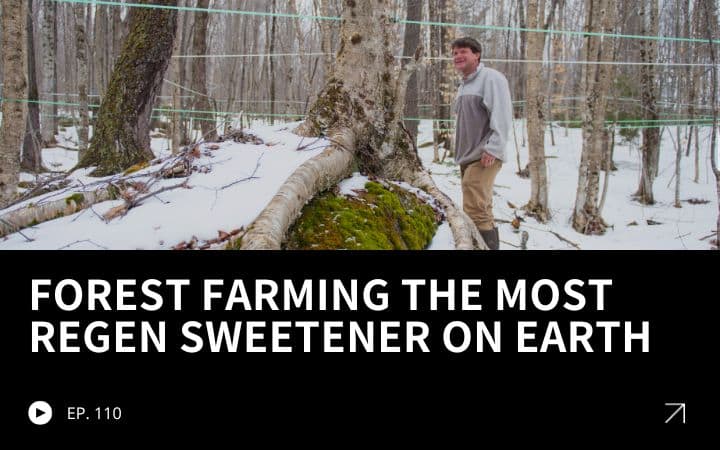
Forest Farming The Most Regenerative Sweetener On Earth
On this episode, we’re heading into the northeastern hardwood forests with Dr. Michael Farrell — forester, former director of the Cornell Maple Research Center, and Co-Founder of The Forest Farmers. Michael is helping brands reformulate with what may be the most regenerative sweetener on the planet.
From scaling a 10,000-acre regenerative forest supply chain to serving brands like Alec’s Ice Cream, Wild Orchard, and Recoup, Michael breaks down how tree sap can go far beyond pancake syrup — and how tapping more U.S. maple trees could unlock major opportunity for regen products.
An Untapped Regenerative Supply
Maple trees grow across nearly every U.S. state, but only a tiny fraction are tapped for sap. Unlike cane or corn, which require plowing, replanting, and irrigation, maple trees are perennial, biodiverse, and relatively hands-off. And yet, Michael reveals that we’re tapping less than 1% of the maple trees that are biologically ready to be harvested in the U.S.
“We’re tapping less than 1 percent of the maple trees that are out there.” – Michael Farrell
The reasons are cultural and infrastructural — not ecological. Most Americans don’t realize what they’re missing, and very few landowners have access to the equipment or labor required to bring tree sap to market. That’s where The Forest Farmers come in.
Why Maple May Be the Most Regenerative Sweetener on Earth
For Michael, the case for maple isn’t just about supply — it’s about sustainability. Sap flows from trees that are decades old, grown in forests that support birds, pollinators, and wildlife, with no need for chemical inputs or fossil fuel-intensive cultivation.
Unlike cane sugar or corn syrup, maple products preserve forests instead of clearing them — and they bring functional benefits, too. Maple sap naturally contains electrolytes, polyphenols, and antioxidants, especially when minimally processed.
“You don’t have to plow the land, you don’t have to fertilize it, you don’t have to irrigate it. And you just keep it as a diverse forest and tap the trees.” – Michael Farrell
Depending on the level of processing, maple can be a neutral sweetener in beverages or a bold character ingredient in sauces and ice creams — with flexibility to match your formulation goals.
Turning Maple Into A Full Suite Of Regenerative Organic Ingredients
The Forest Farmers now work with brands like Wild Orchard, Recoup, and Alec’s Ice Cream — offering sap, syrup, nectar, and maple sugar in a variety of formats. Maple water (a rebrand of maple sap) is gaining ground in the functional beverage space, offering natural electrolytes with no added sugar.
“It’s not just syrup anymore — it’s syrup, sugar, water, nectar, flavoring. We’re trying to be a one-stop shop for maple ingredients that brands can use across the board.” – Michael Farrell
From beverages to marinades, desserts to baking blends, maple is becoming a secret weapon for regenerative brands looking to upgrade sweetness while maintaining flavor, function, and regenerative certification.
Infrastructure, Labor, and the Art of Harvesting at Scale
Scaling a regenerative forest supply chain is no small feat. Michael walks us through the highly engineered systems of vacuum tubing, collection tanks, and reverse osmosis that move sap efficiently through 10,000 acres of sugar bush. Yield depends on pressure — every inch of vacuum can increase sap flow by 6% — making process design a major driver of ROI.
The Forest Farmers also rely on an experienced team of Jamaican H-2A workers who return each year to carry out the precision tapping and seasonal transition between maple, birch, and beech. Their skill and consistency are essential to stewarding the trees and maintaining high-quality flows.
“It takes a while for those trees to get to size. You know, you’re looking at about 40 to 50 years before they’re big enough to start tapping.” – Michael Farrell
How We Get Regenerative Brands to 50% Market Share by 2050
Michael believes that if consumers start demanding better sweeteners, the supply will follow — just like we’ve seen with organic, grass-fed, or non-GMO products. Real maple syrup, he says, only has one ingredient — maple syrup — but many people have never actually tasted the real thing.
That consumer education piece, especially in foodservice and quick-serve restaurants, could be the tipping point that pulls maple into everyday use. And once brands experience the versatility of maple in their ingredient deck, they rarely look back.
“When people want it, the producers will supply it… that’s what it all comes down to.” – Michael Farrell
Michael’s not just tapping trees — he’s tapping into a massive underutilized regenerative resource. And if the regen movement is serious about scaling to 50% market share, forest farming might be one of the fastest, sweetest paths to get there.
This ReGen Recap was written by Anthony Corsaro with the help of Chat GPT
You can check out the full episode with Michael Farrell @ The Forest Farmers HERE
Subscribe to future episodes of the ReGen Brands Podcast on Apple Podcasts, Spotify, or YouTube. You can help support our mission of growing regenerative CPG brands with a 5-star rating!
Stay engaged in the conversation by subscribing to our weekly newsletter, The ReGen Brands Weekly, and connecting with us on LinkedIn: ReGen Brands and AC