
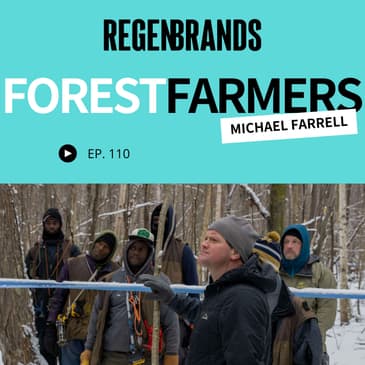
On this episode, we’re going deep into the forest with Michael Farrell, Co-Founder of The Forest Farmers.
Michael and his team are managing over 10,000 acres of forest in New York and Vermont to produce what they believe to be the most regenerative sweetener on the planet.
You’ll hear how The Forest Farmers’ keep forests diverse and thriving, why maple syrup is nutritionally and environmentally superior to more popular, cheap sweeteners, and how brands can integrate maple ingredients into everything from beverages to baked goods.
We unpack how maple trees become a full suite of Regenerative Organic Certified® products — from sap to syrup to sugar — and how those ingredients are now powering a new generation of regenerative brands like Recoup, Wild Orchard, and Alec’s Ice Cream.
Michael also shares why only 1% of U.S. maple trees are tapped today, and how shifting consumer demand can change that.
Episode Highlights:
🍁 Making maple a leading regenerative organic ingredient
🍭 Maple sugar used to be the dominant sweetener in early American diets
🔍 Today’s mainstream syrups are often entirely artificial with no maple at all
🌳 Regeneratively managing over 10,000 acres of diverse forests
🛠️ Vacuum pumps, tubing grids, & gravity — how tree sap flows at scale
🇯🇲 The skilled Jamaican H2A team farming the forest
🎯 The nutritional and environmental advantage of maple-based ingredients
🧪 Process to taste — neutral sweetness or a bold maple profile for CPGs
💼 Supplying brands like Recoup, Wild Orchard, & Alec’s Ice Cream
🌲 The monster maple opportunity in both supply and demand
Links:
Regenerative Organic Certified®
International Maple Syrup Institute
If you find this content valuable, please consider donating to support our work
Follow ReGen Brands on LinkedIn
Subscribe to the ReGen Brands Weekly newsletter
Episode Recap:
ReGen Brands Recap #110 - Forest Farming The Most Regenerative Sweetener On Earth - (RECAP LINK)
Episode Transcript:
Disclaimer: This transcript was generated with AI and is not 100% accurate.
00:34
Anthony Corsaro
On this episode, we're going deep into the forest with Michael Farrell, co-founder of the Forest Farmers. Michael and his team are managing over 10,000 acres of forest in New York and Vermont to produce what they believe to be is the most regenerative sweetener on the planet. You'll hear how the Forest Farmers keeps forests diverse and thriving, why maple syrup is nutritionally and environmentally superior to more popular, cheaper sweeteners, and how brands can integrate maple ingredients into everything from beverages to baked goods. We unpacked how maple trees become a full suite of regenerative, organic, certified products, from SAP to syrup to sugar, and how those ingredients are now powering a new generation of regenerative brands like Recoup, Wild Orchard and Alex Ice Cream.
01:23
Anthony Corsaro
Michael also shares why only 1% of U.S. maple trees are currently tapped today and how shifting consumer demand can change all of that. Let's go. What's up, everybody? Welcome back to another episode of the ReGen Brands Podcast. Very excited today to have an absolute legend with us. Some people call him Michael, some people call him Mike. To me, he is the one, the only, the magic mapleman. Okay, so we have Mike Farrell from the Forest Farmers with us. So welcome, brother. Pumped to have you here.
02:01
Michael Farrell
It's an honor to be here. I've listened to almost every episode, and I'm excited to finally be joining you in a live conversation. So thanks for having me.
02:12
Anthony Corsaro
It is. It's exciting to have this conversation here in the podcast format after, you know, all the ones we've had, you know, on the phone via Zoom and at various industry events. You guys are doing some really cool stuff and really some stuff that Mike, I wasn't super aware of before I met you and learned about the ingredients that you were supplying to some of the brands that we work with. But for those that may not be familiar with the Forest Farmers, just give us a feel for where are you located in the country? What sort of forest ecosystems are you working with, and what kind of ingredients do you supply to folks today?
02:47
Michael Farrell
Well, I here in the Adirondacks, I live in Lake Placid, and we have close to 7,000 acres up in Lion Mountain, about an hour north of here in the Adirondack southern, I mean, northern Adirondacks foothills. Beautiful forest. It's natural hardwood forest, mostly dominated by maple and birch. And then we also have another 3,000 acres in Central Vermont, similar type of forest, also maple beech birch forest that is predominant here in the Northeast. And so we are managing all of that for a wide variety of products. The main stuff that we, you know, as the forest farmers, like, we're farming the forest. That's why we have that name. But it's mostly the SAP from maple and birch trees. And then we take that SAP and do lots of stuff with it as well.
03:42
Anthony Corsaro
Yeah, I was probably just ignorantly unaware of the massive amount of kind of utilization opportunity there was for all that SAP. And it's been fun to learn about that from you and see it in, you know, in real life and some of these products and also for us to kind of dive into it today. But before we go there, would love for people to hear a little bit about your background, because I think it's interesting that you actually had this long career in academia studying these ecosystems and helping people manage these forest ecosystems before deciding, hey, let's go start this business to actually create more of a market for what comes out of them when they are healthy and regeneratively managed. So give people a little feel into your background and how the forest farmers came about in 2015.
04:31
Michael Farrell
Well, I'm sitting here now. I'm actually at the Cornell Maple Research Center. It's literally about a quarter mile from my house. Because I expected to retire from Cornell. I had this incredible job running the Maple Research and Education Center. I love it. It's a great job. Do all sorts of interesting projects, work with tons of producers throughout the country. And in 2015, and the reason I'm up here now is so that we actually have a good podcast and we don't have what we call now. We call. We call it a Conan moment. Because I was actually on the Conan o' Brien podcast and my. There was glitch in the thing. So now I'm taking the. Yeah, taking, you know, these types shout.
05:17
Anthony Corsaro
Out to Cornell for the strong WI fi.
05:19
Michael Farrell
We appreciate it. Yes, much better. Much better than mine. So I came back up to do this. It's literally just up the road. I still have a great relationship with all the folks at Cornell, and I would have stayed there until he retired was a fantastic job. But I also met a fantastic individual 10 years ago. He came here up in the Adirondacks. He was looking to get involved in forest conservation in Maple. Creating jobs and preserving the forest. And that's what you can do with in this industry. And so we met, hit it off. He's a great guy. And I was just planning on doing a little bit of extra consulting work just to help him out, figure out how to get started in this. And then we just had Lots of stuff going on, lots of good opportunities.
06:19
Michael Farrell
I was trying to manage that, trying to continue my job at Cornell and starting a family and life just got too crazy. And so within a couple years I just said, I can't do that. And I had a long talk with Dwight about, you know, do you think I should do this? You think I should just, you know, leave my great position at Cornell? And he was supportive and I wouldn't do that with just anybody. Right.
06:48
Anthony Corsaro
Yeah.
06:49
Michael Farrell
You don't just leave this type of secure, great position with a young family unless you have high confidence in the business you're getting into and the people you're working with. So. So I made the leap and it's been a very interesting 10 years.
07:03
Anthony Corsaro
Yeah. And y' all have really, you mainly own the forest and manage the forest and produce these ingredient type products now, but you've also had a brand, I think even multiple brands in that timeline. So we can kind of talk about that too. But deep perspective into not only managing these forest ecosystems, but also creating markets for what they produce, which is really what this whole podcast is about, is how do we properly manage an ecosystem and how do we create a better market for what comes out of it when it is regeneratively managed? Let's go on the macro. And this is like probably a dumb question for me to start with, but like, how many of these forests, air quote forests are like privately owned and managed and at a scale that can produce B2B type ingredients? Or are they mostly public lands?
07:57
Anthony Corsaro
Are they mostly like really small where people are just tapping one tree in their backyard? Like, you know, how many of the use are there out there?
08:05
Michael Farrell
That's a really good question. And that's actually when I was at Cornell, I also did my PhD at Cornell while I was running the facility. And my thesis was on the growth potential of the maple industry. And what is the opportunity? What are the barriers? And you know, and so I did a lot of looking at just the resource itself and where are the trees, who owns them, what's the availability? And you know, we're tapping less than 1% of the maple trees that are growing in the U.S. wow. Yep. That's crazy. And it used to be much higher. So think about the height of maple production in the US was actually in the mid-1800s, right around the Civil War, because it would. That was their source of sugar and it was like the north produced maple sugar.
09:00
Michael Farrell
They said they weren't going to get slave sugar from the south, everybody tapped those trees. They were clearing the rest of the forest. They only saved the maples because that was the source of sugar. So you had this major deforestation of the eastern U.S. the maples are the ones that were saved. And when that ag land got abandoned, people, you know, moved to the city. They stopped trying to do subsistence farming in the hillsides and it seeded back to maple. And so now maple is one of the most dominant trees in the eastern US because of our history of that. And you know, a lot of them occur on small tracks where, you know, it's only going to be a hobby size operation.
09:44
Michael Farrell
But there's also large private tracks as well that, you know, you only need 100 acres or 200 acres to have an economically viable commercial operation. And there's lots of those types of tracks out there. And even if you don't have that yourself, you can lease from a neighbor. You know, there might be 40 acres back and forth to each other. And a lot of that happens tapping maple trees on other people's land and just paying it lease fee. So there is a great opportunity here in the US Even more so than Canada. Like Canada makes the most maple, but not because they have the most trees. Vermont makes the most maple in the US not because they have the most trees. West Virginia actually has more maple trees, tapled maple trees than Vermont.
10:26
Anthony Corsaro
Wow.
10:26
Michael Farrell
But West Virginia doesn't have the culture that Vermont has. It all really comes down to culture and infrastructure because the trees are there, but you need to have the people who want to do it, who know how to do it and the markets for it. And so Vermont and Canada have done a tremendous job marketing maple. That's what people know. But there are maple trees all over.
10:50
Anthony Corsaro
The U.S. yeah, all over the entire U.S. i would assume it stops somewhere that's more like an east coast thing or. No.
10:58
Michael Farrell
The only state that doesn't have naturally occurring maples is Hawaii.
11:02
Anthony Corsaro
Wow.
11:03
Michael Farrell
Yeah, there's.
11:04
Anthony Corsaro
Wow, that's wild.
11:06
Michael Farrell
Yeah, there's. There's different species of maple all over. And there's maple throughout the world as well. Like we think of maple syrup just as a U.S. thing in Canada, eastern U.S. and Canada. But maples do grow throughout Europe and Asia. They just don't have the culture there either. Okay. And in the US There is more of a movement right now to do maple syrup on the west coast with big leaf maple or in the intermountain west in the Rockies with big tooth maple. There's more happening in the Appalachians. Especially with red maple. Red maple is becoming the most dominant tree species in the eastern US and more people are using red maple. So there's this, basically, no, there's this huge maple resource. We're using very little of it. We can and should be doing more.
11:52
Michael Farrell
And one of the reasons that I gave up my position at Cornell to do this is to do this on a very large scale. And now we are the largest producer in the state of New York.
12:04
Anthony Corsaro
And so first of all, I should correct myself because you're not the maple man. You're really Dr. Maple because you have your PhD. So I got to put some respect on that PhD.
12:15
Michael Farrell
I didn't want to yell at you before.
12:19
Anthony Corsaro
Was is your theory of change and has it stayed this, that food ingredients is the best way to realize the untapped potential of maple in these forests? Or is there also like a timber market or is there other uses? I mean, I would assume there is, but not sure.
12:36
Michael Farrell
Yeah. The best way is actually just getting people to switch away from the fake syrup to real because that's the number one use for maple syrup is on pancakes and waffles. And unfortunately, 90% of the syrup getting poor, at least yeast is of getting poured on those is just fake stuff with artificial microflav.
12:55
Anthony Corsaro
What is it?
12:56
Michael Farrell
What is it? Well, it's. It's either it's high fructose corn syrup for the most part with artificial macro flavoring. That's the aunt Jim and Mrs. Butterworth and log Cabins of the world. And so that's just so much cheaper and you know, a lot. So many people are used to it that you know, just if we can get in, take part of that market share, that's the easiest way to develop more markets for maple. You can also put maple as the sweetener in lots of different foods, which I'm a hundred percent behind as well. But that only accounts for. We don't have good data on it. But the thought is maybe 20 to 25% of the maple syrup being made goes into other foods. And most of it goes on pancakes directly.
13:41
Anthony Corsaro
Wow. And there's no law, there's no way to kind of prevent basically all the fake product that's out there.
13:49
Michael Farrell
I mean, well, they, there are laws and you can actually go to jail for a person and people have. For. Wow. Oh yeah. For being fraudulent. Maple syrup. You have to. Yeah. Oh, and there's been lots of shenanigans over the years. Yeah. So yeah. But most everybody now plays by the rules. It's very rare that you find something like that happening anymore. And.
14:21
Anthony Corsaro
But those big brands that you just mentioned, they get away with it because they just disclose it on the loi and they don't, like, officially call it maple syrup. They just call it, like, syrup or something.
14:30
Michael Farrell
It says, well, it's called pancake syrup, natural maple flavor. If you say maple syrup anywhere on the front label, it's gotta be maple syrup.
14:38
Anthony Corsaro
Okay?
14:39
Michael Farrell
So it's either pancake syrup or table syrup. Somebody tried to do all natural syrup, you know, several years ago, put it in the same jug, so it kind of like maple syrup.
14:50
Anthony Corsaro
So one. One thing that, like, I was not aware of, that I would love for you to break down for us is there is all these ways to utilize the SAP, and there's all these things that the SAP can become right when you tap a tree. So you guys are selling maple syrup, concentrated maple SAP, maple sugar, birch syrup, concentrated birch SAP, beach syrup, maple walnut syrup. Like how. Like, how do you even manage that complexity? And what is the processing like of that?
15:26
Michael Farrell
How does that happen? Yeah, it can get a little difficult depending on how things are shaping up with the weather every year. So there is great synergy between maple and birch because the maple season is basically ending when birch season is starting. So you get to use the same processing equipment to. To turn birch SAP into syrup. You get, you know, same holding tanks, you know, same pump lines, same reverse osmosis and filter press. All that stuff. That's actually really expensive. Like, one of the things that hurts profitability of maple is it just. It costs a lot of money to buy all the equipment.
16:09
Anthony Corsaro
Right.
16:09
Michael Farrell
And to buy the land. And so if you're making one crop, you have all that invested for just maple. And we decided to do as many as we could from the forest. And the other most dominant species is birch. And so, for instance, in New York, we have about a hundred thousand maple taps and close to 30,000 birch. And so our labor force also, instead of just waiting, you know, once you've got all the trees, taps, and you've fixed everything, sometimes you're just waiting for the season to be over, then clean up. Yeah, we have guys here. We'll maybe get into it later, but our workforce is primarily Jamaican through the H2A program. They want to work, and so we have work for them to do. Get ready for birch and do the birch until the maple season's over as well.
16:57
Michael Farrell
So that type of synergy works out really well for us. It's maybe difficult for some other people because they don't might have the labor force or they're, you know, they might not have the same number of trees. You might have mostly maple and just a little bit of birch. So you can't use the same equipment. But we planned this out as well as we could to have. Make great use of that synergy. So that's in like for instance, beech, basically it goes maple and then beach and then birch. And we do walnut at the same time as maple as well. Okay. Because the SAP flow mechanism is the same with beech, it's a little different. Well, it's a lot different. And then with birch it's also significantly different. So it's the best way though to keep a healthy, diverse forest.
17:48
Michael Farrell
Bring in revenue streams from different tree species so that you are incentivized to have as healthy and diverse as forest as possible.
17:59
Anthony Corsaro
Yeah. And I want to talk about the agronomics of that and maybe how the way you all manage the forest to be rock certified gold versus how, you know, it might be managed without. Without your intervention or somewhere else before we do that for just a city boy like me that doesn't even have a rudimentary idea of what tapping a tree is. Oh, you're literally making a hole in the tree.
18:23
Michael Farrell
Yep.
18:23
Anthony Corsaro
You are finding some way to make sure that hole produces the SAP that you're looking for. And then from what I've seen from like videos and photography that you guys have posted, there's this tapestry of like lines and pipes that then takes the SAP from the hole that's been tapped and collects it wherever you want it to be collected at. Right?
18:43
Michael Farrell
Definitely. Yeah. Yep. Yeah. And so we set up that tubing in a way that's the most cost effective, economical way to get SAP out of the tree. It stays up year round. It all goes from a small pipe to a bigger pipe to then to a bigger pipe. Kind of like a think of like a river system, streams and one big river at the end of SAP. And, and we have some pretty. We have the biggest holding tanks in the industry. The way we built our sugar house in New York.
19:14
Anthony Corsaro
Yeah.
19:15
Michael Farrell
We basically like with most places you build a building that you bring in some, put in some tanks. We built the building to include the tanks. So we have five 60,000 gallon holding tanks. They're concrete that. It's basically the foundation of the building is these. And so you have this. It all starts with just one drip of SAP. Out of each tree, out of a hundred thousand trees there.
19:38
Anthony Corsaro
Wow.
19:39
Michael Farrell
And then by the time it gets down to the building, you basically have a 60,000 gallon swimming pool. You fill up two to three of those a day on a good day.
19:46
Anthony Corsaro
And you're basically using like some engineered gravity fed like line system to just make all that happen.
19:53
Michael Farrell
Well, everything would flow by gravity, but we also hook up vacuum to it. And so with the vacuum allows you to collect even more SAP out of the tree. Every inch of vacuum is rated anywhere from zero to like 29 inches. And we try to, we usually can achieve about 27 inches and every inch of vacuum is about 6% more SAP on average.
20:15
Anthony Corsaro
Okay.
20:16
Michael Farrell
Which what the research has shown. So if we just had it gravity, we would still get a lot of SAP, but not nearly like we're getting today.
20:23
Anthony Corsaro
Yeah. Okay, another dumb question. When someone is going to tap a tree, are we working with a power drill? Do we have like a little like stake and a hammer? Like what, how does the hole actually get placed? And is it in the middle of the tree? Is it up high, is it down low? Like how do you know where to go?
20:43
Michael Farrell
We spend a lot of time training people on how to do that properly because it's pretty easy. You just take a cordless drill, you drill a 516 hole and you set it in.
20:53
Anthony Corsaro
Yeah.
20:54
Michael Farrell
So in theory, it's very simple. In practicality, you need to really know what you're doing in order to put that hole in the right spot in the tree. Every year you get a different hole every year and drill the hole properly and set the spout properly so that there's no vacuum leaks and that you're drilling into a good spot in the tree to get the most out. And so that is the most critical thing we do is drilling that. We spend a lot of time training people to make sure it's done and oversight going in, checking and seeing, you know, because if you do that right, you're good. And if you don't, it's just gonna be an uphill battle the whole season fighting.
21:39
Anthony Corsaro
And basically the tree will just produce zap via that hole for as long as it will and then it stops and you just kind of know naturally like, hey, that hole's tapped. And then we'll have to come back and do a new hole next year.
21:50
Michael Farrell
It takes us. Yeah. The way just the seasons work with us where we are. We have long, cold, deep winters. So we start tapping beginning of January, usually it takes us about two months to get all the holes in. And then when it starts to warm up in March, every day that it's above freezing, the SAP is going to flow. And sometimes it's a good flow. Some days it's light, you know, and then it'll pick up usually later in March. And then the first two weeks of April are usually really good as well. And then it starts to tail off the second half of April, and that's when the birch SAP will start flowing.
22:26
Michael Farrell
So because birch needs to just always be above freezing, once you stop having freezing nights, you basically can run for a few more days with maple and then the season's over.
22:36
Anthony Corsaro
Okay, let's. Let's talk a little bit about the agronomics. Right. Like what for? I guess before I say that, you've introduced two terms to me that I think are two epic terms. Sugar house, which is the production facility, and then sugar bush is the forest or the production area.
22:53
Michael Farrell
Yes.
22:54
Anthony Corsaro
And I love both of those terms. What is, what is different about yalls Sugar bush and how you manage it maybe versus someone else's or if. If it was left unattended?
23:06
Michael Farrell
Great question. Yeah. So a lot of maple sugar bushes and it's called the maple sugar bush. And I'd mentioned earlier, like people used to just cut anything that wasn't a maple. So you see a lot of sugar bushes out there. That's the term. I'm sorry, for everybody. Like that's the term for a maple forest that's being used for. For Saplex. It's called a sugar. I should have been mention it. But you know what they. That's the way forest used to be managed. When you're organic, you're now required. Well, it's a guideline that you should have at least 25% diversity in other species.
23:43
Anthony Corsaro
Interesting.
23:45
Michael Farrell
If you can. A lot of them you can't. Like, it's just an existing forest that is mostly it's 90, 95% maple. So you can't have that 25%. But when you do have a diverse forest, and let me give you a little backup on search for the land and why we bought the forest that we did was that a lot of it had not been harvested yet, so it was more of a clean slate. It was harder to get to for timber harvesting. So, you know, the spots that are easy to get to, those are parts that had gotten, you know, cut. But some of this is pretty remote and hard to access. But you can run long pipes to it. Right. And you can get that SAP out that way.
24:29
Michael Farrell
And so yeah, so when we developed the forest management and my background before I got into this, my background was in economics and forestry and I was working as a forester before I got into maple. That's how I got into maple was. I learned about it at forestry school and I was just amazed by it. So then I said, I'm dedicating my life to Maple now. I just got crazy into it. And I got lucky to get that job at Cornell. So like that everything worked out as far as that goes. But you know, like my background, I mean that's what I like to do is manage forest. And so in our prescriptions, we try to keep much more diversity. And we're, you know, keeping not just the maple birch, beech and walnut, but we're also keeping a lot more cherry.
25:20
Michael Farrell
We keep all the basswood. We also, we have somebody doing basswood honey on our forest as well. So you know, we want to keep that. And you can also tap basswood. We haven't done that yet. You can also tap aspen. We left a lot of aspen. Like we're, we just haven't gotten to some of the stuff that we might eventually get to. But it's. The whole point is to, when you're doing, you don't have to go and cut anything. But if you don't, then you have. You're dealing with lots of problems because trees are always dying. There's always stuff breaking up. If you can go in and do what either a pre commercial or some type of low intensity thinning in your forest to prepare it before you put in tubing. That's always the best thing.
26:04
Michael Farrell
One of the things you deal a lot with is trees blowing over, branches breaking down. You're constantly fixing that tubing system because stuff's always falling down on it.
26:15
Anthony Corsaro
Right.
26:16
Michael Farrell
And so you want to try to limit that because that's a lot of work. And then it's also dangerous to be working out there with a chainsaw. So you want to limit that so our forests wind up being much more diverse based on our ultimate objective, which is to keep diverse, healthy forests by leaving a diverse ecosystem of trees that we're gaining annual revenue from collecting this at. Yeah.
26:49
Anthony Corsaro
And you're not really dealing with any of the like practices or replacing the practices that we typically think about as like non regenerative. Like you're not going to till. So you're not.
26:59
Michael Farrell
Oh yeah, you are.
26:59
Anthony Corsaro
No till. But like you would never till anyway, right?
27:02
Michael Farrell
Exactly.
27:04
Anthony Corsaro
You're not, you're not irrigating these trees, I would assume. Right. It's all just natural rainfall and all that.
27:09
Michael Farrell
Exactly.
27:09
Anthony Corsaro
You're not using a ton of chemicals, if probably any at all. Like it's a natural forest. Right.
27:16
Michael Farrell
Actually, when we did our. Because we got regenerative organic certified and you have to do all the same things that somebody who's, you know, doing regular agriculture would have to do. And some of the soil tests, like when we sent them to the lab and sent the results to them, they're like, there must be something wrong because we've never seen these values.
27:35
Anthony Corsaro
Yeah. They're off the scales.
27:37
Michael Farrell
You know, like, I forget which bulk density was one of them because you're basically. It's, it's a forest. It's duff layer, you know, at the top, 6 inches in the forest. Yeah. Which, you know, that's what you want to try to get to in a, you know, in a lot of agriculture. But you know, that's what you, that's just what you get in the forest.
27:59
Anthony Corsaro
What, what's the typical lifespan of most of these species of trees? Like how long are they living and how long are they like actually productive from a SAP perspective?
28:08
Michael Farrell
Yeah. Generally speaking, trees need to, up here in a forest setting need to get to be 40 to 50 years old before they're big enough to start tapping. And then they can live. Yeah, then they can live for hundreds of years, 40 to 50 years before.
28:24
Anthony Corsaro
You can start tapping them.
28:26
Michael Farrell
That's why very few of the trees that are tapped for syrup production are come from trees that people planted. It's almost all wildflower. Like people do plant maples and people eventually tap them in a yard. You could probably get there in 20 to 30 years because, you know, it's typically open grown and you might be watering it or whatever. Like all those roadside trees, like if you look, think of all those beautiful roadside hedgerows. Like throughout New England people did plant those. Right. And that was really forward thinking to do that.
29:05
Anthony Corsaro
Right.
29:06
Michael Farrell
And it, you know, and people are still planting maple, but 99 point whatever percent of the maple syrup produced in the world comes from trees from wild forest that nature planted.
29:16
Anthony Corsaro
I can't imagine the foresight and the management that you all have to just manage, you know, those 10,000 acres in those two plots just to make sure on each revolving 40, 50 year timeline you're replacing, you know, the trees with more productive trees.
29:32
Michael Farrell
Yeah. So it's the way you manage it. You're trying to encourage both the growth of the existing trees and then create space for new trees to grow up so that when the old ones are dying off, you have another cohort to.
29:49
Anthony Corsaro
Yeah, I think you and I could talk about the agronomic side and some of the forest management side forever. But I do want to make sure we talk more about really what's happening on the business side and the potential of these ingredients to be awesome, amazing, regenerative, organic, certified possibilities for a lot of brands in their formulations. So, so let's go there. Give us a brief overview of some of the brands that you've worked with and some of the more popular ingredients that you're supplying to people today.
30:21
Michael Farrell
Mike, Great. Yeah, well, some of them I met through your podcast. So I listened to that.
30:33
Anthony Corsaro
Happy to be helpful.
30:34
Michael Farrell
Yes, happy to be helpful. So I listened to the podcast. I say one of the best stories was I was actually on my way to Fancy Food show in New York City two or three years ago, and I was listening to the podcast with Michael Hamm from Wild Orchard. And it was, I mean, he's just an incredible guy, and that was such a great episode. And I had no idea that they were going to be a fancy food. And like, you see a million booths, right? But then all of a sudden I saw, oh, my God, this Wild Orchard. I just listened to that. I just got off the train. I heard that. And so then I started talking to Michael, said, I heard it.
31:04
Michael Farrell
And now we're working on some really cool stuff together with maple and matcha, we're using maple SAP as a base for the matcha and maple sugar for matcha sticks. And so like that kind of synergy that, you know, I, I love. Right. And so that's an example of, you know, a company that's using both the SAP, like the purest form right out of the tree to brew their tea with. And then also the latest thing you can. I mean, the most transformation you can do is turning that SAP all the way to a granulated sugar. Mm. And so he's also working on granulated sugar with matcha so that you can just pour that into my water and just make your. Your matcha tea.
31:49
Anthony Corsaro
Wow.
31:50
Michael Farrell
Maple. So, okay. And all in between there is. Is maple syrup. Right. So either have maple SAP that's used for beverages. And another example of a great company using maple SAP as the base for the beverages recoup. I was actually working with them even while I was at Cornell for a Long time. Like, Siwat was the founder.
32:15
Anthony Corsaro
They're both MBA students, right? @ Cornell.
32:17
Michael Farrell
At Cornell, yeah.
32:18
Anthony Corsaro
Yeah.
32:19
Michael Farrell
So, yeah.
32:19
Anthony Corsaro
Susan and Siwat.
32:21
Michael Farrell
Yeah. Yep. And so I was giving, like, see what was driving up from New York City to get five gallon pails of maple SAP from us here in Lake.
32:30
Anthony Corsaro
Placid to make it.
32:32
Michael Farrell
To make it as an apartment. And I've seen his apartment since then. I was like, I see. What. How did you do this anyways? You know, so he's. They've been on a long trajectory and now they're doing really well. And one of the reasons is when you use maple SAP as a base ingredient, it's got just a little bit of sweetness. It's got lots of other benefits. The antioxidants, the polyphenols, the. The electrolytes that are just naturally occurring in the maple SAP. So you use that as the base for a beverage. You can add any other stuff, whatever you want to do. And. And you have a naturally sweet beverage with no added sugar because the maple SAP has naturally occurring sucrose in it that is just subtly sweet. There's no real maple flavor yet.
33:24
Michael Farrell
And then you use that as a base rather than saying, you know, a lot of beverages says you'll use water and then you'll add some type of sugar. If you add cane sugar or honey or something else that counts as added sugar. When you use maple SAP, it's just naturally occurring sugar. So it's not.
33:42
Anthony Corsaro
They're calling that maple water, but it's really just the SAP with water, and it becomes this maple water thing that has that natural sweetness and all those maple.
33:51
Michael Farrell
Yeah. Maple SAP and maple water are the same thing. It's just interchangeable. Maple producers call maple SAP, and people trying to sell it to the consumer caught maple water because, you know, people think here SAP, they just think of something sticky like think of pine sack or something. You don't want to drink some sticky SAP. And really, it's like 98% water with a little bit of sugar and all those other good things into it. And so there's a functional water category. There's not a functional SAP category drink.
34:24
Anthony Corsaro
Right. And their drinks are sweet, but light and refreshing. And they don't give you that, like, yucky, fake, artificial sweetener taste. They don't give you that, like, sugar high hangover. So as a avid consumer, you know, like, I, I very clearly feel the difference when consuming that product versus some of their competitors with different ingredients.
34:46
Michael Farrell
Sure. Yep. So we have a bunch of companies that are using the maple SAP as the base ingredient in a beverage. But our main product is maple syrup. And so we produce a lot of maple syrup every year. And that can wind up in a range of other products as well, from granolas to ice cream. Actually, we supply alex ice cream. They've been on this as well. They. They use a maple syrup in. In there. And they also turn the maple syrup into like a thicker version to swirl in. They do that part. Yeah, that's their trade secret there. That's why that tastes so good.
35:28
Anthony Corsaro
Yeah.
35:29
Michael Farrell
But maple juice to sweeten some of theirs. So. And one of the reasons we got regenerative organic certified is because I believe maple is the best sweetener. I think it is the most regenerative, naturally organic. And so for companies that are ROC certified that want to have, you know, at least 95% of their ingredients.
35:56
Anthony Corsaro
Yeah.
35:57
Michael Farrell
When we got certified. Now we are an option for them to have either maple SAP syrup or sugar as the sweetener in their product so they can keep that rock certification. And you know, there are other rock sweeteners. Like you can get a rock cane sugar, you can get a rock coconut sugar. But you know, especially with the cane, like you're still, you're clearing tropical forest to grow cane sugar. Right. You can do it better, you can do it in a regenerative way. But it's still not nearly as good as having just wild tropical forest. And so with us, we're able to just keep the forest as is, maintain, preserve those forests, get the sweetness out of it through the SAP and have a delicious, incredible product. And then also the environmental benefits that go behind it.
36:54
Anthony Corsaro
Yeah. And it's domestic. There's some rock cane sugar that's produced domestically, but most of that and probably most of the coconut sugar for sure, all the coconut sugar would be made not domestic. We, you talked a little bit about the history and maybe why some of the demand fell off for using these maple based products. Is it also just from a sweetener perspective like the unit economics don't. Don't add up. Is it there's not enough companies like forest farmers that are really good at the manufacturing and the marketing of the products? Like what? Why?
37:29
Michael Farrell
The main change came in the late 1800s when the price of cane sugar dropped below the price of maple sugar. And so then people started making maple syrup instead of maple sugar. Most of the maple up until then was actually made all the way to maple sugar because it was easier to store as well. And then so Then you had people have maple syrup, and it was more of a luxury syrup from a price perspective. And, you know, maple doesn't get the subsidies that corn gets, or, I mean, like, so it's. It's just so much cheaper to. To make corn syrup than it is maple syrup. And that's the only reason that has that market share. It had no. No other benefits besides just lower price. Yeah.
38:20
Anthony Corsaro
I mean, what you're articulating from not only an environmental, but a nutritional profile as well. That's why I think there's such a huge opportunity here.
38:30
Michael Farrell
Yeah, definitely.
38:32
Anthony Corsaro
It's like, are you doing testing? Do you have like that in your cell sheets like that really show the nutritional advantage? Like, how do you articulate that?
38:43
Michael Farrell
There's an organization called the International Maple Syrup Institute that represents. It's basically a trade group for the industry. And a lot of the. A lot of the work that they have funded and that they have, you know, worked on in terms of promoting maple had to do with the health benefits of maple, comparing it to the other sweeteners. Maple SAP is naturally occurring in the tree, and it contains a lot of polyphenols, antioxidants, and electrolytes in the SAP itself. And when you. All you're doing is just removing water, all that other stuff is still left in there. Okay.
39:23
Michael Farrell
So it's not huge concentrations, but you are getting other naturally occurring beneficial plant compounds when you consume the maple SAP and all its two repetitive products compared to, you know, a cane or beet sugar, which is highly processed and it's basically stripped down to everything. Anything but besides just sucrose. Yeah, A good example of that as well. Not just from maple, but can think of any other type of product. I was actually. I did a tour of Costa Rica many years ago and went to a farm. And the farmer, in broken English, he had both cane syrup, the cane juice and the cane sugar. The final processed cane sugar.
40:10
Anthony Corsaro
Yep.
40:11
Michael Farrell
And he took this. The cane juice. He said, this cane juice is medicine. This cane sugar is poison.
40:16
Anthony Corsaro
Yeah. You know what's crazy? I just went to Costa Rica and I did the exact same thing. We, we juiced the cane.
40:23
Michael Farrell
Really.
40:24
Anthony Corsaro
We had the syrup, and then they. They fed us like actual. Like we got to chew on a piece of the cane like it was.
40:30
Michael Farrell
Yeah.
40:30
Anthony Corsaro
You know, whatever. And then they showed us the cane sugar, and he explained all the differences to us. That's crazy.
40:36
Michael Farrell
Yeah. Might have been the same place.
40:39
Anthony Corsaro
Yeah.
40:41
Michael Farrell
Yeah.
40:42
Anthony Corsaro
So I. I just want to round out, like, one very specific question. If a brand is listening to this and they have what ingredients currently in their portfolio or future considerations in their portfolio should they be thinking about what you offer as a potential option? Any, any sweetener?
41:01
Michael Farrell
Yeah. Yeah. I mean, I would say yeah, maple can replace any sweetener for sure. Yeah. It just depends on what your final application and flavor profile you're looking for is. Okay. And so we offer different options to companies that some really want maple flavor to come through. And then we have a really strong dark maple syrup or a maple sugar. And we supply other companies that just want maple for its sweetness. They don't want the maple flavor. And our technology, we're able to process SAP in a whey for those customers that it gets. It never gets above 180 degrees. So it doesn't get that caramelization to create that maple flavor.
41:47
Michael Farrell
So you can get basically a syrup or a nectar type of product that has the nutritional and environmental benefits of maple, but you don't have the maple flavor to compete with whatever else you're putting in. Because you might not want maple as a dominant flavor. Right. And like an almond milk or something like you just want it to be sweet, but you don't want it to be a maple almond milk.
42:19
Anthony Corsaro
Yeah. And so, I mean.
42:22
Michael Farrell
Go ahead. No, I was just going to say that. So the wide range of products that maple could be used for, we have different options from the SAP to the nectar, syrup or sugar with different flavor profiles to either keep everything basically the same or potentially enhance the flavor of whatever product is coming into.
42:48
Anthony Corsaro
And so I guess the other question, which is maybe a whole nother beast to unpack, like where do birch and beech come in then? Like it sounds like, I would guess the vast majority of what you're selling is maple based stuff. But is the birch and beach options kind of similar and it's just a very small part of the business or are there different functional applications from a product perspective where they might be a better fit?
43:11
Michael Farrell
Yeah. So the beach syrup is always and only ever going to be made into small bottles that people can basically small sample size bottles for people to use it a certain way. There's not nearly enough made to use as an ingredient in that product.
43:29
Anthony Corsaro
Okay.
43:30
Michael Farrell
And so, okay, the birch syrup can get used as ingredient for sure in different types of sauces and dressings and marinades. We've worked with a company that did a, a birch barbecue sauce. Birch is. Birch has got a much different flavor. More bitters, it's got like this fruity molasses type of flavor profile to it. It's very strong. And so you don't just use it as a sweetener, you use it as a flavoring agent as well. And so there's lots of things like birch syrup often gets used in cooking, like as a glaze on salmon or something in Alaska. A lot of birch syrup made up there. That's like, typical use for it. Interesting interest. Yeah. So, but it's also as much. Maybe 5% of our business is. Is birch.
44:21
Michael Farrell
So we do all these other ones, but we do the birch and the beach and the walnut. But our bread and butter is maple. And so that's why we've been talking about that mostly today.
44:33
Anthony Corsaro
Yeah, let's. Let's talk about syrup, like actual waffle pancake syrup application. And I have like five questions to ask you on this. So I'm trying to decide where, what order, and how I want to package the first one. But I'll start with a story, which is Mike and I go out to. To brunch, slash lunch, my neck of the woods here in Southern California. I will not name the restaurant, but we asked for a sample of the syrup and the maple. The maple doctor was not impressed with the quality, and the restaurant was sourcing some, like, highly fraudulent or concentrated or low quality syrup. And, you know, like you said earlier, that's the vast majority of the market here. So, you know, how. How do we get more rock maple syrup on pancakes and waffles in restaurants, in homes?
45:28
Anthony Corsaro
You know, what are you seeing as the opportunity there and how to make that happen?
45:34
Michael Farrell
Well, as you remember, at that, the guy then went into a story about how they can't afford to get the good stuff because of the rent they're paying. You know, it's like they got to keep food costs so low, you know, it's like, okay, that's fine. I mean, like, you know, he's nice enough guy.
45:50
Anthony Corsaro
It's a, it's a Southern California cop out, whether it was true or not. But definitely high rents around here.
45:56
Michael Farrell
Yes. Yeah. And so, you know, you got to get the consumer to demand it. Right? So if the customer is not going to complain that they have fake syrup, then why would they pay extra for it? So when customers complain and say, wait a minute, this. This is kind of nasty, dude. Like, can we get some real good stuff? Then maybe they'll, you know, shell out the extra money for. For real maple syrup. So, Oh, that'll be.
46:27
Anthony Corsaro
I mean, yeah, two questions then. Okay, one Restaurant question, which is what's it gonna taste like when it's crap? And I should tell them that it's a crap syrup. If I'm at a restaurant and then retail, what am I looking for on the packaging of the maple syrup product? Like in the list of ingredients or on the front, is it a hundred percent pure maple syrup?
46:48
Michael Farrell
It should only be, There should only be one ingredient. The only ingredient on unreal maple syrup is maple syrup. So it says ingredients maple syrup. That's it. That's all I should ever say. And remember I could smell that. I didn't even have to taste it first. I could smell the Aunt Jemima flavor. Okay. So yeah, not everybody knows that, but.
47:11
Anthony Corsaro
I, not everyone's the maple doctor Dog. So you know, you're a class of your own. Probably there.
47:16
Michael Farrell
Yeah. But, but you can def. I mean there's so many different flavors of maple. So you can't just say like, well maple's always going to taste like this. There's four grades. There's golden, amber, dark and very dark. But then there's also the commercial grade where it has an off flavor and if it doesn't have one of, if there's something wrong with it, you're not supposed to be able to sell it in a table grade setting.
47:40
Anthony Corsaro
Interesting.
47:41
Michael Farrell
It gets used, it gets get put into sausage or something else where you're not going to taste any slight off flavor in the maple syrup. Any maple syrup.
47:50
Anthony Corsaro
Who governs that? I mean is that just like self governed by the producers and the people that sell it?
47:55
Michael Farrell
There are USDA guidelines and so interesting. You can get, I mean it's, there's not a lot of oversight on that. But you can definitely get your stuff pulled off a shelf. If it's flavor, I mean that's kind of subjective as well. I mean flavor is, there's other things. There's other like you gotta meet certain density. It has to be, it has to be filtered properly.
48:21
Anthony Corsaro
Yeah.
48:21
Michael Farrell
There's other things. It has to be in the right color class. If you put that there, you know, as far as the, to make sure that you're meeting the USDA guidelines. But flavor is subjective. But sometimes flavor is pretty obvious as well. Yeah. Because like there's syrup that made usually the last syrup made at the end of the season. It's when the buds are swelling and the chemistry of the SAP changes and then the flavor of the syrup changes. And most people could tell that difference. And that's not supposed to go into.
48:53
Anthony Corsaro
The table I also saw on the website that y' all sell ramps, which I was like, not familiar with until I got into the regen space and learned a little bit about that. Talk to us. For those that are unfamiliar, what the hell those are and you know, what you all do with them.
49:07
Michael Farrell
Yeah, ramps. They're otherwise known as wild leeks as well. They're in the allium family. They taste like a cross between garlic and onion. They're the first green to show up in the forest in the spring. So when I was looking for a forest to start the business in this region of the Adirondacks, if you have ramps, that is the best soil. They grow in only the best spots. You're going to have the best sugar bush if you have ramps.
49:42
Anthony Corsaro
Yeah.
49:43
Michael Farrell
And so we have, you know, probably 7, 800 acres where it's just basically a carpet of ramps on the floor, forest floor.
49:52
Anthony Corsaro
Wow.
49:52
Michael Farrell
It's so beautiful in the spring to go out there. Like you're starved for greenery here after a long winter in the Adirondacks. And then right then you go out in the forest in the spring and you have the shoots coming up all these bulbs. So it's a bulb that puts out the two leaves in the spring and then they throw out a flower later in the summer, turns into seed. And where they occur, they often wind up taking over and creating this carpet of ramps on the fourth floor. And they've also been over harvested in many places. Like you're not even allowed to collect them in Quebec anymore because they're not that common up there. And people just dug them all up. You can, you can dig up the bulb with the leaves and eat the whole thing.
50:37
Michael Farrell
But we, I want to keep that forest, that carpet of ramps in our forest. And so we just sell the leaves, will take one of the two leaves early in the spring. And our biggest market for that is a spice company called Burlap and Barrel.
50:57
Anthony Corsaro
Yeah.
50:58
Michael Farrell
And they're getting spices from all over the world and doing incredible stuff. And we supply them with ramp leaves in the spring so that people can use. It's usually just a seasonal thing, but they're the only ones that I know of that are drying and crushing these leaves so you can add them to soups and whatever year round and Nice. So that's a sustainable way to do it to make sure that you're not digging up the bulb as well.
51:27
Anthony Corsaro
Yeah. And if you leave the bulb, it's basically a perennial that will just keep coming back every year.
51:33
Michael Farrell
Exactly. Yeah. Wow.
51:35
Anthony Corsaro
That's really cool. I want to make sure we get in a. Where should brands find you if they are interested in chatting with you? We'll obviously put the website in. In the. In the show notes. But like trade shows or other ways to chat with you about all the stuff that you're doing.
51:52
Michael Farrell
Yeah, we're going to be exhibiting at the IFT show in Chicago this July 13th to 16th. So you know, hopefully if this. Anybody who might hear this before, then it's going to the IT Show. Please come by the booth. It's S4550 or just look it up. Search the thing you're not going to remember. And that's the one trade show that. Because that's basically focused on ingredients, we originally tried to do some forays into the CPG world ourselves with some brands. If I had listened to these hundred episodes beforehand, we would have been much more successful. So I blame you for getting this started. You need to do it about six or seven years sooner. Yeah, but we decided to that, you know, that's not our forte.
52:44
Michael Farrell
And so let the brands who know what they're doing that are creating these great products and out there know how to market and sell them. We just want to supply them with, you know what I think is, you know, the best sweetener in the world for a variety of reasons that we've talked about for the last hour. So, so that's the focus of our business is just supplying these other brands that want to have maple eater SAP syrup, sugar, birch SAP syrup, ramps, you know, anything that we can get from the forest to go into other people's products. And so yeah, so we're going to be at the IFT show. I usually go out to Expo west every year. I've been to some of the other fancy food show type of things.
53:28
Michael Farrell
I'll still go out there just to, you know, meet with people and stuff. But that's where we're gonna focus our efforts as far as in our marketing.
53:41
Anthony Corsaro
And my hot take. Even though you laid out the case today that the data says the opposite, I think the long term market, bigger market for all these products is actually not in just like traditional maple syrup on pancakes and waffles. I think it's in the ingredients that you are trying to, you know, pioneer and build more demand for. I just think, I hope you're right. Consumer trends, I mean all these consumer trends around lower processed health and wellness, more natural, you know, better nutrition profiles, cleaner like the environmental impact of ingredients, like they all trend really well and I just love the fact that you can bring somebody what you guys do in an organic and a rock and what is it?
54:27
Michael Farrell
Fair.
54:28
Anthony Corsaro
You're also fair for life, right?
54:30
Michael Farrell
Yeah, we actually, we, we were fair for life for two years in order to get Rock Gold. But then fair for life is not set up for a company like us and was kind of cumbersome and nobody really cared to have Rock Gold. We were Rock Silver to begin with. And so we decided not to renew that this year. Not that we couldn't do it. It's just there's lots of certifications you can do and you just, when you're trying to control costs and just keep everything as streamlined as possible. We gave up our fare for life. We do have, I mean, we spent quite a bit of other money on our kosher certification, on our NSF third party food safety, like stuff that brands are demanding a need. So, like.
55:22
Michael Farrell
Yeah, you know, it's not because of anything except for the fact that we wanted to keep our cost down as much as possible to keep the cost to the. Yeah, because with maple, you know, brands choose cane sugar or corn syrup because it's cheaper. We're trying to keep our price of maple syrup as low as possible to be competitive so that it can wind up in more products. Because all the trends you just mentioned, yes, maple is spot on and people just have to be willing to pay a little bit extra for it.
55:56
Anthony Corsaro
Yeah. And it's not like your labor dynamics or any of your practice changed at all. You just basically didn't want to pay for the cert anymore. And it didn't. You didn't need to have a Rock Gold product. Rock Silver was completely fine for.
56:07
Michael Farrell
It was fine. Yeah. Yeah. And we do pride ourselves on being a really good employer. And you know, we. Most of our labor force, seasonal labor force is through the H2A program with the Jamaicans. And they love working for us. We take really good care of them. It's a great synergy and, you know, so I hope more people can, you know, continue to come to the U.S. we have lots of immigration issues right now, but the H2A program is bipartisan and it should be hopefully even more important in the future.
56:49
Anthony Corsaro
Yeah. Yeah, Love that. And it's been fun. You and I have had a couple off podcast conversations about that crew and we actually have a pretty epic shot of you and them tapping trees. That's going to be the podcast artwork, so.
57:00
Michael Farrell
Oh, okay. Nice.
57:02
Anthony Corsaro
Yeah, it's a good It's a good spot to close before we hit the last question, which you've heard 100 answers to, bro, so you should be proud.
57:10
Michael Farrell
Mine's not going to better.
57:13
Anthony Corsaro
Don't sell yourself short before you even. Before you even start. But as you know, Final question. How do we get ReGen Brands to have 50 market share by 2050?
57:24
Michael Farrell
How do we do that? People have said it more eloquently than I will, but I think it all comes down to consumer demand. And so when people want it, the producers will supply it, the brands, the farmers will grow it, the brands will buy it and put it in the packages that the consumers want to buy. And so that's what it all starts with. I mean, we. We talked about earlier, we're tapping like 1% of the maple trees. Like we can, right? Utilize more of the maple forest. That's not the limiting factor. If we get more people demanding it that want the maple, then we'll just make more of it and the brands will buy it from us, put in their products, and, you know, that's. That's what it all comes down to.
58:10
Anthony Corsaro
Well, brother, super informative and fun conversation. Really appreciate you joining us and just your support as a listener, as a friend, as an ingredient supplier of the platform and what we're building. It really means a lot. Seriously. I. I just appreciate your personal energy and support in general, but also from a business perspective, I really appreciate it and I look forward to, you know, the next episode when that happens, talking about a bunch of other use cases and case studies that y' all are supplying all this cool stuff to more brands. So just appreciate you, man, and thanks for joining us.
58:44
Michael Farrell
Well, I appreciate you and everything you're doing to support this industry. You are. You are the legend, and it's. It's a pleasure working with you and glad that I got a chance to be on the podcast with you and look forward to seeing you again sometime soon down the road.
59:05
Anthony Corsaro
Thank you, brother. For those that want to check out more, we'll have this in the show notes, but the URL is the forestfarmers.com so let me know if you want to chat with Mike, reach out to him directly. Check out their website and yeah, thanks everybody for tuning in. And Mike, thanks for joining us, man.
59:22
Michael Farrell
Appreciate it. Okay, yep. Thank you.
59:27
Anthony Corsaro
For transcripts, show notes, and more information on this episode, check out our website, regen-brands.com that is regen-brands.com. You can also check out our YouTube channel, ReGen Brands, for all of our episodes. With both video and audio. The best way to support our work is to give us a five star rating on your favorite podcast platform and subscribe to future episodes on Apple podcasts Spotify and YouTube. You can also subscribe to our newsletter, the ReGen Brands Weekly, and follow our ReGen Brands LinkedIn page to stay in the know on all the latest news, insights and perspectives from the world of regenerative cpg.
01:00:04
Anthony Corsaro
Thanks so much for tuning in today.
01:00:05
Anthony Corsaro
The ReGen Brands Podcast. We hope you learned something new in this episode and it empowers you to use your voice, your time, your talent, and your dollars to help us build a better and more regenerative food system.
01:00:16
Anthony Corsaro
Love you guys.