
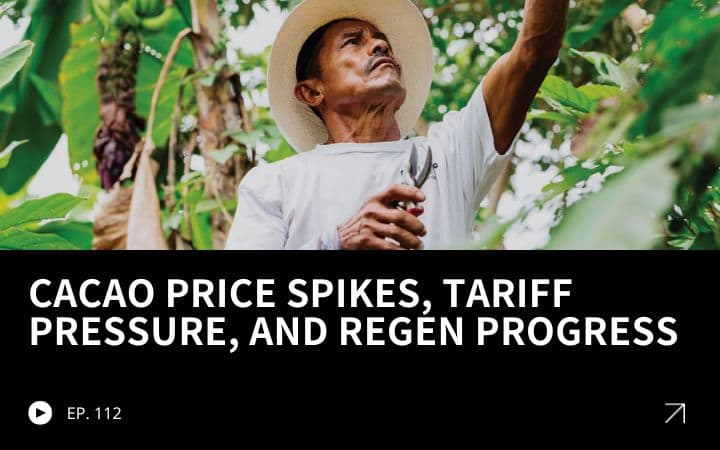
Cacao Price Spikes, Tariff Pressure, and Regenerative Progress
Alter Eco CEO Keith Bearden joins the ReGen Brands Podcast to share a candid, behind-the-scenes look at navigating skyrocketing cacao prices, a disruptive new 39% Swiss import tariff, and the company’s unwavering commitment to regenerative agriculture.
From market volatility to farmer partnerships to certification challenges, this conversation covers the urgent realities shaping the future of premium chocolate — and what it will take to ensure that regenerative brands can thrive in the face of unprecedented headwinds.
When Cacao Outperforms Bitcoin
In late 2023, Keith closed the deal to acquire Alter Eco at $3,800 per metric ton for cacao. By April 2024, prices had surged to $12,800 per ton — a quadrupling in just four months.
“I had a friend of mine send me a meme at the end of 2024… cacao outperformed Bitcoin last year.” - Keith Bearden
The drivers of this historic price spike are complex: climate change’s toll on yields in West Africa, disease pressure, extreme weather, and speculative trading have all contributed to extreme volatility. While Alter Eco sources exclusively from Latin America, the global market ripple effect is unavoidable. With 60% of the world’s cacao coming from West Africa — much of it from monocropped plantations in climate-stressed regions — a 20% drop in global yield has hit every chocolate maker’s bottom line.
Supporting Farmer Transitions to Dynamic Agroforestry
While market forces have been unpredictable, Alter Eco’s on-the-ground commitment to farmers has remained steadfast. The company buys cacao from a handful of co-ops representing 15,000–20,000 farmers. They source cacao from Ecuador, the Dominican Republic, and Peru, with various programs that help farmers transition from monocrop cacao to diversified “dynamic agroforestry” systems.
“Our farms look like a jungle. Timber trees, plantains, coconuts — whatever grows best locally — alongside cacao.” - Keith Bearden
These systems not only improve biodiversity, soil health, and water retention, they also give farmers new income streams. Alter Eco supports these transitions with direct financial incentives, agronomic training, and even providing plants — like the coconut trees being planted at their partner farms in the Dominican Republic.
The Certification Conundrum
Despite sourcing 75% of its cacao from regenerative systems and aiming for 100% across cacao and oats, Alter Eco has yet to pursue regenerative certification. The reason? Cost, scalability, and the burden on farmers.
“I can show my receipts… but to tell me they have to test all 16,000 farms before they give us the symbol? I can’t support that.” - Keith Bearden
Keith respects the value of third-party validation but questions the feasibility of certifying every farm individually. He believes the solution lies in harmonizing across existing certifications — Alter Eco is already USDA Organic, Fair for Life, and B Corp certified — and finding hybrid approaches that maintain rigor without making it economically unviable.
A Tariff Threat Like No Other
As if price spikes weren’t enough, a new 39% Swiss import tariff has created fresh challenges for Alter Eco, whose chocolate is manufactured in Switzerland for its unmatched craftsmanship. Already operating on slim CPG margins, absorbing a tariff of that size is impossible without drastically raising prices.
“The 39% tariff went into effect August 7th… I might be able to mitigate 10%. I can’t mitigate 40.” - Keith Bearden
The uncertainty around whether the tariff will stick makes long-term planning nearly impossible, and Keith estimates that tariff-related tasks are currently consuming 30% of his time.
How We Get Regenerative Brands to 50% Market Share by 2050
Despite these headwinds, Keith remains optimistic about regenerative agriculture’s future. He believes that harmonized definitions, institutional support, and government incentives can accelerate adoption.
He envisions a future where certifications are unified, consumer messaging is clear, and both small mission-driven brands and major players are aligned in building demand.
This ReGen Recap was written by Anthony Corsaro with the help of Chat GPT
You can check out the full episode with Keith Bearden @ Alter Eco HERE
Subscribe to future episodes of the ReGen Brands Podcast on Apple Podcasts, Spotify, or YouTube. You can help support our mission of growing regenerative CPG brands with a 5-star rating!
Stay engaged in the conversation by subscribing to our weekly newsletter, The ReGen Brands Weekly, and connecting with us on LinkedIn: ReGen Brands and AC