
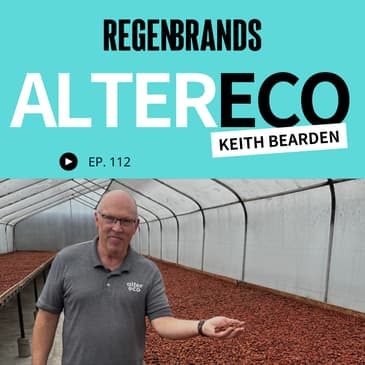
On this episode, we sit down with Keith Bearden, CEO of Alter Eco, to unpack one of the most turbulent years in chocolate’s history.
We dive into why cacao prices have more than tripled over the past two years and how a new 39% Swiss import tariff is disrupting their business in ways we have never seen before.
Keith shares how Alter Eco is helping farmers transition to dynamic agroforestry systems across Latin America, why regenerative certification doesn’t always pencil out, and what needs to happen to unify the movement so consumers truly understand regen’s value.
Episode Highlights:
🍫 Leading in eco-friendly chocolate for over 20 years
📈 Why cacao prices have skyrocketed the past two years
🌴 Helping cacao farmers transition to dynamic agroforestry systems
💵 Providing direct financial and agronomic support to farmers
🛒 Why Swiss manufacturing is now a core part of brand messaging
🚫 The 39% Swiss import tariff causing major disruption
🤷 Why regen certification doesn’t pencil out right now
🤤 Consumers buy for indulgence, then learn about impact
🗣 The imperative for more harmonized regen certification and communication
🤯 Why we’re headed towards $10 chocolate bars
Links:
Alter Eco Sustainability Report
Regenerative Organic Certified®
If you find this content valuable, please consider donating to support our work
Follow ReGen Brands on LinkedIn
Subscribe to the ReGen Brands Weekly newsletter
Episode Recap:
ReGen Brands Recap #112 - Cacao Price Spikes, Tariff Pressure, and Regenerative Progress - (RECAP LINK)
Episode Transcript:
Disclaimer: This transcript was generated with AI and is not 100% accurate.
00:13
Anthony Corsaro
Welcome to the ReGen Brands Podcast. The place for brands, retailers, investors and other food system stakeholders to learn about the consumer brands supporting regenerative agriculture and how they're changing the world. I'm your host, A.C. thanks for tuning in. Now, let's get into today's conversation. On this episode, we sit down with Keith Bearden, CEO of Alter Eco, to unpack one of the most turbulent years in chocolate's history. We dig into why cacao prices have more than tripled over the past two years and how a new 39% Swiss import tariff is disrupting their business in ways that we've never seen before. Keith shares how Alter Eco is helping farmers transition to dynamic agroforestry systems across Latin America. Why regenerative certification doesn't always pencil out, and what needs to happen to unify the movement so consumers truly understand regens value. Let's go. What's up, everybody?
01:15
Anthony Corsaro
Welcome back to another episode of the ReGen Brands Podcast. Very excited today to have my friend Keith from Alter Eco joining us. So welcome, Keith.
01:23
Keith Bearden
Thank you. Nice to be here.
01:25
Anthony Corsaro
Good to have you, man. We were commiserating in the prep portion before we hit record that we have quite a few not so fun maybe topics for Keith to shed some light on. So especially grateful for him to kind of spend some time with us as cacao prices and tariffs and many things affect his business. So just an upfront, you know, piece of gratitude for you joining us to break all that down, Keith, but we also have a lot of fun and exciting things to talk about as well. But before we do any of that, for those that maybe aren't familiar with Alter Eco, which I'm sure is not many folks, will you just share a little bit of background on the brand? What do y' all produce and where can people find your products today?
02:05
Keith Bearden
Yeah, happy to do that. So Alter Eco has been around for a little more than 20 years now, and the brand was founded with the. The foundational elements of restoring ecosystems, improving livelihoods and reducing waste. Hence the name Alter Eco. Yeah, you know, we're. We're known for our chocolate. We produce some of the best chocolate in the world and I would challenge anybody to try it and say otherwise. We also produce a wonderful line of granola and we have some legacy products that are quinoa. They've been around since the beginning. Not a lot of differentiation other than, you know, we support some local farmers with our quinoa products coming out of Latin America. So the brand is really focused on Helping to change the ecosystem, if you will. And we'll get into that when we talk more about regenerative.
03:03
Keith Bearden
But yeah, we're the, we're one of the top chocolate brands in the natural channel. So you can find us at Whole Foods, Sprouts, Natural Grocers, all the independent retailers. But we're making a lot of headway into the conventional market these past couple years. And of course you can find us online@Alter Ecofoods.com and on Amazon.
03:25
Anthony Corsaro
Nice. Yeah, my personal Alter Eco addiction is the caramel skew chocolate bar and gotta buy it, take it home, freeze it for about an hour, you know, get it nice and cold and almost like frozen. And that's my number one. What's, what's your favorite Alterico product?
03:45
Keith Bearden
You know, I really gravitate toward the darker. Yeah. So probably classic Blackout is my go to.
03:53
Anthony Corsaro
Yeah.
03:54
Keith Bearden
But if I have truffles sitting around, they're really hard to resist.
03:59
Anthony Corsaro
Yeah, I can imagine. I can imagine. Well, you mentioned the brand's been around for almost 20 years or 20 years. You know, I come to really the conclusion that Alter Eco has been a leader in a lot of these topics for a really long time. Maybe even when they started with some of the work, it wasn't called what it's called today or the general narrative around it has shifted. But really doing good for people and planet has been at the core of the brand since the very beginning, like you mentioned. Can you, Keith, just bring people up to speed on maybe some of the original origins of the brand and also when you got involved and in what capacity you're involved today. So they know kind of what perspective you're bringing to the conversation.
04:41
Keith Bearden
Yeah, well, I have to give credit to the guys that founded the company, Edward and Matthew, they were pioneers. I mean, going back to 2004 and talking about regenerative agriculture, or you're right, the term wasn't even there then. It was like, how do we restore these ecosystems that have been clear cut and they're not helping the planet? And so they started out with kind of a mission to focus on helping the farmers. But then at the same time, how can we help restore the planet? From a climate perspective primarily is where they were focused. So if we plant bigger trees and we have timber trees and plantains and bananas and coconut trees, they're going to provide shade for the cacao plants. They're going to consume carbon from the atmosphere, the roots are going to be deeper.
05:36
Keith Bearden
So they're in times of drought, they're going to suck up more groundwater and then all their foliage is going to create more organic matter into the soil. And it just helps the nutrients in the soil. So this whole concept and they referred to it, and we still do today, as dynamic agroforestry.
05:54
Anthony Corsaro
Yeah.
05:55
Keith Bearden
Not regenerative farming. It's. It's what existed in nature. And so now we're trying to put that nature back in place.
06:04
Anthony Corsaro
Yeah.
06:05
Keith Bearden
And so they led the company up through 2017. And like many natural foods companies, especially impact driven companies, you know, they had to go out and raise capital to grow. And in 2014, there was a private equity group out of San Francisco called Next World that invested in the company. And then in 2017, Next World acquired Alter Eco.
06:31
Anthony Corsaro
Okay.
06:32
Keith Bearden
And in 2018, I became an advisor to Next World, not specifically related to Alter Eco, but in general around their whole portfolio.
06:42
Anthony Corsaro
Okay.
06:42
Keith Bearden
And they're a very mission driven private equity group. They, they invest in companies that are mission driven, primarily climate and environmental impact driven. And so Alter Eco was a perfect fit for them. And so in 2019, they asked me to join the board of Alter Eco. And I was on the board for a few years. And then like all private equity, you know, they had the asset for quite some time. So in 2023, they decided they were going to sell it and reinvest the money in additional companies to help them grow. And I raised my hand and said, I really like this company. I'd like to buy it. And so we negotiated for a while, agreed on a price, and then I said, okay, now I gotta go find some money.
07:38
Keith Bearden
And so I found some investors and In December of 2023, we acquired the company.
07:45
Anthony Corsaro
Nice. It's never a bad deal when you acquire a business that comes with a lifetime supply of truffles. You know, that's always a nice Perk.
07:53
Keith Bearden
This is tr. That's true.
07:55
Anthony Corsaro
Yeah.
07:56
Keith Bearden
And I took over as the CEO in at the end of 23 when we did the acquisition. And I've been running the company since then.
08:04
Anthony Corsaro
Yeah.
08:04
Anthony Corsaro
And I mean, what a time to buy one of the leading natural chocolate brands. We've had Cacao sprite prices go, what, 100x or something insane in 2024?
08:15
Keith Bearden
Yeah, more than that. I had a friend of mine sent me a meme at the end of 2024 and it was a picture of a cacao podcast and a picture of Bitcoin. And he said cacao outperformed bitcoin last year. Great.
08:32
Anthony Corsaro
Yeah.
08:33
Keith Bearden
I just what I needed to hear, you know. But when we bought the company, we closed on the deal December 22, 2023.
08:43
Anthony Corsaro
Okay.
08:43
Keith Bearden
Cacao prices were $3,800 a ton. Had my first board meeting in April after we closed first quarter, cacao prices were $12,800 a ton. Wow. Forex almost.
09:00
Anthony Corsaro
Wow.
09:01
Keith Bearden
And of course my investors said, did we do the right thing?
09:07
Anthony Corsaro
Yeah.
09:08
Keith Bearden
And I said, hey, you know, we'll make it through. And all things that go up eventually come back down. And they have come down some. I mean they're trading now somewhere around between 8 and 9,000. And it's really traders and speculators that are causing such volatility in the market today. Up to that point though, what caused the volatility was yield. And so you know, to around our discussion around regenerative farming.
09:41
Anthony Corsaro
Yeah.
09:42
Keith Bearden
60% of the world's cacao comes from Africa.
09:46
Anthony Corsaro
Right.
09:46
Keith Bearden
Predominantly western Cape of Africa, Ivory coast and Ghana. Most of those plantations were clear cut monocrop plantations and have been that way for 60, 70, 80 years. You know, we don't talk a lot, we don't call it global warming anymore, we call it climate change now.
10:07
Anthony Corsaro
Yeah, yeah.
10:08
Keith Bearden
You know, but that climate change over the last, specifically over the last four or five years has caused significant declines in yield, especially out of Africa. And so you've had extreme seasons of drought, you've had extreme seasons of rain, you've had a lot of extreme heat. And cacao doesn't respond well to any of that.
10:34
Anthony Corsaro
Right.
10:35
Keith Bearden
You know, and so there's been disease because of too much rain, there's been lack of yield because of too little rain. And so in 20, the 22, 23 season the yield was down about 10 or 12%. But remember, they produce 60% of the world's supply in 2324 the yield was down 30%. And so now you're talking about a 20% decline in the world's yield.
11:07
Anthony Corsaro
Right, right.
11:08
Keith Bearden
And once prices started climbing, then speculators jumped in and started buying futures and buying everything they could.
11:18
Anthony Corsaro
Can you break that down Keith, for somebody like me that doesn't live in that commodities world specifically with like something like cacao. So I think it's easy for most people to understand what you just unpacked from a climate change, weather related kind of yield reduction and how like hey, just basic supply demand that's going to drive up price. But how have some of the financial gaming air quotes, right. That the speculator trader influence, how has that affected pressing? How does that work? Can you give us a layman's breakdown on that.
11:45
Keith Bearden
Yeah, yeah. So cacao's traded on two commodity exchanges in the world. One in London, one in New York now. And it's traded just like a stock or like oil or like citrus or coffee or, you know, anything that's traded on a commodity exchange. Now having said that, big players don't spot by. We, we don't spot by even, we don't spot by unless we run out of stock or we grow too fast, which in 2024 we grew faster than we forecasted, so we had to spot buy some at the end of the year, which was really painful. Yeah, but you know, the big players like Hershey's, Mondelez, Nestle, Mars, they go in and they negotiate with the farmers and they pre finance them in some cases and they commit to the entire crop.
12:34
Keith Bearden
But when the prices start going up, you have some of these farmers that'll say, oh, I know I promised you 100 tons, but I only have 70. And they'll take that other 30 tons and they'll sell it on the open market. And cacao is not only used in producing chocolate, right. It's used in all kinds of baking products, it's used in all kinds of flavors and fragrance creations. I mean it's used in thousands and thousands of applications. And so, and most of those players that aren't chocolate producers, they're buying from traders, you know, the, the cargills of the world or the sunopters of the world or the troddens of the world that are buying cacao, right. Producing cacao powder, cocoa butter, you know, cocoa liquor. And they're selling to these smaller producers a ton at a time or 2 tons at a time.
13:36
Keith Bearden
And you know, where we buy, you know, we buy 30, 40 tons at a time, that's a different scenario. And we negotiate directly with the co ops and with the farmers and lock in pricing. We, and like I said, unless we outgrow what we locked in, you know, we're buying it not at that spot price.
13:57
Anthony Corsaro
Right.
13:58
Keith Bearden
But having said that, I can't expect my farmers to sell to me for less than they can go sell on the spot market. Yeah, that's not fair to them. And part of our ethos is improving their livelihood. So everybody's price went up. I mean, the only good news about that is that all chocolate producers are playing by the same rules.
14:23
Anthony Corsaro
You, you mentioned to me. I think it's like 16,000 farmers total. Maybe not all cacao farmers that y' all work with. Last time we chatted, that's a rough number.
14:32
Keith Bearden
I mean, we, you know, it fluctuates from year to year, but it's between 15 and 20,000 that we work with. And those are predominantly. We only buy from Latin America. We don't buy anything out of Africa.
14:46
Anthony Corsaro
I was just going to ask, what are all the geographies just for cacao that you're sourcing from?
14:50
Keith Bearden
Yeah, we source out of Latin America because that's where most of the organic cacao comes from. Most of it coming out of Africa is not certified organic. It's conventional products and goes into most of the conventional manufacturers. We source primarily from Ecuador, Dominican Republic, Peru. So those are the three bigger growing regions for organic cacao.
15:16
Anthony Corsaro
Yeah, yeah.
15:18
Anthony Corsaro
Nice. And there's some cool stuff y' all are doing on the regen side. Lots of cool stuff. And the, selfishly, the Regen Report, the impact sustainability report that y' all publish was very easy for a podcast host to make good questions from and to make a little outline from. But yeah, let's, let's go there and talk about what you're actually doing on, on the land. You mentioned this term, dynamic agroforestry. Love that term. And we've definitely talked to many brands that support these dynamic regenerative, you know, biodiverse agroforestry systems in Latin America. And really, in so many ways, it's a return to what the indigenous peoples or previous generations of farmers or even some people have always practiced in those areas. And it's like you said, what shows up in nature.
16:06
Anthony Corsaro
And you know, I'd love for you to just kind of maybe start with can you compare what a alter eco farm might look like that y' all source from versus like just a conventional monocrop cacao plantation?
16:19
Keith Bearden
Oh, yeah, Ours looks like a jungle.
16:21
Anthony Corsaro
Yeah.
16:22
Keith Bearden
I mean, literally. You know, if you're looking at it from a satellite view perspective. Yeah, you're not going to see cacao plants at all. You're going to see trees, you're going to see timber trees, you're going to see. It depends on the region. Certain regions grow plantains much better than they do coconuts, for example, and other regions will grow coconuts better. And so we try to work with the local people to understand A, what's going to grow the best there, B, what's going to give them an additional cash crop. Because remember, we're trying to improve their Livelihood.
16:59
Keith Bearden
So if we go in and they've been mono cropping cacao for however long, we're actually going to take out some cacao plants, and that's going to reduce their income, you know, but we're going to put in coconut or banana or plantain or limes or avocado bushes, you know, and whatever grows well in that region. And over a period of three to four years, those plants are going to start to produce, and then it's going to give them a more diversified income. And during that timeframe where we're asking them to make that transition or supporting them in making that transition, we're helping them financially to bridge that gap. We're also providing education through some of our partners down there and our partner in Switzerland, and then we're also providing the plants. We're working on a project right now in Dominican Republic where we.
17:57
Keith Bearden
Where we're helping farmers plant coconut trees. Coconuts are a big. Coconuts are in big demand in Dominican Republic for a lot of different reasons. And. But they grow and they grow really well there. But a lot of the farmers have never had coconut trees, and it's not been something that they've really cultivated. And so they're importing a lot of coconuts from Vietnam, from Indonesia and things like that. And so by helping them plant coconut trees in that region, it does a number of things. One, it gives them another. It gives them another income source. Number two, once those trees grow up, coconut trees are huge and provide fabulous shade for cacao plants.
18:46
Anthony Corsaro
Yeah.
18:47
Keith Bearden
Third, it reduces emissions because they don't have to import so much. Mm. And so. And it pulls more carbon from the air. So it's a really win project. We're pretty excited about that one.
18:59
Anthony Corsaro
Yeah.
19:00
Anthony Corsaro
And it's interesting we've seen theme now after so many of these podcast episodes where, you know, I think a question we used to ask everybody is like, what are the. What are the key reasons or what are the key challenges for helping a farmer transition? And it seems like the three ways that you all are supporting seems to be the three that always rise to the top as the answer to that question. Right, Right. So it's the direct financial support to actually make the changes that need to happen. It's the agronomic support to know how the hell to do the things that you're asking them to do or that they want to do, but maybe don't know how. And interesting. It's.
19:32
Anthony Corsaro
It's like the third one is always that propagation that you mentioned that y' all are doing which the actual, like, execution of enabling the agronomics or it's some sort of something to do with the actual, like most upstream variable for getting plants in the ground and actually getting stuff growing in a different way. The financial incentives, does that vary based on, you know, how y' all are supporting people? Is it just a price increase for the offtake? Is it like actually purchasing some of those initial plant species that they're now replanting? Like, what does that piece look like?
20:08
Keith Bearden
So we're. It's a number of different things and it depends on the situation.
20:14
Anthony Corsaro
Yeah.
20:15
Keith Bearden
We obviously we don't buy directly from 16,000 farmers.
20:20
Anthony Corsaro
Yes.
20:20
Keith Bearden
That would be impossible.
20:22
Anthony Corsaro
Right.
20:22
Anthony Corsaro
So.
20:22
Keith Bearden
So we work with the co ops. And so there are co ops in specific regions and the co ops have a pretty good reach. I think we work with three specific co ops in Ecuador. And about 40 to 50% of our cacao beans come from Ecuador. Okay. And so they're covering a lot of territory. And so we will work with them to make sure that we may actually provide additional revenue for the cacao beans. But one of the things we do with our Swiss partners, we pre finance everything. So when we commit to a crop, we buy the whole crop and we pay for it up front before it's ever even harvested. And so. And then in the case of this project in Dominican Republic, we actually bought all the coconut trees.
21:15
Anthony Corsaro
Wow.
21:15
Keith Bearden
And, and shipped them down there. You know, so we're investing quite significantly in the farmers. And the interesting thing about that is that these farmers are so loyal and committed to us, you know, because of what we're doing with them. And when I go down there, it, I mean, it's such a rewarding experience because they're so proud of this information.
21:39
Anthony Corsaro
Yeah.
21:40
Keith Bearden
And they want to show you. I mean, they had a table set up one of our farmers in Ecuador and it had nine different products on it that they were selling now.
21:52
Anthony Corsaro
Wow.
21:53
Keith Bearden
And so it was amazing. There was papayas, there was avocados, there was limes, there was plantains, there was baby bananas. And if you've never had an organic baby banana, oh, my God, they're so good, you know. And of course, cacao was front and center. That was, that was still their main cash crop. But all these others contribute as well.
22:16
Anthony Corsaro
I love the, like, how kind of interrelated the co op organizational structure for most of these farmers is related to this biodiversity slash, cash crop, income diversity play. Because I think as Americans, that's not our prototypical Vision of a farmer, like a farmer here kind of is an very independent person that usually produces one thing and like that's kind of status quo. And yeah, in a lot of these Global south areas it's like the complete opposite paradigm for success. And it I'm sure makes it a lot more efficient and centralized to be able to work organizationally between brand alter eco Swiss chocolate manufacturer and the various co ops. And that can be, I think, power that's wielded in a negative way a lot of times.
23:06
Anthony Corsaro
But it's really cool to see it wielded for positive gain and to really take care of these farmers and work with them in this capacity. And you know, there's. For us to make this agricultural thing work that we're trying to make work, there's gotta be a lot more of that without losing the scale and the efficiency that makes it actually pencil out from a numbers perspective.
23:26
Keith Bearden
Perspective. Right. Well and we also engage with consultants in this space too because we don't claim to have all the knowledge nor does our Swiss partner. And so we work with some agro consultants specifically in Ecuador and Dominican Republic. And it was interesting the last time I was in Ecuador five or six months ago, we, they were demonstrating how groundwater is retained with the different plants.
23:59
Keith Bearden
And so they had these little boxes set up and they had the roots of these plants embedded in one and then the other one they just had the cacao roots and nothing else and they just poured water in them and you could see the water just come right out of the one with nothing but cacao plants in it and the other one had very little water dripping out of it and a bunch of farmers were standing there watching this and they're like, oh, okay, you.
24:30
Anthony Corsaro
Know, so yeah, that's, I feel like that's something very common now in the regen space is people doing those demonstrations and it really is super influential to see whether you're a consumer farmer, brand operator, whoever, because many times when you're looking at a regenerative farm versus a conventional farm above ground level, you can see the difference. Right. But you maybe can't visually get the full understanding of like why we're investing in soil health and soil function and nothing tells the story better than that.
25:00
Anthony Corsaro
So I love that.
25:01
Keith Bearden
That's really cool.
25:04
Anthony Corsaro
So mainly sourcing from Latin America, majority or a large portion coming from Ecuador, working with the various co ops doing that direct project with the group in the. Dr. I want to say I'm Trying to look at my notes here. The, the impact report said the transition efforts specifically with farmers that had not really engaged in regenerative practices to date has. You guys have worked with 573 farmers and it's affected almost 2,000 acres. And I want to say that there might have been some numbers for the Dr. Project, but I didn't write those down or I need to.
25:37
Anthony Corsaro
Pull them back up.
25:39
Anthony Corsaro
But yeah, super cool to see that type of impact that y' all are able to have there.
25:44
Anthony Corsaro
Yeah.
25:45
Keith Bearden
I mean the average size farm down There is about 12 acres.
25:48
Anthony Corsaro
Right, right.
25:49
Keith Bearden
You know, so it's not like we're working with farmers that are farming thousands and thousands of acres.
25:55
Anthony Corsaro
Yeah.
25:56
Keith Bearden
Having said that, we do things that are regeneratively focused that don't directly impact our supply chain. We partnered with Kiss the Ground to convert a thousand acres in the United States. That has nothing to do with us, but we believe in the movement.
26:16
Anthony Corsaro
Yeah.
26:17
Keith Bearden
So I mean we try to, we try to make sure we walk the talk.
26:22
Anthony Corsaro
Yeah.
26:23
Anthony Corsaro
And I think the other two stats that stood out to me, there were 75% of the cacao beans y' all currently source are from those dynamic agroforestry systems. So this is the vast majority of your supply. And you've committed to basically sourcing 100% of the cacao and the oats in your supply chain from farms that have regenerative practice, adoption slash application. And I, I'm pretty sure that's by and large way far and away your two most important ingredients for the business. Right.
26:51
Keith Bearden
Oh, for sure. Well, cane sugar is another one, but it's already regenerative.
26:56
Anthony Corsaro
Yeah. There you go.
26:57
Keith Bearden
The farm wheat. The farm. The farmers we work with in Paraguay are actually regen certified.
27:03
Anthony Corsaro
Yeah.
27:04
Keith Bearden
How.
27:05
Anthony Corsaro
Go ahead.
27:06
Keith Bearden
No, I was just going to say, I mean our goal is a hundred percent. We're making progress every year. It's attainable, but it's going to take time to get there. Yeah.
27:21
Anthony Corsaro
And you and I, I think, had an interesting conversation and maybe we can move to some of the commercial piece here which is like it's not always the easiest thing in the world to get to an identity preserved product with an on pack claim when you have the breadth, depth and diversity of sourcing partners that you all have and a lot of the multi ingredient SKUs that you all have.
27:43
Keith Bearden
Right.
27:43
Anthony Corsaro
So I, I'd love to hear you talk about how you have thought about that as you've kind of evaluated the product portfolio and maybe potential innovation opportunities from an Alto eco perspective. But also like, hey, what's going on with this regenerative thing as it comes to like, consumer awareness, claims, adoption, et cetera? How are y' all thinking about the fact that you're very invested in doing this work, but you haven't really produced a skew with an on pack claim, but maybe, you know, maybe you won't, like, break that down for us.
28:11
Keith Bearden
Yeah, that's a really challenging and interesting topic.
28:16
Anthony Corsaro
Yeah.
28:17
Keith Bearden
The consumers, I think. Well, let me paraphrase or articulate the consumers in Whole Foods, I think they understand what regenerative means. The consumers in sprouts, they understand what regenerative means. The consumer in Kroger's, not so sure. Consumer in Walmart, not so sure. I think the transparency and focus on sustainability is something that resonates with the Gen Z, the Gen Alphas, even the Millennials, more so than my generation.
29:00
Anthony Corsaro
Yeah.
29:02
Keith Bearden
I had, I had an interesting conversation with a guy from Nielsen who does all of the market data collection and whatnot. And, and he described what he called the, say, do gap. The boomers said they wanted to do things the right way and they wanted to be healthy, but they kind of did this over here. And he said, the Millennials, the gap got a little smaller and with the Gen Z's, it got even smaller. And he said, with the Gen Alphas, there's no gap. If they say they're going to do it, they do it. And he said, but they don't necessarily understand the impact of regenerative farming, emissions management, what it's doing for us. But they just say, oh, well, we should all be doing the right thing. And they look for brands that are doing that.
29:58
Keith Bearden
And again, that transparency and sustainability messaging is important. I'm not sure the consumers actually understand it at this point. And they definitely don't understand what it takes to get there.
30:12
Anthony Corsaro
Right. Right.
30:14
Keith Bearden
As far as the certifications go, I have a lot of mixed feelings about that. Yeah, we're organic, we're fair for life. We're helping these farmers make this transition. And I can show my receipts. That's what my marketing team tells me all the time. We got to show our receipts. And the way we measure this is, I mentioned earlier, you can, if you're looking at satellite imagery, you can tell ours look like a jungle. Well, that's how we measure it. I can't go out and measure all 16,000 farms. So we know the regions that the co ops are Buying from and where we're buying from. And so we look at those and you can easily see that one's clear cut. And with geospatial technology today, you can measure how many acres that is very easily. That's the way we do it.
31:11
Keith Bearden
So I don't have the time or the money to support going out and testing all these farms. Am I improving the soil health by introducing additional organic matter? Absolutely I am. And I don't have any issue at all with the certifying bodies going and randomly testing two or three farms in one region and two or three farms in another region.
31:39
Anthony Corsaro
Right.
31:39
Keith Bearden
But to tell me that they have to test all 16,000 farms.
31:43
Anthony Corsaro
Yeah.
31:44
Keith Bearden
Before they can give us the symbol for certification. I can't support that.
31:50
Anthony Corsaro
Yeah, yeah. Especially because we don't have the data that shows that it resonates enough with the consumer to be worth that investment also.
31:59
Keith Bearden
So it's great. We don't.
32:01
Anthony Corsaro
Yeah.
32:02
Keith Bearden
I mean they're saying, you know, studies are saying that regenerative brands can charge more, that the average regen brand compared to a non regen brand can typically get 8 to 12% more. That's not a drop in the bucket compared to what it would cost to go through that certification.
32:23
Anthony Corsaro
Yeah.
32:24
Keith Bearden
And I talked, I've talked to these guys, I've talked to Rock, I've talked to regenefied, I've talked to all of them and say, you know, soil alliance and I'm like, work with me here. Come down to Ecuador. I'm happy for you to come down and check out some of our farms. I'm happy for you to go to the doctor and check out some of our farms. But I'm not, I can't afford to pay for you to go test them all and there's no value in that.
32:49
Anthony Corsaro
Yeah, yeah.
32:51
Anthony Corsaro
And hopefully we can find answer there.
32:53
Anthony Corsaro
Right.
32:54
Anthony Corsaro
Because you know, I think there's a very clear paradigm in CPG that the easiest mechanism is like third party validation of claims. We feel like people should still be able to first party validate and maybe present that to a third party. Shouldn't have to always pay for it. Shouldn't have to fit into some super defined box by people in the United States when we're working with you know, indigenous and non global north farming systems. So we definitely think absolute dogma and rigidity is not the answer there. And we also think there's like real value in like third party validation and all the thing that comes with.
33:38
Keith Bearden
That for sure there, you know, it's got to be a hybrid. It's got to be a hybrid. And, you know, at the same time, I mean, we're. We're going through all of the other validations and certifications, and so how can you harmonize some of those across different platforms? Like I said, we're organic. We're fair for life. We're B Corp certified. We've been B Corp certified since 2009. We were one of the first companies in the United States to be B Corp certified. There's a lot that goes into that. Go through a B Corp certification audit. You'll understand how much goes into that. And then we've got the consultants on the ground, too, and they're certified in what they do. And so there's so many different checks and balances here that if we can harmonize across these things, you know, it supports the movement.
34:29
Keith Bearden
And we, you know, these certifications, we put the. We put the onus back on the farmer, and that just adds cost.
34:38
Anthony Corsaro
Right.
34:39
Anthony Corsaro
You know, so, yeah, there definitely need. We need to find some sort of transformative way to stop charging all the good actors more to prove that they're good instead of, like, letting the bad actors, like, be cheap and worse. But as a society, we haven't. We haven't quite cracked the code on that one yet.
34:56
Keith Bearden
Not yet. Not yet.
34:58
Anthony Corsaro
You said something that I found very interesting.
35:01
Anthony Corsaro
Go ahead.
35:01
Keith Bearden
Well, I was going to say. I will say the retailers recognize it.
35:05
Anthony Corsaro
Yeah.
35:06
Keith Bearden
I was at a. I was at a conference last year, and the senior vice president for grocery at Whole Foods was talking about their commitment to regenerative, and she was calling out one of their farmers in Mexico that produces mangoes, and their farm is regenerative. Certified has the rock symbol on it. And she's like, and if you guys haven't tried this, it's really good. She paused for a minute, and I had given a presentation earlier in the day. She paused for a minute and she said, okay, it's not as good as Keith's chocolate, but it's really good.
35:48
Anthony Corsaro
Yeah, the.
35:50
Anthony Corsaro
There's. There's something related to this, like building consumer awareness and demand conversation. Specifically to alo. That really caught my attention when you and I spoke last time, which was since. Since you've taken over the company, you've made more prominent this Swiss manufacturing, and that seems to be resonating with consumers. I would love to hear the story behind that and what you're seeing there. And, like, I'm. I'm asking the Question. So we can relate it to how can we make something like Swiss manufactured chocolate? How can we make regen, you know, as important to a consumer as maybe what that has been for y'? All? So I'd love to talk here. You talk about that.
36:27
Keith Bearden
Yeah. So the way that all came about was mid last year, I brought in a new chief marketing officer. And she's fabulous. I love her to death. And she asked me to describe Alter Eco. And one word. When I was interviewing her, she's interviewing me. She's like, so describe Alter Eco for me in one word. I sat there for a minute and I'm like, organic. No, no, no. You lost me. I said, well, sustainable. No. Regent? No. She's like, why do I buy chocolate? I said, well, because it's good. It's delicious. She's like, okay, tell me it's delicious. And then she said, but why is it delicious? I said, well, because it's manufactured in Switzerland and the Swiss been making premium chocolates for 450 years. They're the best in the world at it. She's like, okay, now you got me.
37:35
Keith Bearden
Yeah, now I want to buy it. I want to try it. She said, and now that you've got me, you can tell me all the other good things you do too.
37:47
Anthony Corsaro
Right?
37:47
Keith Bearden
She said, but I'm not going to buy a chocolate bar because you bought regenerative cacao beans. That's not why I buy chocolate. I buy chocolate to indulge myself. But if I know that indulgence comes along with helping improve the planet, oh, well, that's a win. Win. So, you know, like I said, she's brilliant. She, she, you know, we grew over 20% last year, and a lot of that growth came in the second half of the year. And it was mid year when I brought in our marketing director and our new PR team and I, I can't attribute the growth to anything else. Yeah, I mean, we didn't introduce any new products. We didn't, you know, we did earlier this year, but I mean, last year they just, they transformed the brand messaging. And she said, alter Eco has always been such a serious brand.
38:54
Keith Bearden
You guys are so serious about everything you do. And she said, and it's a serious topic. Don't get me wrong. I understand the weight and the magnitude of what you're trying to do, but people buy chocolate because they want to indulge themselves. Get that message out there first, then tell them about all the good things we're doing.
39:17
Anthony Corsaro
Yeah, yeah. There's an Interesting bridge, I think overall in regen marketing, messaging and in kind of the movement and the storytelling of it, where we are very much, I think, still stuck in the activist rebel paradigm. And like, I, I very much came to the space being one of those individuals myself, so I can deeply resonate with it. But I don't know if you get to enough of the adoption curve with like, that being the storytelling paradigm forever. So I love, you know, the example you just gave to kind of further illustrate, like, hey, let's make this a little more fun. Let's make this approachable. And, and yeah, it's still activism and it's still doing good, but it's fun and approachable versus like we're going to war or something. That's maybe a little more daunting.
40:07
Keith Bearden
Yeah, yeah.
40:09
Anthony Corsaro
Interesting segue.
40:11
Anthony Corsaro
Right.
40:12
Keith Bearden
Being.
40:12
Anthony Corsaro
Being a Swiss manufactured chocolate has had many advantages, it sounds like, historically, but I know there's a great deal of maybe adversity right now with the current tariffs. I want to say, last time I checked, it's 39% for Swiss imported products.
40:26
Keith Bearden
Correct.
40:28
Anthony Corsaro
Which, knowing what I know about margin in this business, I can't imagine how you're going to not have to pass all of that, or at least a vast majority of it on to some of your partners, you know, down the supply chain. But this I think is a really good opportunity for us to just have someone educated our audience on what's happening live with some of these tariff decisions. We haven't had a brand, I don't think that's been as affected or we haven't talked about it in depth. So, Keith, can you just take us through kind of the journey of what you've dealt with related to this topic and how that is really affecting the business right now from like a pure dollars and cents perspective?
41:04
Keith Bearden
Yeah, well, as you said, you know, no CPG brand has that kind of margin to be able to absorb even 15%, you know, things coming out of the EU. I was on a call earlier today with a major retailer in the Southeast, and they were saying that they're seeing significant supply chain disruptions because of the tariffs that manufacturers, brand owners like ourselves are trying to find alternative supply chains to mitigate some of the tariffs.
41:44
Anthony Corsaro
Right.
41:44
Keith Bearden
So if you were buying materials from Vietnam, now it's 20% tariff. If you're buying materials from Brazil, it's 50% tariff. If you're buying Materials from India, it's 50% tariff, Switzerland, 39%. But the EU is at 15%. And even 15%, there is no consumer packaged goods company in the world that has 15% cushion.
42:11
Anthony Corsaro
Yeah.
42:11
Keith Bearden
To still be profitable.
42:13
Anthony Corsaro
Right.
42:13
Keith Bearden
We're lucky if at the end of the day we make 10%. And that's, I mean, that's really managing your trade spend, managing your logistics, being efficient with your manufacturing. CPG companies, typically, if they're hitting on all cylinders, are making 10%. You can look at the publicly traded ones and see that's the way it works. So when the tariffs were announced in April, Switzerland got hit with 31%. Then of course, it got backed off and it was 10%. Most people don't know it. Chocolate already had a tariff on it. Chocolate has been had. It wasn't called a tariff then, it was called a customs duty. So chocolate had five and a half percent coming in from Switzerland.
43:05
Anthony Corsaro
Oh, wow.
43:06
Anthony Corsaro
It already had five forever.
43:08
Anthony Corsaro
Wow.
43:08
Keith Bearden
Okay, so that 10% got laid on top of that five and a half. Now that five and a half was already baked into our cost of goods and everything, because it's been there forever. Yeah, but now that 10% on top of it, and don't forget that cacao prices went from $3,800 to $12,800. And so now you're looking at chocolate companies having to raise the price 30, 40, 50%. And we still aren't recovering everything that we're investing. So I was talking to a guy in the industry from one of the very large companies, and he said people are going to have to get used to the fact that a chocolate bar is going to cost them eight to ten dollars. Wow. Because it's not going back. And that was before the 39% tariff.
44:03
Anthony Corsaro
Right.
44:03
Keith Bearden
That was just based on cacao pricing, based on global demand. He said, you know, we had a hard time moving from $2 to $3, but then over the last couple years, it's gone from $3 to $5 for premium chocolates. He said, now it's going from 5 to 7, and in the next 18 to 24 months it's going to go to 10. And he said, and that's just going to be the reality of it. And so I sat there and I listened to that and I'm thinking, wow, you know, I guess consumers will determine because it's a discretionary buy, right? They'll determine, you know, or am I going to buy one every two weeks instead of one a week, you know, and that's okay.
44:56
Keith Bearden
I mean, I don't have an issue with it as long as we're all playing by the same rules because I believe in the quality of our products. I believe in what we're doing from a global impact perspective. So that's okay. Even if we get smaller before we get bigger again, that's okay, too.
45:14
Anthony Corsaro
Right.
45:16
Keith Bearden
But what's not okay is being penalized or being under a punitive trade barrier where now I, I'm not even. I, I can't be competitive with the other landscape because none of my other competitors are produced in Switzerland.
45:40
Anthony Corsaro
Yeah.
45:42
Keith Bearden
Wow. And I don't have. I don't have the power in the marketplace. I mean, Alter Eco is a big brand, don't get me wrong. But we don't have the power in the marketplace of somebody like a limp, for example.
45:58
Anthony Corsaro
Right.
45:58
Keith Bearden
Who is ubiquitous for being the Swiss chocolate of the world. They can go out and do a 40% price increase. Everybody's still going to carry lint, right. They have to. I do a 40% price increase. There's retailers that'll say, sorry, I can't have you on the shelf because it's so premium priced. I can't afford it. Now, having said that, I always tell people, never underestimate the value of your product. So if your product's really worth that, then charge for it. Charge for it. If you're doing something that's so unique and has so much value baked into it, don't be afraid to charge for it.
46:50
Anthony Corsaro
Yeah.
46:51
Keith Bearden
And I can guarantee you I can line up every one of our competitors, I can walk into Whole Foods and pick up every one of those chocolate brands and put them on the table. And I will stand Alter Eco up against any of them in terms of flavor, in terms of quality, and in terms of everything else that we do. There's nobody out there that has the certifications we do. There's nobody out there that has the commitment to doing the right thing that we do. My graphic designer told me we can't get any more certifications.
47:23
Anthony Corsaro
I said, why? She's like, I got no place to.
47:25
Keith Bearden
Put them on the package.
47:28
Anthony Corsaro
Yeah, yeah.
47:30
Anthony Corsaro
What, what have some of those conversations with retailers been like? I assume they're empathetic, but to a point, right?
47:36
Keith Bearden
And that's exactly right.
47:38
Anthony Corsaro
Are you.
47:39
Keith Bearden
They're empathetic to a point. I mean, when the 10% tariff hit, a lot of us, not just Alter Eco, but a lot of us went to the retailers and said, we need to have a 10% price increase.
47:52
Anthony Corsaro
Yeah.
47:52
Keith Bearden
Right. Now they're like, well, no, you gotta follow the standards. You know, we need 90 day notice period before you can do a price increase. It's like, well, we didn't get 90 days.
48:03
Anthony Corsaro
Right.
48:05
Keith Bearden
You know, and the 39% tariff went into effect August 7th. I didn't get 90 days.
48:14
Anthony Corsaro
Yeah.
48:14
Anthony Corsaro
And it's August 12th right now for people listening to the episode. So.
48:18
Anthony Corsaro
Yeah.
48:18
Anthony Corsaro
Dealing with this right now.
48:20
Keith Bearden
Yeah. In real time. And I was on the phone with my Swiss partners this morning. We talk every couple of days now trying to figure out ways to mitigate it. I might be able to mitigate 10%. I can't mitigate 40.
48:37
Anthony Corsaro
Yeah.
48:39
Anthony Corsaro
I think some.
48:41
Keith Bearden
Honestly, honestly, I don't know what we're going to do if it stays.
48:45
Anthony Corsaro
Yeah, well, let's hope it doesn't. One and two, you know, we've spent some time actually talking about how you can implement the changes that would relate to that type of an increase. But I also think there's this whole other category of stuff that's almost impossible to quantify, which I would just call overall tariff disruption. That has to do with the amount of bandwidth you and your team are spending on preparing from a speculative capacity and now also handling the fallout and then also handling if it does get repealed or if it gets changed. Can you try and, like, articulate that or quantify that for the audience so they understand, like, how. How disruptive has this truly been for the business?
49:27
Keith Bearden
Oh, tremendously. The uncertainty is the. Is the biggest issue.
49:33
Anthony Corsaro
Right.
49:33
Keith Bearden
You know, obviously, I don't want a 39% tariff to stick.
49:39
Anthony Corsaro
Yeah.
49:40
Keith Bearden
But if I knew that it was going to, then I would be developing alternative plans, maybe moving my manufacturing, which I hate to even think about doing. But.
49:53
Anthony Corsaro
Yeah, right.
49:55
Keith Bearden
But if I go to all that trouble and don't under. You can't even imagine the amount of work that it is to even start to plan that.
50:06
Anthony Corsaro
Right, Right.
50:07
Keith Bearden
And then all of a sudden the tariffs are repealed and it's back down to 10% or 15% or, you know, who knows then? And it's not just me. It's disrupting the entire industry.
50:20
Anthony Corsaro
Right.
50:21
Keith Bearden
Because I can't make those plans on my own. I've got to go out and talk to other chocolate manufacturers. I've got to talk to people in Canada. I got to talk to people in the U.S. i got to talk to people in Italy. I got to talk to people in. In France and Belgium, and I'm. I'm pulling their resources and their time to say, oh, yeah, we would love to. And don't get me wrong, all of them would love to produce for Alter Eco Yeah, right. They know the brand. They know the. The. The brand loyalty and the brand equity that we have, and they would love to be a partner with us, but it takes a lot of work for them to gear up to think about doing that. Our flavor profiles are unique.
51:07
Keith Bearden
Our relationships with our farmers, transitioning them to go to a different manufacturer, and, I mean, it disrupts the entire supply chain. I spend probably 30% of my time on this right now.
51:33
Anthony Corsaro
I. I feel like I should know more than I know about this topic. But one simple fix that maybe is naive and incorrect. So you. You, as someone who knows more, feel free to chime in. Why are we not exempting products that we cannot source domestically? Like, why are we allowing this to be affecting coffee and chocolate and things that, like, we will never grow here at any scale to satisfy the American consumer?
51:56
Keith Bearden
I know that's the question that all of us have. Yeah, and God bless Hershey's because they're big enough that they're lobbying. They have lobbyists in Washington saying, how can you tariff cacao? Show me a cacao plant in the United States. How can you tariff coffee? How can you tariff tea? None of these things grow in the US Coconuts. I mean, there's certain things that just. Okay, a little bit in Hawaii, they can't even satisfy their own demand.
52:32
Anthony Corsaro
You know, it's so small.
52:34
Keith Bearden
I mean, yeah, we get Kona coffee into the United States, and that's the biggest export out of. Out of Hawaii, but they couldn't grow enough cacao to satisfy even my demand, much less Hershey's and Mars and Nestle and Mondelez and. And all the big guys. There's no way. Yeah, I mean, we. We consume as. As a. And the United States consumes more chocolate and coffee per capita than anybody else in the world, except for a couple small pockets in Europe.
53:05
Anthony Corsaro
Yeah, we like our coffee and chocolate over here. That is. That is for sure.
53:11
Keith Bearden
We do. And there's no. To your point, there's no way we can bring those industries into the United States. It's physically not possible.
53:23
Anthony Corsaro
So I. I want to maybe wrap the tariff thing, and I appreciate you sharing so transparently and vulnerably, especially as you're literally dealing with this in real time as we speak. So just. Thank you. Last question. To maybe just give even more of an idea to the audience of how significant this issue is. In your career, have you dealt with anything similar from how disruptive it's been? Maybe Covid. Or maybe, like, can you think of anything that's been as Disruptive as this has been to what you're dealing with.
53:56
Keith Bearden
COVID was interesting, for sure. I happen to be running a company called American Botanicals during COVID and we supplied a lot of the nutraceutical companies with medicinal mushrooms and echinacea and red beet root powder. So our sales went off.
54:15
Anthony Corsaro
I was about to say, so it's probably a good time for you.
54:18
Keith Bearden
It was. It was unbelievable. Getting the product in.
54:23
Anthony Corsaro
Yeah.
54:24
Keith Bearden
And getting it processed was difficult.
54:26
Anthony Corsaro
Yeah.
54:26
Keith Bearden
But were also designated as an essential employer.
54:31
Anthony Corsaro
Yeah.
54:31
Keith Bearden
And so we never shut down. And so it was. It was. Business boomed that year, you know. But having said that, it was very disruptive from a logistics perspective. Of course, logistics went sky high that, you know, during COVID Ports, you know, ports couldn't process. They didn't have workers. Things were backing up in docks and things of that nature. But I've never dealt with something that had the level of uncertainty that we have now. And I mentioned that, you know, I used that term earlier if you know, the devil, you know, is something that you can plan against.
55:15
Anthony Corsaro
Exactly.
55:16
Anthony Corsaro
Yeah.
55:17
Keith Bearden
It. It's the one you don't know. And I can honestly tell you when. When the EU settled on 15%, I started planning for 15%, because I just. I had in my mind that Switzerland, you know, it's. It's. Yeah, they're independent, but they follow most of the things that the EU follows. And they. And over year, over the years, contemplated becoming part of the eu, but, you know, and I just kind of started the mental process of planning around 15%, and then it's announced at 39%. I'm like, what did the Swiss ever do to anybody? I mean, you know, and. And I get the fact that there's a lot of exports that come out of Switzerland into the US and there's a trade imbalance. But Switzerland's a country of 9 million people.
56:17
Anthony Corsaro
Right.
56:18
Keith Bearden
One of the journalists in Switzerland said something that I thought was the most humorous of the whole situation. He said, everybody in Switzerland could drink a bottle of Jack Daniels a day and buy a Harley Davidson, and we would still have a deficit.
56:37
Anthony Corsaro
Wow, wow.
56:41
Anthony Corsaro
Wow.
56:42
Anthony Corsaro
Do you know what the other big things that are coming in from Switzerland are by chance?
56:47
Keith Bearden
Yeah. I mean, Switzerland's a very prosperous and productive country, for sure.
56:52
Anthony Corsaro
Yeah.
56:52
Keith Bearden
So pharmaceuticals are number one.
56:54
Anthony Corsaro
Okay.
56:56
Keith Bearden
Gold bullion, believe it or not.
56:59
Anthony Corsaro
Yeah.
57:01
Keith Bearden
Flavors and fragrances.
57:03
Anthony Corsaro
Okay.
57:03
Keith Bearden
The largest flavor company in the world is Swiss. Huh. Okay. But they produce a lot in the US they have their largest outside of Switzerland. Their Largest manufacturing facilities in the United States.
57:16
Anthony Corsaro
Okay.
57:19
Keith Bearden
Chocolate and watches. Dairy. Dairy, Swiss cheese, Emmenthaler cheese, Gare. I mean, there's a lot of cheeses that come out of Switzerland, but, you know, we don't make those things anywhere else.
57:37
Anthony Corsaro
Right, right.
57:38
Keith Bearden
You know, and they don't import a lot from the United States because they're landlocked. They're surrounded by major manufacturing countries like Germany and Italy and France and Turkey. And, you know, they don't. Again, they're. They're a country of 9 million people.
58:01
Anthony Corsaro
Yeah.
58:01
Anthony Corsaro
So the Jack Daniel New York City has more crazy.
58:06
Keith Bearden
Yeah. I mean, he picked out the two most iconic, you know, US Brands that are only manufactured in the US and he's like, we could all drink a bottle every day and buy a Harley Davidson and there would still be a major deficit.
58:21
Anthony Corsaro
Yeah.
58:22
Anthony Corsaro
Well, you were telling me before we started recording that they're saying Roger Federer might get involved in the negotiations. That was on MSN this morning.
58:31
Keith Bearden
That was on MSN this morning.
58:33
Anthony Corsaro
Roger.
58:33
Keith Bearden
Roger came out and volunteered to be helpful in any way he could.
58:41
Anthony Corsaro
Well, for your sake and many others, hopefully he gets involved and has. Has a positive effect. But yeah, like I've already said a couple of times, just. I appreciate you sharing all this with us and educating me. It certainly is an extremely difficult thing to deal with for your business and, you know, taking an hour out of your time to talk to us about your business overall. But also this topic, I'm sure you can put other places. So just appreciate it. Thank you.
59:07
Anthony Corsaro
Yeah.
59:08
Keith Bearden
Well, and I feel for all the other brands that are dealing with it, even if they're not dealing with 39%, they're dealing with 15 or 20. I was talking to a coffee company. A friend of mine that owns a coffee company and all of her coffee comes from Vietnam and that's 20%. Talking with another friend of mine that owns a coffee company and she's getting coffee out of Brazil. It's like these things aren't. These things aren't sustainable and ultimately the consumer's going to pay the price.
59:37
Anthony Corsaro
Yeah, yeah.
59:38
Keith Bearden
That's where it's going.
59:40
Anthony Corsaro
Yeah.
59:41
Anthony Corsaro
And I. That's a good segue into something I want to get your take on. You know, you've been in business for quite some time. You've worked for other very prominent, successful CPG brands. You've been in food for quite a while. What do you think is the future of this regenerative thing when it comes to Being a consumer claim for brands, you know, about their businesses or about specific products. Like do you think we're headed to a centralized, one symbol, USDA organic type approach that eventually has the type of market resonance that label does? Do you think we're never going to get there and it's never going to be whatever, like what do you see 10, 20, 15 years down the road for this whole region thing?
01:00:26
Keith Bearden
I think we'll get to one certifying body like USD organic or fair trade. I mean went through iterations with fair trade too.
01:00:35
Anthony Corsaro
Yeah, right.
01:00:36
Keith Bearden
I mean a number of different iterations and certifying bodies. But it eventually harmonized. I think we'll eventually harmonize. I won't be running a company when we do. I don't plan to work that long because it'll take 15 to 20 years probably. But I think we have to get to some harmonization in that aspect. And you know, it's entities like Kiss the Ground and Rock and Yourself that are going to drive this movement toward a harmony harmonization. Because the brands. We can't do it. Yeah, we can't do it. It's going to have to be all the, the voices that are making the noise to the consumer and educating the consumer. I can't afford. I ran a company a number of years ago that had a fabulous product out of South Africa that had more anti inflammatory benefits than anything else on the market.
01:01:48
Keith Bearden
But the US consumer had never heard of it, didn't understand what it was. And no matter how much scientific studies and Brunswick lab reports showing where it sat on the Orac scale, it was an educational sale and it was so expensive to educate the consumer as a brand. We couldn't do it.
01:02:09
Anthony Corsaro
Yeah.
01:02:09
Keith Bearden
It takes a voice bigger than the brands to be able to do it. And you're seeing some big brands start to embrace it and when the bigger brands embrace it, then the voice gets louder.
01:02:23
Anthony Corsaro
Yeah, yeah.
01:02:25
Anthony Corsaro
We're continuing to evolve how we are showing up in that effort. I mean we do the most like tactical work there for, with the trade association, with the coalition. And then also there's some stuff we do through the Institute, which is the nonprofit that does the podcast and the other work. And it's going to take all of us, like you said, it's going to take a lot more of a unified, harmonious kind of narrative and approach. And I also think because it's much more of a transition type vehicle versus like a hard and set consumer claim, we need the retailers to Take more of an advocacy transition approach also and be very helpful in being the vehicle that interacts with a lot of the eyeballs and not just from an assortment perspective.
01:03:13
Anthony Corsaro
Yes, a lot of them are prioritizing regenerative brands and SKUs to get on shelf and promote them or spotlight them in marketing. But we also have to do some even more like tactical awareness and education with all those eyeballs that are in stores every day, because that's the easiest, it's the easiest place to reach them.
01:03:31
Keith Bearden
For sure. For sure. I mean, I will say, you know, if you look at things like conferences and things of that nature, there's so many more of them now and there's a lot more attendees. I mean, I'm speaking at two coming up this fall. I'm speaking at the Reuters event in Minneapolis which is called Transform ag. And it's all about regenerative. And then I'm actually speaking at Supply side West in October. And so those are things where the audiences are getting bigger. The, the, you know, the mouthpieces like me are getting more opportunity to get in front of the audiences. And so, you know, it's, it's a movement, but it's a long ways coming before it harmonizes and where the consumer then recognizes it the same way they do. The USDA symbol, for example.
01:04:26
Anthony Corsaro
Yeah.
01:04:26
Keith Bearden
And we have to be very careful. We have to be very careful about greenwashing because it's happening and there's no traceability on some of these things. How do you prove it one way or another? How many brands produce a regen report like we do, that shows our receipts.
01:04:45
Anthony Corsaro
Right? Right.
01:04:48
Anthony Corsaro
So, yeah, a hundred percent. And it really feels like the groundswell and the momentum is really there in trade in the industry. Right. Like if you work in the space, you've at least heard of the term and hopefully you kind of have a general idea of what it is. But reaching that same level of resonance with the consumer is a, a totally different task. And like I said earlier, it's almost like a different approach that takes kind of a different messaging style and different tactics. So we'll continue to all lock arms and chip away at that. And I'm sure maybe solving for that is part of the answer to our final question that we ask everybody. But I'll turn it over to you to just share your overall thoughts. How do we get ReGen Brands to have 50% market share by 2050?
01:05:34
Anthony Corsaro
We got to do to make that happen.
01:05:37
Keith Bearden
By 2050, that's that. I mean, I mean, that's a long ways off, but yet at the same time, it's not. I think it does take institutional support and harmonized certifications, really. Defining the definition. I was on a podcast a couple weeks ago and I said something about regenerate. Regenerative farming in the cacao industry is very different than regenerative farming in oats or rice or, you know, annual crops.
01:06:11
Anthony Corsaro
Right.
01:06:12
Keith Bearden
And the podcaster said, well, I don't consider that regenerative farming. And I said, but it is. And she's like, well, not really. You know, it's improving soil health if they do cover crops and rotations. But I don't really think of that as regenerative. I said, but we have to think that we can't just focus on those crops like bananas and cacao and things that are going to be climate control regenerative because we have to think about soil health and micronutrients and reduction on dependency on fertilized chemical fertilizers and all those things, because that's regenerative too. And she's like, wow, I think I need to broaden my definition of regenerative. So, But I think it's going to take. And, and I, I wouldn't say that it's going to take government interaction.
01:07:16
Anthony Corsaro
Yeah.
01:07:17
Keith Bearden
But it's going to take governmental support. So I, I don't know exactly what that looks like, but I mean, if you look at farming, I mean, farming subsidies and whatnot have been around for over a hundred years. So subsidizing those that are focused on regenerative could really make the movement go faster at a farming level.
01:07:44
Anthony Corsaro
Yeah, yeah.
01:07:45
Anthony Corsaro
More harmony to catalyze more support within the industry and more kind of harmony and efficiency so that institutional policy, government, et cetera, support can show up and play its role.
01:07:59
Keith Bearden
Agreed. Agreed.
01:08:02
Anthony Corsaro
Hey, man, thank you so much for joining us. This has been super informative, very fun. Like I said, appreciate you joining us especially during this time and all that you're dealing with and just appreciate the legacy work that Alter Eco has done to lead in this regard and also your remaining commitment as kind of the new steward of the brand. So just thank you for all of that and what you continue to do and spending some time with us.
01:08:24
Keith Bearden
You're very welcome. Enjoyed it.
01:08:29
Anthony Corsaro
For transcripts, show notes and more information on this episode, check out our website, regen-brands.com that is regen-brands.com you can also check out our YouTube channel, ReGen Brands for all of our episodes with both video and audio. The best way to support our work is to give us a five star rating on your favorite podcast platform and subscribe to future episodes on Apple podcasts Spotify and YouTube. You can also subscribe to our newsletter, the ReGen Brands Weekly, and follow our ReGen Brands LinkedIn page to stay in the know on all the latest news, insights and perspectives from the world of regenerative cpg. Thanks so much for tuning in to the ReGen Brands Podcast.
01:09:08
Anthony Corsaro
We hope you learned something new in this episode and it empowers you to use your voice, your time, your talent, and your dollars to help us build a better and more regenerative food system. Love you guys.