
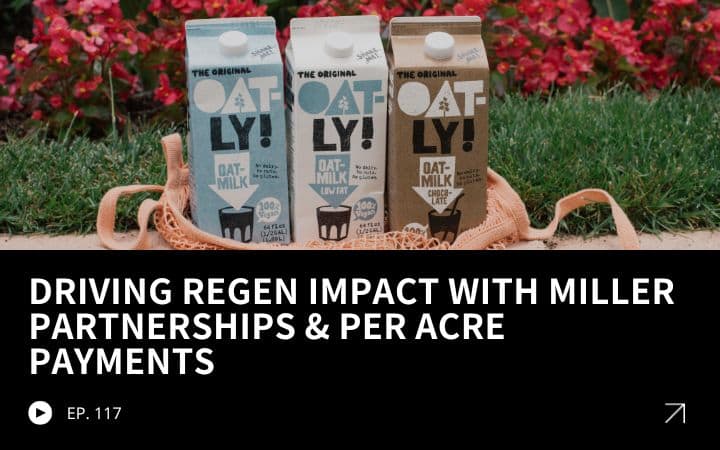
Driving Regen Impact With Miller Partnerships & Per Acre Payments
Oatly’s Journey Into Regeneration
On this episode of the ReGen Brands Podcast, Anthony sits down with Stacy Cushenbery, Senior Manager for Global Regenerative Agriculture at Oatly. While many listeners know Oatly for its oat milk and barista blends, this conversation pulls back the curtain on how the company is tackling regenerative agriculture at scale. Stacy explains how Oatly is structuring its programs, partnering with mills, incentivizing farmers, and embedding the costs of regeneration into its procurement system.
Oatly, which began in Sweden in the 1980s as a sustainable alternative to dairy, is now operating in over 50 countries. Its mission has evolved from supporting lactose-intolerant consumers to driving food system change on a global level. Today, that means thinking beyond its own supply chain and investing in practices that create system-level impact.
Why Oatly Measures Impact by “Equivalent Acres”
Rather than focusing only on sourcing oats directly from regenerative farms, Oatly has adopted an “equivalent acres” strategy. The idea is to create impact across the same scale as their sourcing footprint, even if not every ton of oats comes from identity-preserved regenerative fields. This mass balance approach allows the company to maintain flexibility in procurement while still funding regenerative impact at scale.
"Changing how we source oats would put us in a precarious position if farmers couldn’t deliver. Equivalent acres lets us drive system-wide impact while keeping procurement flexible." – Stacy Cushenbery
By taking this approach, Oatly can influence farming systems beyond just their contracted suppliers. It opens the door to collaboration with other buyers, supports rotations beyond oats, and helps create regional-scale change that reflects the reality of how commodity agriculture works.
The Essential Role of Mill Partners
One of the most unique aspects of Oatly’s approach is how it centers mill partners in its regenerative programs. These mills are more than just processors – they are the bridge between Oatly and farmers, handling both the agronomy support and the farmer relationships that make practice change possible.
"Their agronomy team has those direct relationships with the farmers. We work with them to say, these are the practices we really care about at Oatly. And then they help farmers decide what works best for their operation." – Stacy Cushenbery
Through this model, Oatly isn’t dictating practices from a distance. Instead, it builds programs collaboratively, relying on mill agronomists to co-design incentives and track adoption throughout the season. This partnership has proven critical in building trust and ensuring programs adapt each year based on farmer feedback.
Paying Farmers to Adopt New Practices
So what does Oatly actually incentivize? The programs cover a wide range of practices – from nutrient management and variable-rate fertilizer application, to cover cropping, pollinator strips, no-till, and even integrated grazing systems. Farmers choose from a menu of options, with points assigned to practices based on cost and adoption rates.
"We’re trying to give farmers as many options as possible because they know their operations. They know what they want to try and what they don’t." – Stacy Cushenbery
Farmers receive roughly $55 per acre for practice adoption, split between an upfront payment to cover early costs and a second payment after the season. Programs are designed to evolve year after year, reflecting the realities of farming in Canada and Sweden while giving farmers room to test, fail, and learn.
Building Regeneration Into Procurement Budgets
For regenerative programs to stick, they need to move beyond pilot projects and into the core business model. Oatly has done exactly that by embedding the costs of its regenerative initiatives into procurement budgets, ensuring these incentives are not treated as side projects but as part of the true cost of sourcing ingredients.
"Once we had a clear sense of what we’re doing and the costs, regen ag moved from my budget into procurement. That’s allowed for buy-in across the whole company." – Stacy Cushenbery
This shift has given Oatly cross-functional alignment – procurement teams now understand, explain, and defend the regen program just as sustainability does. By mapping the costs of incentives down to a cost per liter of oat milk, the company has translated ambitious sustainability goals into operational reality.
How We Get Regenerative Brands to 50% Market Share by 2050
In closing, Stacy reflected on the bigger picture. For regenerative agriculture to scale, transparency is key – companies must share their sourcing regions, data, and challenges openly. Equally important is redefining the true cost of food so that regenerative products aren’t expected to compete with cheap, extractive alternatives on price alone.
"We need to meet the emergency we are in. The days of keeping supply sheds quiet should be gone. We need transparency and honesty about the true cost of our food." – Stacy Cushenbery
This ReGen Recap was written by Anthony Corsaro with the help of ChatGPT
You can check out the full episode with Stacy Cushenbery @ Oatly HERE
Subscribe to future episodes of the ReGen Brands Podcast on Apple Podcasts, Spotify, or YouTube. You can help support our mission of growing regenerative CPG brands with a 5-star rating!
Stay engaged in the conversation by subscribing to our weekly newsletter, The ReGen Brands Weekly, and connecting with us on LinkedIn: ReGen Brands and AC