
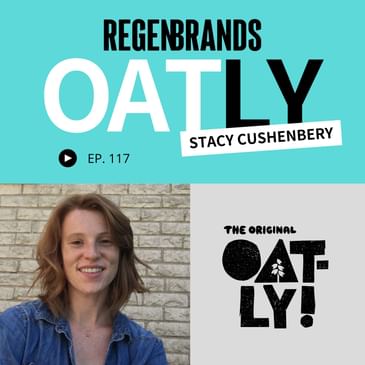
On this episode, we sit down with Stacy Cushenbery, Senior Manager for Global Regenerative Agriculture at Oatly, to unpack how one of the world’s most recognizable plant-based brands is tackling regeneration at scale.
We explore why Oatly chose an “equivalent acres” approach instead of chasing identity-preserved sourcing, and how that decision balances procurement flexibility with landscape-level impact. We dive into why mill partners are the hidden backbone of their program — organizing farmers, shaping agronomy plans, and making regen real on the ground.
Stacy shares the nuts and bolts of what practices Oatly is paying farmers to adopt, how much support they receive, and what the company has learned about building trust and iteration into the process. And finally, we go inside the business model — how Oatly calculated program costs down to a cost-per-liter of oat milk and embedded those expenses directly into procurement budgets.
It’s a conversation about pragmatism meeting ambition, about turning lofty sustainability goals into operational reality, and about how brands can work across systems to create genuine impact.
Episode Highlights:
🌍 Working towards system-level change in their regional supply sheds
🌾 Incentivizing regen practices in their two main sourcing regions
💡 Choosing mass balance impact over a segregated sourcing approach
🤝 Partnering with mills as the backbone of farmer engagement
🧑🌾 Supporting farmers with flexible, farmer-choice practice menus
🌱 Incentivizing farmers with per-acre payments for practice adoption
📈 Mapping sustainability costs down to cost per liter of oat milk
🛠 Embedding regen incentive costs into the procurement budget
📺 Educating consumers through authentic farmer storytelling
🎯 Calling for recognition of the true cost of food to drive change
Links:
If you find this content valuable, please consider donating to support our work
Follow ReGen Brands on LinkedIn
Subscribe to the ReGen Brands Weekly newsletter
Episode Recap:
ReGen Brands Recap #117 - Driving Regen Impact With Miller Partnerships & Per Acre Payments - (RECAP LINK)
Episode Transcript:
Disclaimer: This transcript was generated with AI and is not 100% accurate.
00:14
Anthony Corsaro
Welcome to the ReGen Brands Podcast. The place for brands, retailers, investors and other food system stakeholders to learn about the consumer brand supporting regenerative agriculture and how they're changing the world. I'm your host, AC. thanks for tuning in. Now let's get into today's conversation. On this episode, we sit down with Stacy Cushenbery, Senior Manager for Global Regenerative Agriculture at Oatly, to unpack how one of the world's most recognizable plant based brands is tackling regeneration at scale. We explore why Oatly chose an equivalent acres approach instead of chasing identity, preserve, sourcing and how that decision balances procurement flexibility with landscape level impact. We dive into why mill partners are the hidden backbone of their program. Organizing farmers, shaping agronomy plans and making Regen real on the ground.
01:10
Anthony Corsaro
Stacy shares the nuts and bolts of what practices Oatly is paying farmers to adopt, how much support they receive, and what the company has learned about building trust and iteration into their process. And finally, we go inside the business model. How Oatly calculated program costs to down to a cost per liter of oat milk and embedded those expenses directly into procurement budgets. It's a conversation about pragmatism, meeting ambition, about turning lofty sustainability goals into operational reality and about how brands can work across systems to create genuine impact. Let's go. What's up everybody? Welcome back to another episode of the ReGen Brands Podcast. Very excited today to have my friend Stacy from Oatly joining me. So welcome Stacy.
01:54
Stacy Cushenbery
Thank you so much for having me.
01:56
Anthony Corsaro
Absolutely. Gotta do our table setter first question. As always, I'd be pretty surprised who doesn't know Oatly at this point. But for those that are maybe unfamiliar or less familiar with the brand, Sezi, can you just share what products do y' all produce and where can people find those products today?
02:12
Stacy Cushenbery
Yeah, so Oatly produces oat milk. That's our main one. We, we also do a half and half. We do some creamers and then we also do some ice cream. And one of the biggest places people can find us is at their local coffee shop. Our barista blend is used on coffee shops around the world and then at markets and supermarkets. We are in about 50 different countries around the world.
02:37
Anthony Corsaro
Wow. Crazy. And we've done a few episodes like this, Stacy, with what I would say people that are in that sustainability role or sustainability function, you would fit in that category to really talk about like hey, what is actually happening agronomically partnering with farmers, customers and transitioning supply and from your And I's prep conversation and previous conversations. I think Oatly's a really interesting case study because it's not a small brand and also not a huge brand. So you're kind of in this middle space of figuring a lot of that out at that size. And there's also some other, I think, super interesting dynamics about the brand that lend itself to yalls unique context that are really cool and excited to unpack with you.
03:20
Anthony Corsaro
Before we dive into all of that because that'll be our main focus for those that maybe are unfamiliar with the history of the brand. When was it started? Why was it started? What, what's really the story behind it?
03:32
Stacy Cushenbery
Yeah. So Oatly dates back to the 1980s in Sweden, in southern Sweden and called Malmo, where we're currently still based straight. And were created as a sustainable, nutritious alternative to dairy, mostly for people who are lactose intolerant. And that is still like a core part of our mission. One of the things though that's evolved over the last 30, 40 years is the sustainability part of it. So not only are we there for people who are lactose intolerant, we also understand that we need to start to shift how we eat in this country and around the world. And so moving away from dairy products, milk products and starting to shift to a more plant based diet. Oatly's core belief is that we can provide nutritious, sustainable food that isn't overly taxing on the planet.
04:25
Stacy Cushenbery
So that's really kind of the driver of everything that we do at Oatly. And it's a cool thing to have that be your mission because it allows you to be really proactive in all of the things you want to do because you're a mission driven company and you care about the planet at the very core of who you are and it's why you were created.
04:45
Anthony Corsaro
Yeah, yeah, I love that. And I don't know if it's on the website or anywhere and I just missed it, but was the focus of the original crew always oats or was it like, hey, we need to do something that's plant based. And they kind of found oats as the solution to that.
05:00
Stacy Cushenbery
Yeah. So oats were always the idea and it was the idea that the oats are grown in plentiful amounts in Sweden and they are very diverse crops crop that can be used in a multitude of different ways. And so coming out of that research and the science in Sweden is where the Oatly product came and seen that like oats are Actually a really great substitute within the like for dairy.
05:27
Anthony Corsaro
And if I'm remembering correctly too, the business was really built on the food service side in the coffee shop lane first. Right. And then the CPG kind of followed it.
05:38
Stacy Cushenbery
In the United States. Yes. So originally in Sweden, it was definitely, you know, in the markets, in the superstore, in the supermarkets, kind of a product. And then when it came to the United states in the 2000s, were really focused on the coffee shops because what we found was this is much before I was at. Much before I was at oatly was that it's a really wonderful product for barista to. To use to create like all the latte art, all of that stuff. And so originally in the US it was kind of going through all of those coffee shops and those independent coffee shops. The clamoring for it was quite high in the early 2000s and there was some black market oatly selling going on and we really struggled to keep up with demand, but we kind of been able to meet demand now.
06:30
Stacy Cushenbery
So not only is it obviously provided to coffee shops, but now obviously it's in the markets too.
06:36
Anthony Corsaro
Yeah. Nice. Yeah, it's funny, I. You know, that's one thing we've noticed as a theme. I think doing the show and talking to all the various brands is food service can be this great kind of gateway for various products and brands for trial. And I think creamer for coffee is especially probably a high leverage opportunity there because this is typically something that people are consuming daily or multiple times a week at a coffee shop. Right. And they want to put something in their coffee. So definitely kind of a high leverage opportunity for. For trial and kind of building brand and product awareness. And what. What has happened in terms of like the alt milk explosion of consumption and growth in the last 20, 30, 40 years has been absolutely insane. And I know y' all have been a big part of that.
07:24
Anthony Corsaro
So just interesting to continue to kind of witness and follow along. Shifting gears to you personally, Stacy. Can you share like your personal context and what you are focused on at O? What is your title? What's kind of your role in Scope? What do you work on a day to day basis? And how does that interface into kind of the larger work of the brand?
07:45
Stacy Cushenbery
Yeah, so my role is the senior manager for global regenerative agriculture. Kind of a mouthful, but I really get the honor to work with our farmers.
07:55
Anthony Corsaro
Yeah.
07:57
Stacy Cushenbery
To work with our mill partners on a really daily basis, which is wonderful. So we have a couple of projects that I work predominantly on. We have a project in Sweden and then also a project in Canada, which is like the bulk of my work. On the other side of my work, I also do a bit of our scope three reporting. So I work with our data providers both in Canada and Europe, to really understand our emissions, to start to get nature data flowing through the system, to start to look at water. And so data is also a very large part of my role here at Oli.
08:32
Anthony Corsaro
Yeah. And I think it's good to just mention and feel free to build if there's like context here. But I think two things that makes the brand's context unique are it's a publicly traded company. One, and it has that European leadership still, which I think would be unique context compared to maybe a lot of the brands that we've had here that are completely kind of American focused and also privately held companies.
09:00
Stacy Cushenbery
The Swedish mentality around at Oatly kind of goes across the Atlantic. We have a really lovely team that's based in the US but also works on the global side of the company. And we are able to kind of understand a lot of what's happening in the eu, a lot of the regulations, and really also be pioneers here in the United States and North America around a lot of the stuff that we want to be able to do in the agricultural space.
09:29
Anthony Corsaro
Yeah. And from a. From a hardcore like legal financial market considerations, the company's publicly traded on the U.S. exchange. Right. So it's. It's publicly traded in the U.S. but because you have so much business in all these 50 countries and so much in the EU, you are obviously beholden to all the product level requirements that go along with that too.
09:52
Stacy Cushenbery
We sure are. And we have policy folks and communication folks that keep us abreast of all of it. It's pretty exhausting part of the job. But it does mean that we are really at the forefronts in all the different countries we work with.
10:08
Anthony Corsaro
Yeah. Okay, let's dive into regenerative agriculture at Oatly. What. What does that mean? Why does it matter? You know, what's the brand working on? I know you specifically are leading the specific projects, one in Sweden and one in Canada. But back up from that and maybe just help me in the audience understand. Kind of like, why does Oakley do this work? Why is it important? What does it mean to Olee? What has kind of shaped the strategy?
10:37
Stacy Cushenbery
What?
10:37
Anthony Corsaro
You know, whatever you can share at a high level about how the brand thinks about it generally.
10:41
Stacy Cushenbery
Yeah, it kind of goes back to what I said towards the beginning of, you know, we really want to look at how we can shift our food system so that we're eating less plants or less plants, less meat and dairy and more plants.
10:55
Anthony Corsaro
Yeah.
10:56
Stacy Cushenbery
And to be able to do that, we need to start to find. Find a way to really value the true cost of our food within our food system. And so that's a really big part of why Oatly is doing high quality food should not be a privilege. It feels like it is, unfortunately, but. And so one of the things we are really focused on is how can we influence a positive movement within the food system so that we can see substantial changes not just with the farmers that are directly within our supply chain, like Oatly farmers, but within entire regions.
11:33
Stacy Cushenbery
It's unique for a company to say, yes, we care about our exact supply chain, but we think that the impact going to happen at a landscape and regional level and we want to be part of that and we're going to actually put money towards that. And that's what Oatly really is doing. We, the planet does not care if Oatly's name is on a project. The planet cares that we are trying to do seismic changes. Right. And so it's a. It's a unique approach which allows us to be so much more innovative in the things that we do and also collaborative and transparent. I think that's a big thing about Oatly as kind of have like internal sayings that we need to be brave.
12:19
Stacy Cushenbery
And being brave sometimes means sharing all of the things that are going wrong, all the things that are going right, opening up the data to be able to partner with folks that might be a little hesitant to work across sectors.
12:35
Anthony Corsaro
Yeah, yeah, I love that. And that was really clear, I think in the conversations that we've had where you've detailed the work like you're about to, for the audience, where you all y' all are really working on a, you know, commodity ingredient scale, on a regional scale. And it's not just because, like you said, it's. It's the desire of the organization from an impact perspective. But I think what I've learned in the conversations with you and others that are in that context, it's really the most and only viable path to really make an impact anyway. So it's nice that matches up.
13:10
Anthony Corsaro
And it's like, if we are really going to have real regenerative impact in those crops, you have to work at a regional and kind of full commodity level scale, especially for a brand Like Yalls, where that's really how you're sourcing and it's not super possible to have some sort of niche identity preserved, you know, perfectly segregated supply. So excited for you to kind of unpack someone that lives that every day more than just the guy who talks to you about it, you know, once a quarter on a podcast, because you will have a lot more expertise and knowledge to share than I will. But was there an early path where that wasn't the case and that was like discovered by the brand and kind of shaped and molded that, or was there, was it always pretty known?
13:53
Anthony Corsaro
Hey, that's kind of the path we need to take. And, you know, here's why.
13:57
Stacy Cushenbery
Yeah, I think it's been shaped over the last, you know, three and a half years that I've been at OLEE originally, when we started to look at what we would call regenerative agriculture, OLE created a large framework. Like most companies, we call it the farm framework. And it was really the driver of how we want to approach any programs. And that includes like people, climate and nature. So we really wanted those three buckets really, you know, embedded in the program. And originally the way we thought about it was around a very clear, like sourcing program. Right. We were going to source this many of acres of oats and be able to put things very clearly on our pack and then we would have a vertically integrated region program. Seems so simple. But as you know, I kind of stepped into my role.
14:59
Stacy Cushenbery
It became such. It started to become much more complicated. Right. And as soon as you start to involve your procurement and your sourcing team, nothing is as easy as a sustainability team. And so we started to look at what is a way we can do projects at a math balance approach. Because changing how we source oats puts not only oatly in a very precarious sourcing position, in case, like let's say were sourcing 100% of our oats on contract. We source a lot of oats. That's most of what we source. If there was large climatic events and those farmers could not provide those oats, we would be in a very serious financial situation.
15:48
Stacy Cushenbery
And so from a business standpoint, not that's the only driver, but from a business standpoint, it made sense to how do we fit a region program which we highly value, into a system which vast majority of companies use, which is buying things off of contracts of mass balance. And, and that started to. That approach was tricky because one, we had to get sustainability buy in and Then two, we had to able to understand how to fit the economics of this into the business because it can't just sit with sustainability, it has to sit into the different functions. And so how do you fit a regen program where you're not sourcing the oats into procurement? And so we worked a lot with our procurement and sourcing teams in North America and Europe to understand like, hey, this is what we are trying to do.
16:47
Stacy Cushenbery
We're paying for practices, we're paying for that soft infrastructure like education, agronomic support, peer to peer learning. We're going to do it through our mill partners. Right. Establish relationships and we know what those costs are year over year as we scale. And then this will map those costs out till 2050 and then go down to the cost per liter of oatly. And so we had to do all of that work to make the business case, so to speak, that it makes sense to do this on a math balance approach versus changing how we source and going to a segregated system. Yeah, and I use oats as the example. We also source a vast amount of rapeseed, but oats are like I think 85 to 90% of what we source.
17:37
Anthony Corsaro
Okay, yeah, that was a super helpful breakdown. I took a ton of notes and I'll just pull out a couple things that stood out to me. Like the business constraint is procurement and really supply chain risk and supply chain flexibility makes complete sense. Right. So that kind of eliminates the whole perfectly segregated, vertically integrated approach. Then you move to this mass balance approach and what you're saying is, you know, how do we make the economics work both for our business but also for funding air quotes like the impact that we're actually trying to see on the ground. And then I would assume, you know, something you kind of alluded to earlier is also like, it's probably way easier to report on the data if it's that segregated approach.
18:19
Anthony Corsaro
And it becomes a little hairier to report on what exactly are we doing and what is the impact when it's not like the supply that's going into our products as well. So those things kind of stood out to me. And if I'm remembering correctly, the goal now is basically a hundred percent equivalent acreage impact as what you source, but it doesn't necessarily need to be acreage being sourced from. Is that. There's probably a better way to articulate that than what I just did. But that's the goal, right?
18:50
Stacy Cushenbery
No, that's, that's perfect. It's not sexy to say the least. And there was some concern around leadership of like equivalent acres is not like an appealing, like bite sized little thing you can kind of say at a conference. But it's the truth. Right. And what it means is that when I work with our mill partners, I get to work with a whole host of farmers that aren't necessarily growing just for oatly, they're growing oats. And that's what we care about. We, we care about making changes in the production system we work with. So that's the oats and canola, but we also care about making changes in the production system that we don't work with and things in our rotation and things that touch our rotations. Right.
19:42
Stacy Cushenbery
And I think it's a perfect way to be able to do it on a mass balance approach because all of a sudden you get out of this kind of pigeonholed idea of like, this is Oatly's data, this is how we are making impact on our tiny supply chain. And instead it's like, oh, wow, there's 1.2 million acres theoretically of oats within our supply chain and we have a tiny portion of it. But look at all of the actors in that area. How do we work with those other actors that are also buying oats? How do we work with our mill partners? How do we work with the barley growers that are doing things on the other side of the rotation? How do we work with the grazing folks that have integrated systems in Canada?
20:24
Stacy Cushenbery
And so I think it opens it up to be a much larger impact and program than if were solely focused on just the canola and the oats in our system.
20:34
Anthony Corsaro
Yeah, yeah, that's amazing to think about impacting that much acreage. Right. And like that is the goal and that's like the requirements of the moment. That is the level of scale we need to be operating at to really make the changes that, you know, people on planet need. Is there a specific number of acreage for that equivalency goal that you are working on hitting every year? I mean, I'm guessing maybe it changes year over year.
21:01
Stacy Cushenbery
Yeah. So it's tricky because I work pretty closely obviously with procurement and our acreage hectare goal is like a moving target. Right. And so what we did is we have our kind of big sourcing regions and for us that's Canada, Sweden and the UK is just like the top line. And those numbers can change year over year. Right. Based on how many oats we need from those specific countries. And so we really have to be very quick with how we look at those goals and making sure that sustainability and procurement are really close relationships. So that I know, hey, this is what our projected buy is from Canada in 26. And then I can adjust. Okay, that means that I need to adjust my targets going down all the way to 2035 to absorb that.
22:01
Stacy Cushenbery
And maybe in 27 there's a less of a buy. So then I adjust my targets down there. And so it's always this kind of like iteration on the program. And that is fun. It's not easy. I mean, it's nice. We're doing it with one of the big commodities, right? Oats, we're not talking about 50, 15 different product or commodities. But the other thing that we really have to be able to do is make sure that there's like continuity between all of the programs. So if I'm saying, hey, we're going to buy a little less in Canada, that doesn't mean that we're gonna do less of a program in Canada. It just means that we just need to continuously have those adjustments in place and scale at a rate that's going to work for the company.
22:49
Stacy Cushenbery
And our rate of scale is planned out on annual basis out to 2035 and then in five year increments out to 2050. So like we've thought through a lot to try to make sure that we can hit those targets on annual basis.
23:06
Anthony Corsaro
Yeah. Can you share the total acreage affected maybe today in the programs or some sort of number that gives some scale to what's happened historically so far?
23:18
Stacy Cushenbery
Yeah. So in Canada we have about 22% of our supply for 20 for this year, for 2025, and that's about 5,000, a little over 5,000 acres, which kind of says how big Oatly is. We are a large, we are a small company with a large voice. That's kind of how I describe us. In Sweden, we have about 5% of our supply for 2025 next year. In Canada, the goal is to have about 35% of our supply, our equivalent supplies. So like, those are big leaps for us.
23:54
Stacy Cushenbery
And I will say we could never do that without our mill partners because we need 100% buy in for them to want to do this with us, to want to have a program to want to reach out to their farmers network to make sure that the farmers understand it, to coordinate with us on farmer meetings and field days. So it's A partnership with our mill partners. And they always say they're like the invisible person in the room with me. Like nothing I do is, can be done without them.
24:23
Anthony Corsaro
Yeah, yeah, you read my mind. Because that was going to be my next question, which is you've done a really nice job laying out kind of like, hey, to work at a regional or commodity scale, we need to work with these partners. We need to work with them from an operational perspective because we are supplying like actual pay for practice incentives and we're providing, I love the term soft infrastructure that you use, which is a lot of that non payment other support that you just mentioned. Can you go into detail a little bit more about why the mill partner is so important operationally? Is it because you're paying them and they're actually making the payments to the farmers? Is it because they're already organizing some of those field days like you said?
25:03
Anthony Corsaro
Is it because, you know, I don't know, I should just let you answer the question. But like what specifically, you know, monthly, quarterly, annually, are you relying on them to help you do, to operationalize this thing?
25:17
Stacy Cushenbery
Yeah. So I'll start a little bit from the beginning with this. So about three years ago when I started at Oatly, the first discussions I had with our meal partner in Canada was like, hey, we want to try out a program. Would you be interested in doing this in collaboration with us? Right. And we started it about. And oh gosh, it was like on 250 acres. So tiny. Knowing the size of acres inside the farms in Canada, 250 is very small. But it was it, we can call it a pilot. It's what it was like, let's start somewhere and see if we can actually get something right.
25:56
Anthony Corsaro
Yeah.
25:57
Stacy Cushenbery
And see if we can actually move the needle on some of this stuff. And what have developed over the last three years is a program where I meet almost weekly with our mill partners to do the coordination. So the coordination is really working with their sourcing team and then also their agronomy team. Their agronomy team has those direct relationships with the farmers. And so we work with the agronomy team to kind of say, hey, these are the practices that we really care about. Oatly at Oatly. These are the practices that we know are prevalent in the region due to our research, due to our data collection, due to farmer interviews and then developing a program that meets the needs of all three of us. So farmers being the third.
26:45
Anthony Corsaro
Yeah.
26:45
Stacy Cushenbery
And then what we do is the agronomy team actually meets individually with farmers. It is a laborious process.
26:52
Anthony Corsaro
Yeah.
26:53
Stacy Cushenbery
And they're the ones that help them decide on their practices. They're the ones that kind of track those throughout the growing season. And then, and then Oatly is really there to learn as much as humanly possible from those growers and the agronomy staff of like this is what went well. This was what really bad and this is what we want to see change and we honor that. It's an iterative, it's an iterative program and I don't, I mean I know people don't like the word pilot anymore and I don't either. But I think the essence of a pilot is that it can change over time. And so our program is designed for every year it gets better based on previous experience. So it's not a stagnant program.
27:40
Stacy Cushenbery
The other thing that we work really closely with our mill partners on is the data portion of it. So Oatly uses regrow for sustainability insights. And so that's really looking at our entire supply shed and understanding what our emissions are, understanding practices. And so we actually opened that platform up to Grain Millers, our mill in Canada. And we look at what is the abatement potential of the certain amount, certain practices in the counties, they're called RMs in Canada to say hey, the combination of no tail and variable rate is going to see a bigger reduction in emissions or we're going to see more soil benefits because of these practices.
28:23
Stacy Cushenbery
And then we can work with the OLE procurement team, the Grain Millers procurement team to kind of start to like in a target areas where we know these practices need to be employed or they're actually going to see benefits for the farmers. So it's a very close relationship. The long way of saying that.
28:41
Anthony Corsaro
Yeah. So two probably dense areas of follow up. One on the actual like practices and financial incentive side and then one on the reporting side. So I'll start with the practices and financial incentives. You mentioned some, you mentioned kind of the process of getting to the total list. I don't know if you can share if this is if content confidential or not. But like can you share more details on what exactly the practices are? Maybe we can just focus on Canada to keep it simple and like what type of monetary incentive there is and like maybe what the requirements are. Is it like have to be a new practice adoption? Can it be the continuation of a practice? And I'm sure there's like a nice visual chart that lays all this out.
29:22
Anthony Corsaro
So maybe A tougher question to answer verbally, but can you just talk more about the practice selection and kind of financial incentives and requirements?
29:33
Stacy Cushenbery
Yep. So I can talk about all of that, which is great. And I'm very like, we need to start talking about this more openly so companies and all of us can learn from each other. So some of our big practices are around nutrient management. So, so we, to start off, our practices are broken down into some like required practices. And these things are either mandated from the provincial or the federal government level or at the mill level. So the mill has specific specs that like you have to meet or they're things that we care about so deeply at Oatly, like land conversion that like there's a no go here. Right. And so there's like three or four of those and then we start to get into like an a la carte menu. And each practice has a point assigned to it.
30:22
Stacy Cushenbery
And the point is assigned based on the cost of the practice, the rate of adoption within the region. So if it has a very low adoption rate, it gets a higher point. And those points really add up to different buckets for farmers. And so the practices that we offer range from integrated grazing, so we're paying really for fence rows, right. And rotation and freezing operations, which I think is amazing. We do things like cover crops though in Canada it's more for green cover and not soils sequestration because it's a short growing season. We do reduce the no till. No till is a far more incentivized practice because we're these toes very common in this part of Canada. And now we do things like buffer strips, flower strips, pollinator strips, all of that. And then anything around nutrient management.
31:17
Stacy Cushenbery
So things like variable rate application for our nutrient management plans, which can be very costly, laborious to implement. And so we're trying to give farmers as many options for things that would work in their operation. Right. And they get to pick and choose what works for them. There's no additionality. So these are practices that they could be wanting to make small tweaks like a diversified cover crop rotation. This could be things that they want to test out and fail miserably at. Right. Like that is agriculture. Like you need to be able to experiment. So we try to keep it as welcoming as possible because I think one of the things that tends to happen is when we start to dictate, we lose people. These, these folks are brilliant at business.
32:08
Stacy Cushenbery
They know their operations, they know what they want to try and what they don't so we have to meet people where they're at and kind of work with them to understand what the benefits of these practices are over time. And so those three buckets for pricing for the first year, and these are in Canadian. So I'll do like a Canadian. Canadian. US Translation.
32:29
Anthony Corsaro
Yeah.
32:30
Stacy Cushenbery
We. It. The first year is like your trial. You just have to do those required practices. You don't have to do anything else. You do it for one year, it's about $15 Canadian an acre. And then those three buckets, the median price say it in US dollars is around US$55 an acre.
32:46
Anthony Corsaro
Okay.
32:47
Stacy Cushenbery
For the practices.
32:49
Anthony Corsaro
Wow.
32:50
Stacy Cushenbery
Yeah. So we're trying to incentivize it at a pretty high cost.
32:54
Anthony Corsaro
Yeah.
32:55
Stacy Cushenbery
Yeah.
32:57
Anthony Corsaro
Stacy, is. Are those payments made before the growing season, where people kind of commit to implementation and then verify that it happened, or they paid after? Like, how does the actual timing of that work?
33:08
Stacy Cushenbery
Yeah. So in Canada, it's a split payment. So we do. I think it's about 20%. I have to double check. But it's around 20% of that payment is done at the beginning of the season because there are upfront costs that we inherently know exist and then the rest of it's done at the end of the season. That being said, we've had farmers who have tried to do things like cover cropping. They bought all their seed. Then winter hit way earlier. And we're not like saying, no, you don't get that second payment. Right. It's just more of kind of understanding what that process was throughout the season. Good faith that farmers are going to do what they say they're going to do. And. And so those payments are split to give them a little bit upfront and then on the back end as well.
33:53
Anthony Corsaro
Yeah, I love that approach. That seems like the best approach from what I've learned about kind of how those agronomic decisions and payments are made and needed. So love that reporting. You mentioned working with Regrow. You mentioned working with grain millers on that side. Can you break down, like, what exactly is being tracked and why? And maybe it's helpful to, like, illustrate that based on the function of the business. So, like, from a sustainability perspective, hey, here's what I'm tracking from my, like, internal scorecard for, like, what we're actually doing from a Scope three reporting perspective. Here's what we're tracking so that we can put it in our, you know, public disclosures from a EU regulation. Here's what we're tracking for XYZ thing. I don't I don't know what that looks like, but can you break that down for us?
34:39
Stacy Cushenbery
Yeah. So right now we are really focused on our supplier level emission factors within all of our thirsty regions. And it seems like such an easy win, but it takes a decent amount of time to understand what your supply chain looks like or your supply shed looks like with each one of your mills all over the world. And so previous to me joining Ollie, were really looking at country level averages and country level averages give us the US insight, but they don't give us the depth of what we need. And so we started in Canada with that supplier level emission factor and understanding like what's the three year rolling average of this, what things are we seeing that are contributing to higher or lower emissions?
35:28
Stacy Cushenbery
And then the other thing that we work a lot with Green Millers is tracking the farmers, tracking practices and continuity across the years of the program. And a lot of this is done through narratives. We have started to look at how do we get project level data for our region programs to understand like what do we really need to be collecting from farmers? Understanding that data having 100 primary data from farmers is a very burdensome kind of proposition. And so what we're doing right now to understand what we actually need to collect is we're doing analysis on what are the indicators of a healthy system. So if I think of like healthy watershed, hey, there's a good indicator, we have a healthy watershed.
36:19
Stacy Cushenbery
And then what's the levers that Oatly can internally take to make a change to that water system and then what's the data that comes from that? Because a lot of times what happens is we have all this data, we collect a ton of data from farmers and none of it leads back to indicators. Right. It's just data in the system. Yeah, it's just 0.0215, you know, kilograms of something and that's not useful, it's not useful for farmers because we want to be able to share this data. It's not useful for us as a company in our reporting and it's not tangible to see if we're actually making changes.
36:53
Stacy Cushenbery
And so I think we've been very slow is not the word, but very maybe responsible on how we think about data, making sure that any data we collect is actually going through that whole system, going back to those indicators. And so a lot of times what we've, our approach has been how do you have a system where you're seeing all these things that we care about For Oatly which is a lot of nature stuff. Right. And then extrapolate out into things like carbon because we can say, hey, we know that we have soil retention, we know that we have good soil microbial health, we know that we have yields are stabilized in this system. And we have a system where there is a variable rate application of fertilizers, whether that's synthetic organic.
37:49
Stacy Cushenbery
And from that information, you can actually kind of start to look at the carbon system to versus say we are just going to account for the carbon in this system. And that's the thing that we care about. Doing it the way that we are trying to do it makes it a lot more onerous and tiresome and exhausting, but it does allow. I'm like venting a little, but it does allow us to have a much more holistic view of like actually what's happening in the system.
38:16
Anthony Corsaro
Yeah, yeah. I don't envy that work. That's some good old data, highly quantitative stuff. That's not what my personality naturally jives with, but it definitely sounds like it's a lot. But it's important not only for just like internal compass, but also like external accountability and maybe some requirements there as well. Yeah, the actual financials. And feel free to tell me if there's stuff you can't share here, Stacy, but you know, you mentioned you're basically saying, hey, there's this total cost that we're estimating and then we're trying to come up with the, I believe you said cost per liter based on the actual like end product we're producing. So then does that calculation go into some budget line item that sits under procurement that like is used to then make those payment. Does it sit in the sustainability box?
39:11
Anthony Corsaro
Is it a separate foundation that Oatly created and there's a. And the money lives there. Like how does the actual financial piece of the backend work?
39:20
Stacy Cushenbery
Yeah. Oh, great. I would love if we had a foundation to pull from, but we. Yeah, yeah. That's not our story. And so how we've kind of structured it is when a project is starting out and it's in that exploratory phase, it sits in sustainability. So I get a lot of. In my budget. I will have a lot of projects that like nature monitoring. Right. That's very new for us. That sits in my budget for the next couple of years. And then once we have a really clear sense of like, this is what we're doing, this is how we want to do it and we have an understanding of the cost it then sits in some other part of the company. And so for our regen Ag, for the first couple of years it sat in my budget and now it sits in procurement.
40:03
Stacy Cushenbery
And I think what it has allowed us to one, be really responsible with the funds that we are using and pull in procurement and sourcing as much as humanly possible. Not only for those conversations with our mills, but also around the data. I work so closely with our procurement team of like understanding our sourcing region, understanding the practices, how we're tracking things on platforms. And so they have as much knowledge as I do, which I think is awesome because they can go out and explain these programs and explain why we've designed them the way we have, why we've decided to do equivalent acres.
40:44
Stacy Cushenbery
And, and I think it allows for a very cohesive message across the entire company and it allows for buy in across other, you know, parts of the company because I think a lot of times sustainability in other areas can struggle to get buy in from sourcing, from procurement, from leadership. And this has really solved a lot of that trouble.
41:07
Anthony Corsaro
Yeah, yeah. It's the cross functional alignment, communications and just effort that's needed to make some of these sustainability programs work when you're operating at any decent scale is really, I feel like astounding and probably just under discussed and understated most of the time. So it's fun to have people like y' all that are live in it come really like unpack it because there's a lot there. The, the simple mills crew was like our hot take is that we actually need more meetings because there's only one way to like make sure everyone's on the same page, which is you have to communicate about all of it that's going on. So I think that, that rings true.
41:53
Anthony Corsaro
This is maybe a self serving or biased question by me because I'm so on the train of like we need more pre competitive collaboration and more brands or just off takers in general, like working together on this. Have you been able to pull in other brands or off takers that work in that same supply shed or with that same mill to help you out? Because I would assume many of these farmers are growing a rotation where you're not actually off taking all the crops anyway. So I mean you can kind of just say hey, that's not our problem because the mill's buying it and like then they're selling it. But is there opportunity to get other offtake kind of players involved in this stuff?
42:30
Stacy Cushenbery
Yeah, we are working so Hard on this. It's like one of the biggest goals for the rest of this year in 2026, I will say we've had a lot more success in Europe. I think the size of farms, the relatively close relationships that we have has made it a little bit easier. But in Canada we are working really proactively on this. So there's a few different organizations that are starting to get at a lot of this though I think we still struggle with what are we wanting, what's the data we want to collect. And we start to get bogged down in the data stuff and it kind of starts to fall apart. But the short answer is yes. And I think what's happening is there is a, it's centered around like an environmental like corridor or area of concern.
43:26
Stacy Cushenbery
So for us in Canada, there's an area called the Aspen Parklands that runs directly through the prairies of Canada. And it's a very sensitive area. And the coalition that's starting to build around that with not just other companies, but the processors, nonprofits, indigenous groups, is quite strong. But it's all there to protect the, this specific corridor. And so I think the way that we will see most of this work around this collaboration, you know, kind of stuff is when there is a corridor that we all care about, there's, there is a reason to care about that region, whether it's the water supply, whether it's a prairie system. And we see the same thing in Europe when you can start to say, hey, this is an area that is affecting us all. It's all part of our supply chain.
44:24
Stacy Cushenbery
It's protected, we need it to be protected. It's vulnerable. I think you see a lot more action versus like hey, who wants to just pay for, you know, incentives on barley and we'll pay for oats? That's not as compelling I think for a lot of companies.
44:40
Anthony Corsaro
Yeah, yeah. So the multi stakeholder engagement and complexity even continues to expand, but seems like it's an absolute necessity and you'll have some good positive momentum there. So I'm happy to hear that. And you know, I think your Yalls approach and the way that you're articulating like the hardcore operationalizing of it really reflects back to something that I think you said and I might be paraphrasing where it's a direct quote from our last conversation, which is like we're trying to figure out how to make regen the standard, not the exception that need some sort of cost premium at the ingredient or you Know, product level.
45:21
Stacy Cushenbery
I think one of the things that we are, when we start to talk about premiums in the system, I think what. And I, I get concerned because is there enough market signals to say to a farmer, hey, this premium means you're going to get a higher price at market. And sometimes there is and sometimes there isn't. I don't think at this point in time that something that is regenerative has enough market pull at volume, like at scale to get to have a, you know, a continuous premium associated with it. And I'll use organics in Canada as kind of a bit of an example. One of the concerns that we've seen or one of the trends that we've seen is that organics was labeled as an opportunity. There'd be market availability, farmers would get a higher premium at market.
46:18
Stacy Cushenbery
And those higher premiums never really established. And so you have a lot of farmers that went through the organic transition. They spent a lot of time and money to do that and the market never appeared right. It was never stable enough. And so they never made higher amounts. And so a lot of farmers are actually removing their farms from organic certification, which is the last thing we want to have happen. So I think making sure that all companies are really aware of like what's the market signal that we're sending. And historically I think companies at large have not then as hyper aware of those signals that they are actually sending and what that repercussions are for the farmers at the end of the day.
47:09
Anthony Corsaro
Yeah, it's. That's a layered topic, right? I, I couldn't agree more. The beginning of what you said, like the market signal is not there at scale right now for regen, not yet. And we do need to be super careful. Like you said at the tail end. I think part of the challenge of that is the dreamers and marketers like myself sometimes want to beat the trend and kind of announce its arrival or scale or kind of go predict it before it happens or kind of use that as a way to help get it there. Right. There's a better phrase that's probably more accurate than fake it till you make it, but kind of that type of approach. But I think about it like yeah, we talk a lot about from a government policy standpoint, carrot or stick.
47:57
Anthony Corsaro
And with Regen it's just there's different colored carrots, right? Purple carrots for some people we got yellow carrots for some people we got orange carrots for some people. And probably even more than that. And you know the purple carrot might be the vertically integrated identity preserved one single brand carrot. The yellow carrot might be the mass balance supply chain, pay per practice incentive carrot and then et cetera. But as long as the carrots leading to continuation of regenerative acreage under management or net increase of practices and acreage under management, like it's a, it's a useful and workable carrot.
48:38
Stacy Cushenbery
Yeah, I, I agree. And I think the other thing that we really need to come to a point with is understanding the true costs of our food. I think a lot of times, you know, we will say that, you know, not say but food is priced at a very low value within our societies, especially in North America. And understanding like the really the cost that goes into producing high quality food and starting to have kind of a shift in this is very philosophical and what we value like we should be spending way more of our money on food and health and that versus on materialist stuff. So. And that's 100. My, my view. But I think if we can start to get in a better place with that, our food system will highly benefit from it.
49:30
Anthony Corsaro
Yeah, yeah, and I appreciate that. You know, those, the vast majority of the financial burden of what you're talking about doing here like lives on the procurement and sourcing team now because that is being internalized into the cost of producing the food or the items that y' all make. Even if it's not an identity preserve supply chain where you know, that supply ended up in the cart. You know. So I think that, that ideal is reflected in the strategy that y' all have built. So I, I appreciate that. Stacy, I know this is not your role. Right. You're not the VP of marketing or the CMO or anything there at the brand, but I'm, I know you're working with those folks. Like what do they ask you for? How are they involved in this regenerative agriculture work? Like how are they communicating it?
50:12
Anthony Corsaro
We know it's not what's necessarily an on pack certification or claim, but you know, what are they doing with all this work that's happening from a consumer facing perspective?
50:22
Stacy Cushenbery
Oatly's unique is we don't have a marketing team. It's actually called the odmc, which is the Oatly Department of Mind Control. So it is a unique.
50:33
Anthony Corsaro
Yeah, that's funny.
50:34
Stacy Cushenbery
It's a very unique. Part of my job is working with them. And so they are really working to understand what our Programs are all about. Right. And be able to find a way to present this work which can be complex, can be very technical in a very compelling way. And so one of the things right now that we're doing is we just were up in Canada and did a farm visit and really it was like a life, a day in the life of a farmer that grows oats. So understanding the Canadian landscape, understanding how vast these operations are and really like allowing folks that, you know, follow Oatly to meet a farmer and understand farming even for, you know, a short clip. And so that's one of our big things.
51:30
Stacy Cushenbery
The other side of it is making sure whatever we say is really factual and true. A lot of my role has to do with things that we can say that one are going to allow folks to understand our programs in a very transparent way, but not over claiming what we're doing. And I think that's such an interesting tight rope to walk of.
51:55
Anthony Corsaro
Yeah.
51:56
Stacy Cushenbery
I want to say as much as humanly possible about this. I don't want to be silenced because I'm worried I'm get in trouble.
52:02
Anthony Corsaro
Yeah.
52:02
Stacy Cushenbery
But at the same time making sure that, you know, marketing, communications policy folks have all the tools that they can. They need to be able to talk about this work eloquently. And that is really difficult when you don't have an agricultural background. So it's something that we need to just continuously work at. There's a lot of time and energy spent of like this is what an agricultural system looks like. This is why we want to influence change and getting away from some of those buzzwords or misconceptions that farmers have been doing things wrong all these years and actually talking about the facts. Like actually we created this system. We all were part of creating the system. And now we need to autocorrect and work with people where they're at and make incremental changes.
52:53
Stacy Cushenbery
I think another thing that you mentioned was things on POC that's a high interest, obviously. Totally. We put a lot of our emissions stuff on pack as well. But the consumer education, I think, you know, when you go to the grocery store, I work in this area and I will see 10 different labels on a pack. And even I am like, I don't know what all these mean.
53:17
Anthony Corsaro
Yeah.
53:17
Stacy Cushenbery
And so trying to be really clear with consumers of like this is what this actually means on pack and this is what we're actually doing is a big part of what the ODMC does too.
53:29
Anthony Corsaro
Yeah. Yeah. And it's. I Think in today's world where we are constantly inundated with content and marketing, copy visuals, et cetera, of all different types, and we have ChatGPT that can come up with something in 15 seconds, it's easy to think that, oh, that's not that hard to do. But then you think about how, you know, sustainability, procurement, regulatory, marketing and whoever else like all needs to be in that room getting on the same page and sifting through like you said, some very rich and many times like technical data. So yeah, and then you got to make that cool, sexy, accurate, regulated and compliant. And so there's a lot of pieces to developing that, I'm sure. What do you find in your role as like maybe one of the bigger challenges of interfacing with the rest of the organization in that sustainability role?
54:26
Stacy Cushenbery
Yeah, I think the biggest challenge is the practicality of it. I, I think that sustainability folks, we tend to be a little bit on the dreamier side. We have very ambitious goals. We, we want to get things done. And really, you know, I think you go into sustainability because you care deeply about it and you really want to see some huge changes and sometimes that doesn't match the practicality of the business.
54:56
Anthony Corsaro
Yeah.
54:57
Stacy Cushenbery
And so I think one of our largest, one of my largest challenges and just the same sustainability in general is taking those ambitions and making sure that they're actually doable on annual basis. Right. That they make financial sense, they make long term planning sense and they fit into the operation. You know, we can say we want electric trucks on all of all of our fleets, which we, you know, we have a huge ambition for. But if those trucks, the size of those trucks doesn't fit into docking systems, that's a problem. Right. And so you have to have the practical side where it's involving the other parts of the company that are much more practically and business driven, helping you make those decisions versus a mandate from sustainability.
55:50
Stacy Cushenbery
I'm lucky to work at Oatly because that willingness to work with sustainability and value their opinion and value their strategies is quite high. But I know that can be a challenge in many other companies of sustainability isn't always valued in the same way that, you know, operations is.
56:11
Anthony Corsaro
Right, right. Yeah. And I think all of us on that dreamer side need to be empathetic to just the nature of running a business. Right. Like it's not always possible to do everything that you want to do to the scale and the cost that you want to do it. And many of us have to be conditioned the Hard way to understand that when we come from that dreamer perspective. Yeah, I'm curious like when you look at the macro of this term regenerative and it as a consumer facing piece of marketing terminology or claim, where are we going to be in 2030, 2050? Like is the term just going to be the standard? Is it going to be table stakes, just like sustainability and kind of mean some elevated version of what that means today?
57:00
Anthony Corsaro
Are, you know, is most of the work going to be in this segregated, identity, preserved, certified kind of stuff? You know, I'm an idealist and an is. I don't know if inclusivist is a word but like I want everyone that's doing good work to come to the table and like it all to work out. But I'm sure there's people that would say that's probably not gonna happen or possible. But like where do you see it going both from the term itself at large and also like the consumer facing kind of side of the term.
57:30
Stacy Cushenbery
Yeah, I think one of the things we struggle with the word regenerative is it's not understood inside a company or outside a company. And so I think, you know, I get a lot of questions around well, what does regenerative mean? And I have to break it down into well, we're talking about people in their communities and water supply. And I think one of the things that's going to happen in future years, probably the 5, 10 year mark, is we will start to have a much better understanding of the complexity of the agricultural system. And instead of the need necessarily to label it a certain standard, I think we're going to start to see systems level change and recognizing that regenerative isn't necessarily a destination, it's something that's in flux and it can change per crop and it can look different on each farm.
58:31
Stacy Cushenbery
But what we're looking for is a system that is highly integrated, that's you know, diversified, where there is economic support within the community, where there's value for what the farmers are growing. And so I again very sustainability minded I am. My hope is that it is a much more holistic view of what agriculture actually is versus right now what we have is a label which is driven by data points. And I think it's hard for the public to be compelled by this nascent word that we just really don't like. We can't get our hands around, we can't feel and touch it in some ways. But that feeling of like when you go to a farm. And like you see it like, you see the things that are working, like you can almost feel it. Right. You can hear the ground practically.
59:28
Stacy Cushenbery
That is what I hope that this starts to transform into and we can start to see how everything in these communities, in these regions are connected. Yeah. Very high in the p thinking though.
59:44
Anthony Corsaro
No, I mean it was beautiful. It made perfect sense. And if it becomes reality, we'll all be better off for it. So I share the hope that it does. And you know, another question kind of prompted from your response, which was what I feel like I heard you say there is really a strong take on kind of the operationalizing of the term into the actual like agronomics in the business practices and also the use of it as like a consumer claim for an end product and it not necessarily going to be the thing that just has the most recognition and demand as a consumer claim. Are you curious about or hopeful for or bullish or bearish on maybe the data associated with some of these changes being like the consumer poll, like the nutrition data or the sustainability data?
01:00:39
Anthony Corsaro
What do you think about that element of it?
01:00:41
Stacy Cushenbery
Yeah, I, I really struggle with what, understanding what's the driver for consumers in this area. Right. Part of me thinks like, okay, maybe the driver is something that they just inherently feel good about. Right. And that's very hard to quantify to be like, I feel good about this brand. And as soon as you start to get into specific data points, that's really helpful, I think, at the brand level and the regulatory side. But I don't think the general public has a really firm grasp of what any of that means, how it's quantified and maybe they don't even need to. And so I think that there's a lot of work that still has to be done between brands and consumers and retailers around. How do you language this to consumers and where's those, what are those decisions? Right.
01:01:45
Stacy Cushenbery
Because when I buy food for my family, I buy whole foods that are healthy and I feel good about them and I'm not necessarily looking at the emissions of those products. Products. And so I think that we will have to, I mean, and I know about it, so that says something. Right. I work in this space. So I think this, there's a, there's something to be said about the fact that there is right now language that's happening internally, companies and retailers that isn't resonating or being met by consumers. And so squaring that up I think is going to be something that's going to be needed to see this movement move forward.
01:02:28
Anthony Corsaro
Yeah, I'm definitely bullish is good, I believe, and bearish is bad. I'm bullish on sustainability data as a potential stick and as potential regulatory tool. If, you know, we're a long way away from that being done at scale and well and correctly. But that tool, I think has its most potential impact in that regard. I'm super bearish in terms of using it for consumer marketing and demand and pull. I just don't think people care about data, specifically that data that much. I think we just have like thousands of years of evidence that it's not what moves people to make emotional purchasing decisions. I am, I am bullish on the nutrition piece, but I think that is going to look really different based on the product in the category. Like, I think it really matters for ground beef.
01:03:22
Anthony Corsaro
I don't know how much it matters for crackers. You know, I think it really matters for milk. I don't know how much it matters for baking mix, but, you know, we'll see.
01:03:35
Stacy Cushenbery
Yeah. And there's so much research that is starting to happen around the nutritional density in the relationship with regenerative practices that I think that will be something that if that can be proved out, which I have my fingers crossed that it can be, will be a substantial driver.
01:03:54
Anthony Corsaro
Yeah, I feel like we just spent the last five or so minutes answering this last question. But I'll tee it up just in case you have anything to add to what you've already shared. Stacy, the final question we always ask everybody, which is how do we get ReGen Brands to have 50% market share by 2050? And I will just put the disclaimer of, you know, we want to include people working in the type of context that you and Oatly are working in, where it's maybe not necessarily a certified product or a identity preserved supply chain, but it is products being produced that are having a net positive effect on regenerative acreage. So all that said, how do we get 50% market share by 2050 for all the folks doing both of those things?
01:04:36
Stacy Cushenbery
Yeah. The biggest thing I think that needs to happen internally with all these companies is we have to be way more transparent, aware ourselves. Supply sheds are how we're sourcing, the logistics that we're using and the challenges that we're having and how we intend to overcome those challenges. Transparency, I think, and the data portion of it, I think that's going to be super necessary. I think the Days of this is my supply chain. I'm going to keep my sourcing area quiet and I'm not going to talk about my supplier should be gone. It's not necessary. We need to meet the emergency that we are in. And when you have an emergency, you have a crisis plan. And so I think we need to start to get there or we need to be there, you know, 10, 20 years ago.
01:05:26
Stacy Cushenbery
I think the other thing that needs to happen is there needs to be a much larger assessment at the federal level across multiple countries about the true cost of our food. I've talked about that a few times and really assessing like what is the cost of a very conventional grown product to our health, to our society, to the actual cost of the land to the farmers and start to look at what is the true cost to our health for things that are grown in a very different system, that are much more sustainable, that are providing back to the planet. And just be very clear about there needs to be labeling around that we need to have some type of consumer knowledge of this is what this is costing us as a society.
01:06:17
Stacy Cushenbery
Yeah, I think once we can start to talk in those really just pragmatic, very clear health, that very clear health language, we will see shifts in how we eat. And when we start seeing shifts in how we eat, then there is that recognition of like actually this is a system, the regenerative system is much better for our planet. It's much better for me and my family and our health. And I think you'll start to see that momentum build.
01:06:47
Anthony Corsaro
Love that. And completely agree with everything you said. I think well said on the macro of kind of like this true food cost accounting, internalizing externalities. And I, I actually think especially in the industry, like we're there, like we've had this moment of awakening where like we all realize that what needs to happen next, like you said, is like actual policy or actual carrots and sticks that then you know, do the actual operationalizing of internalizing those externalities and this is where not to get into this. And because I, you know, I'm staying informed on it, but I am by no means an expert. Seems like where the Maha thing has kind of fallen short. What it's done really well is it's massively increased the awareness of these issues and it's really put a spotlight on them, which is I think should be super celebrated.
01:07:37
Anthony Corsaro
But you know, the actual like plans around what are we actually going to do to operationalize the change has seemed to be pretty light so far. So agree on that take in the macro and I actually think where I'm not super fired up about maybe what exactly Maha has accomplished from an operationalized perspective, I am super excited about. I think we are on the path based on the gains in awareness and the gains on kind of enlightenment to then eventually get there. And then I really want to spotlight what you shared more of a micro level, kind of an operator level of the transparency because I think many people have mentioned it as a consumer marketing tool for transparency, which I think you are including when you say it.
01:08:21
Anthony Corsaro
But what I really hear you saying is it's a transparency among operators to better share kind of operational data so we can all get better at this quicker because that's what really is more important than maybe the consumer story that gets told about it. Yeah, I agree, Stacy. Super fun, super informative. Really appreciate you making some time and really appreciate the work that you're doing. So just yeah, thank you for being here and thanks for spending the time with me.
01:08:49
Stacy Cushenbery
Yeah, thank you so much. I love talking about this. I could talk about this for a lot longer, so thank you.
01:08:55
Anthony Corsaro
Well, we'll have more time in episode two when we record that maybe in a future year and we will link a bunch of stuff in the show notes for folks that want to learn more and check out more about what y' all are doing. But yeah, thanks again for joining me and really appreciate it.
01:09:12
Stacy Cushenbery
Thank you.
01:09:15
Anthony Corsaro
For transcripts, show notes and more information on this episode, check out our website region regen-brands.com that is regen-brands.com youm can also check out our YouTube channel ReGen Brands for all of our episodes with both video and audio. The best way to support our work is to give us a five star rating on your favorite podcast platform and subscribe to future episodes on Apple podcasts, Spotify and YouTube. You can also subscribe to our newsletter, the ReGen Brands Weekly and follow our ReGen Brands and LinkedIn page to stay in the know on all the latest news, insights and perspectives from the world of regenerative cpg. Thanks so much for tuning into the ReGen Brands Podcast.
01:09:54
Anthony Corsaro
We hope you learned something new in this episode and it empowers you to use your voice, your time, your talent and your dollars to help us build a better and more regenerative food system.
01:10:04
Stacy Cushenbery
Love you guys.