
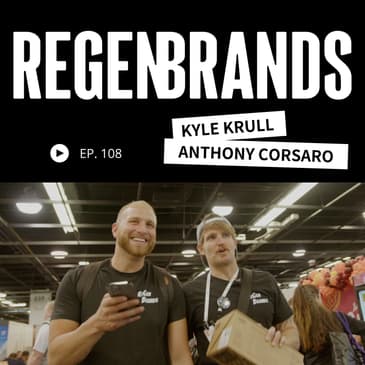
On this episode of the ReGen Brands podcast, a voice you know and love is back. Kyle returns after his brief two-episode hiatus, but this time as the guest.
We’re diving deep into a foundational issue facing regenerative CPG: we still have no unified way of tracking how regenerative products are performing at retail.
From disjointed data systems and third-party paywalls to the chaos of unstandardized claims, this episode breaks down why brands, retailers, and certifiers are flying blind when it comes to understanding regen product performance.We explore how syndicated data platforms like SPINS and Nielsen work, why regenerative claims often aren’t tracked, and what that means for brand strategy, buyer decisions, and movement-wide progress.
Kyle also shares why even the best sales data means nothing if you can’t translate it into value. Plus, we break down our two-pronged solution to ensure that regenerative products can be tracked just like organic, keto, or gluten-free items are today. And we detail the coordination effort it will require between certifiers, retailers, data companies, and brands.
Episode Highlights:
📉 Why we don’t actually know how regen products are selling
💸 Retail sales data is paywalled, fragmented, and hard to access
🧩 Each data provider has its own rules for product attribution
🔍 No unified system exists to track regen-specific product claims
📊 Retail buyers rely on data to greenlight trends (regen’s nearly invisible)
🤝 A unified attribute across platforms could unlock new retail wins
🧪 More regen data = better decisions, faster learning, less greenwashing
🔐 Data providers are open to change, but need an ROI to justify it
🛠️ We need industry consensus on regen claim and data governance
🏆 The holy grail = data that unlocks point of sale causation
Links:
Regenerative Organic Certified (ROC™)
If you find this content valuable, please consider donating to support our work
Follow ReGen Brands on LinkedIn
Subscribe to the ReGen Brands Weekly newsletter
Episode Recap:
ReGen Brands Recap #108 - We Have No Idea How Regen Products Are Selling (Kyle Returns!) - (RECAP LINK)
Episode Transcript:
Disclaimer: This transcript was generated with AI and is not 100% accurate.
Anthony Corsaro - 00:00:13
Welcome to the ReGen Brands Podcast, the place for brands, retailers, investors, and other food system stakeholders to learn about the consumer brand supporting regenerative agriculture and how they're changing the world. I'm your host, AC. Thanks for tuning in. Now let's get into today's conversation. On this episode of the ReGen Brands podcast, a voice you know and love is back. Ka returns after his brief two episode hiatus, but this time as a guest. We're diving deep into a foundational issue facing regenerative CPG.
Anthony Corsaro - 00:00:39
We still have no unified way of tracking how regenerative products are performing at retail. Kind of a big deal. From disjointed data systems and third party paywalls to the chaos of unstandardized claims, this episode breaks down why brands, retailers, and certifiers are flying blind when it comes to understanding regen product performance. We explore how syndicated data platforms like SPINZ and Nielsen work, why regenerative claims are often not tracked, and what that means for brand strategy, buyer decisions, and movement wide progress. Kyle also shares why even the best sales data means nothing if you can't translate it into value. Plus, we share our two pronged solution to ensure that regenerative products can be tracked just like organic, keto, or gluten free items are today.
Anthony Corsaro - 00:01:30
And we detail the coordination effort it will require between certifiers, retailers, data companies, and brands. Let's go. What's up, everybody? Welcome back to another episode of the ReGen Brands Podcast. After a extremely long two episode hiatus, Kyle is back on the pod. So welcome back, brother.
Kyle Krull - 00:02:03
What's up? You know what? I'm so stoked to be here. It does feel it does feel different because I honestly feel like I'm kind of a guest on this episode instead of a co host. Right? So
Anthony Corsaro - 00:02:19
Yes. It's
Kyle Krull - 00:02:20
I I got my guest hat on, and I'm I'm ready to I'm ready for the hard questions. You know?
Anthony Corsaro - 00:02:27
Yeah. Hey. Well, we're lucky to have you in any capacity, bro. We'll take it. And I will say just for the audience, this was supposed to be at least a five episode hiatus, but because of some other episodes scheduling needs, Kyle was nice enough to, to do it a little earlier than we had originally planned. But in my typical fashion, as soon as we recorded the farewell episode, I asked Kyle to do this episode on this topic. So, you know, just just how it roll, bro. I'm sorry. I can't I can't live without you. What can I say?
Kyle Krull - 00:02:56
We're here, man. You know, I'm I'm for it. It definitely I think we've taken longer breaks, just, like, for the holidays or other times, just naturally. But, you know, it's all good. It's all good.
Anthony Corsaro - 00:03:08
Yeah. And, as funny as all that is, I would say we are here to talk about a rather serious topic, that we've talked about multiple times on the pod in various different ways. But I don't think we've done a appropriate deep dive, and I don't think there is a in process solution to this problem in the industry. I mean, we're working on some stuff very tangentially, tangent tan however you say that word.
Kyle Krull - 00:03:39
I'm not gonna try
Anthony Corsaro - 00:03:40
to do
Kyle Krull - 00:03:40
it better. I'm I'm just gonna mess that up too.
Anthony Corsaro - 00:03:43
But, you know, the the the the baseline opening to this episode or statement we're trying to make is we actually have no idea how Regen products are selling at retail. And it's a pretty audacious, bold claim to make. So I think it's our job to explain why that is and how all that works. And Kyle and his roles in the CPG industry, would be, you know, the right the right expert to kinda come in and explain how retail sales data is tracked, how it's accessed, what are the current gaps holding back our level of insight into Regen product sales growth and kind of tying Regen Flames to to sales results. So that's what we're here to do today. Anything you would add to that? I don't know if
Kyle Krull - 00:04:28
I would say add. I think the statement you just made is, like, the bold headline, like, the clickbait, if you will. Yeah. Yeah. Which I I don't disagree with at all. And I think that it's worth acknowledging that there is some level of information out there, and we can dive into why that is incomplete and there's still opportunities to improve and build on the systems that already exist. You know? Yeah. So, I I we might not be worth diving into, like, that nuance right now, and maybe it's worth starting at the beginning of, like, okay. Why is retail data important? And then we can kinda dive into some of that complexity.
Anthony Corsaro - 00:05:01
Yeah. The the proper headline, which we will not use because we wanna be as click baity as possible, is probably like, we know nothing about regen retail sales data, but in parenthesis, like, in aggregate or in total, because we do, we do know bits and pieces and individual brands have access to that data. And the data providers obviously have access, but we are not looking at this thing in totality and with any coherence,
Kyle Krull - 00:05:29
for
Anthony Corsaro - 00:05:29
the work that I think we're really trying to do that's, you know, what am I trying to say, in in aggregate or in total or as a as a unified claim architecture. So, anyway, you you were taking us the right direction, which is why you're here, to make sense of this, especially for those of us who are living in it every day. So maybe the right question for you, partner first, is just like, how does CPG retail sales data work today? What should people know? What's the basic one zero one? And you and I can riff, and I can maybe ask you some some follow-up questions from there.
Kyle Krull - 00:06:07
Yeah. I think that's a good start, but, actually, I wanna go, like, zoom out even further. You know? Like, you know, how do people sell natural food is really I mean, food in general is sort of, like, the starting point. And if you think about and and we'll focus primarily on, like, regenerative brands and natural products because that's my core competency and and probably most of our our listenership. But when you're a small brand and you're just trying to cut your teeth in retail, like, you're doing attribute focused sales. So you're talking about, hey. You're regenerative. Maybe you use avocado oil. Maybe you've got a hyper clean ingredient list. You know, you're you're non GMO. Correct.
Kyle Krull - 00:06:35
And and those are the attributes that are getting you your initial points of distribution. The first retailers are gonna they're gonna pick you up because there's some level of differentiation. Maybe you're the second sorta chip with avocado oil, you know, something along those lines or whatever other claim for whatever other category you're looking at. And then as a brand or and products continue to grow in this region and you try to get into more and more bigger chains, maybe not like the independent local store, the infros and the NTGs, There's regional chains, then you get into some conventional doors. There's national chains. Like, the selling story becomes more important, for each, like, one of those rungs in the ladder.
Kyle Krull - 00:07:15
And the attributes are still important, don't get me wrong, but these larger retailers wanna see, like, quote the proof in the pudding. Like, can you actually sell? And they measure that in a variety of different ways. And there are these syndicated data houses who have contracts with these retail partners to collect the scan data, it's called. Like, every time your product scans through a register to aggregate that information to allow category managers the high level information they need to understand what is and isn't performing in those specific doors. And this goes beyond the specific brand performance, but it can also be tailored to specific attributes, like regenerative or organic or keto or paleo or whatever attribute is hot at the moment.
Kyle Krull - 00:07:58
And getting those attributes coded in these syndicated platforms provides a level of recognition for the claim and, helps to identify the success and or traction or trajectory of that movement. That feels like a really long ramble and monologue, so I'll pause there and see what else we need to dig into.
Anthony Corsaro - 00:08:33
I think it was a really good high level. This is somewhat off topic, but a curiosity, and I actually don't know the answer to it. So are you saying if a retailer has a contract with a certain data provider that I I know, for instance, if if Anthony Casar wants to buy that data or if a brand wants to buy that data, they are purchasing that data to access that data. But let's say I was the owner of Bob's Market and I had a deal with Nielsen, or I had a deal with SPINZ. Because they're giving them their scan data, do they get that data back for free? Is that how that works? And are they using it for their own analysis, or are they using, like, their own ERP system? Do you know?
Kyle Krull - 00:09:12
That's a good that's a good question. So, like, I know Sprouts, for example, like, Sprouts Yeah. As a a contract with SPIN. So that's common knowledge. We're not re you know, this is this is not like we're dealing industry secrets here. Yeah. But I also know that Sprouts, I'm pretty sure, uses their own in house data platform, you know, to check their performance stuff. So I don't think they're in a spin system, but it's possible they are. I've been not 100% sure on that. I know for smaller retailers who don't have the, you know, resources that the Sprouts might have, They could have access to something on their end.
Kyle Krull - 00:09:33
But I actually don't know the answer to that question either. I don't know if they're getting paid for their data, that they're providing or they're receiving some level of service in exchange or a combination of the two. I'm not exactly sure. Yeah. One thing I would say, though, when a brand is growing, brands often want to be able to measure their success. Mhmm.
Kyle Krull - 00:09:52
So oftentimes, brands will have a higher trade rate or prioritize an account that reports into a syndicated platform. So if, you know, for example, Barron's market in Southern California doesn't report into spins. Right next door is Jimbo's, who does. So if I'm a brand and I'm trying to develop a selling story that's gonna get on the radar of these category merchants for all these different companies who are maybe buying decisions, I might allocate more resources towards Jimbos because I can track and measure my success there and share that story easier than if I were to invest the same amount of money into Barron's.
Anthony Corsaro - 00:10:36
Right.
Kyle Krull - 00:10:36
So there's a there's a a different type of value for retailers who choose to opt into these systems.
Anthony Corsaro - 00:10:44
Okay. Next question. Can a brand go to a go to a chain like Jimbo's and say, can you just give us our data for Jimbo's? Or does Jimbo's say you have to buy it from Spinn since we have an agreement with Spinn's?
Kyle Krull - 00:10:57
No. There are a handful of chains that will provide data to brands, in particular smaller brands, to to help them get started, which is really, really cool. And that's, that's a huge value add for small start up brands. I'm trying to think of a couple. You know, AirOne actually has a platform that they started. I think you have to buy into it. That's one. Gosh. There's a handful of other providers out there, but there's there's another way to get access to this data.
Kyle Krull - 00:11:15
And we're we're going really off topic now, but there's, like, distributor depletion data, which is not exactly the same as syndicated sell through data, but it's directionally close, and it's helpful. But that's not information that, like, the the category buyers are gonna be able to see or have their hands on.
Anthony Corsaro - 00:11:40
Yeah. So to me, one zero one takeaways for people just to understand the problem in the macro. Nothing to do with the product being regenerative. Just basically like brands selling into these retailers that we we focus on. There's there's three there's three things people should know. One, the data is managed by third parties. Right? And it is aggregated sold into put behind the power of whatever these third parties like Nielsen, Spins, etcetera. Circana. Yeah. Circana.
Anthony Corsaro - 00:11:59
So it's it's managed by these third parties, not by the actual retailers. Two is it's disjointed. Right? So Sprouts data is with Spins. Whole Foods data is with no one, right, as as far as I know. Like, that's a separate thing you have to do to access Whole Foods data.
Kyle Krull - 00:12:26
Whole Foods you you can get access to Whole Foods competitive level data through Nielsen, and they have their own internal data platform. That that's another it it's the prime example. I can't believe I didn't think of it before. Every brand who sells into Whole Foods has access to their data platform for free, which is incredible and and a huge resource in value. So, you know, kudos to Whole Foods for doing that.
Anthony Corsaro - 00:12:48
So the but the takeaway there is still anyone with decent distribution in The US has to access multiple systems to basically understand their entire the entirety of their business, non chain or non store specific. So yes. So it's disjointed. Right? So third party, disjointed. Those are the first two takeaways. And the last one is it's all paywalled, but you really haven't talked about.
Anthony Corsaro - 00:13:02
Like, that that's a rare example, like a Whole Foods where if you're on the shelf, you get access to the data, which even that you could consider paywall because it costs money to be carried in Whole Foods and to do promos at Whole Foods and all the things it takes to service that retailer. But whether it's Nielsen, Spin, Cercona, any of these data providers, none of it's free, pretty much. Or if it's free, it's something that's freemium that ultimately you really can't get the true value of until you're a paying customer that's a pretty significant cost. Break break that break that paywall piece down for us maybe with some specificity and some examples if you can.
Kyle Krull - 00:13:46
First, before we get into the paywall piece, there's one other really important thing to differentiate. You know, when we talk about, like, the specific retailers like Whole Foods, for example,
Anthony Corsaro - 00:13:53
I,
Kyle Krull - 00:13:53
as a brand, can log in to the Whole Foods portal and get my specific brand performance data. So I can see how my brands and my SKUs are performing at Whole Foods stores. Right. I do not have access to any category level or competitive level data, which is the information brands need to present to buyers to get off shelf. So there's a there's a huge difference there. And what you're talking about in particular is, like, you know, the the paywall. To get access to that competitive level data to see, you know, how does my brand let's say I've got a functional beverage.
Kyle Krull - 00:14:17
How does my functional beverage compete against the other existing functional beverages within a a given geography? Right. That's where things start to cost a lot of money.
Anthony Corsaro - 00:14:36
It it's the equivalent to running the 100 meters in a track meet, and you can see your score, but if there's not other people in your heat, you can't see their score. So it's like, you might have an idea of your goal or if it's good versus your internal goals that you're, you know, you ran a sub 1,000 meters. But if there's not other people and you can't see their score, you don't have the the competitive set to know actually how you're doing in the the competitive race, so to speak.
Kyle Krull - 00:15:01
I I think that's a really good analogy. So yeah. And and to get access to that data, man, I I haven't asked this question of spins. And and I'm I'm gonna focus on spins for a lot of this because they they they have more contrast with the naturally leaning retailers than a Nielsen or a Circana. So with spins, they've got, like, a entry level like, I think it's, like, an emerging brands package. Right? And I think the baseline package there is in the the smallest thing. And it it all depends on the category, the size of the category. And when I say the size, I'm talking about the amount of revenue the category brings in, how many retailers end up in the packages.
Kyle Krull - 00:15:31
It's relatively complex to figure all that out. But at the minimum, I think you're looking at between 10 and $15,000 a year to get I mean, scratching the surface of the data you need to succeed as a brand. Mhmm.
Anthony Corsaro - 00:15:53
And I'll just say disclaimer because we're gonna we're gonna have to go here to talk about the specific data providers. One, we are presenting anecdotal information based on the best knowledge we have at the time that could no longer be up to date, but we believe is up to date. So one, don't sue us, please. And you shouldn't. Two, spins and Nielsen IQ specifically, we are in conversations with people on those teams trying to work on creating solutions for these. So I wanna just state at least those two organizations to some degree are working in good faith with us to try and support regenerative brands and regenerative products. So we, by no means wanna say this is totally their fault. They're totally incompetent. They're they're totally not helping with these issues.
Anthony Corsaro - 00:16:28
We want to work to do more and faster with them on these issues, but we are not trying to paint them as the bad guy, bad guys, or gals, and say that they're, you know, they're evil or doing something wrong. Like, we are trying to just expose this fundamental problem for the work that we see that needs to happen and use this as a form to kind of, brainstorm potential solutions by understanding the problem better. So just just wanna say that as a disclaimer, basically.
Kyle Krull - 00:17:03
I think that's a fantastic disclaimer, and the and the right time, especially as I'm I'm, like, spitballing numbers based on my memory from, you know, six years ago at this point. Yeah. So, yeah, definitely take it all with a grain of salt. But yeah. And and I think we're still focusing on just the regular brand and not even regenerative at this point in time, and I think we're we'll start to make that pivot soon. But I think Kettle on Fire actually is a really good, like, case study for the types of problems we're talking about right now because when Gettle on Fire first hit shelves, like, we were the first shelf stable bone broth. And when we had to buy data, we had to buy category data for the entire it's called, like, SSRTE, like, soup, which includes broth and all this other stuff, and you have to buy that package.
Kyle Krull - 00:17:36
And at the time, there was no subcategory for bone broth. So we had to manually buy UPC, pull that out to look at because, you know, as a as an emerging bone broth company, you know, six years ago, seven years ago, we didn't wanna be competing against Swanson. Our performance is gonna look like next to nothing, and we're very different attributes, different bio claims, different ARPs. You know, we were almost $10 a box at the time. They were $2 for 32 ounces. So that's not the selling story. That's not our competition. It's a different target market. It's not gonna help us.
Kyle Krull - 00:18:10
Now bone broth has become such a monolith that is has a category definition within spins, and there is a an official subcategory. So now we have, like, filtering system where we can just click on bone broth and see how kettle on fire bone broth is performing, against other bone broths in the in the category. I should also say this time that kettle on fire is considered we we now consider ourselves a broth company, not a bone broth company. This is killing a fire plug for a moment. And we have become the number one broth brand in the natural channel, which is a monumental success. And to be able to track that, you know, we we've been tracking that stat for the last six and a half years, and we just started to achieve it recently.
Kyle Krull - 00:18:54
And to go up against, like, the incumbents of this category is is huge to see this is just I'm I'm trying to showcase, like, how we use data internally and and really just giving us a little bit of a shout out because it's it's a pretty big moment for us as a brand.
Anthony Corsaro - 00:19:17
Yeah. No. Super cool. And I actually think you added a fourth, like, major takeaway, that we should highlight by by sharing that, which is it's managed by third parties, one. It's disjointed, two. It's behind a paywall, three. And fourth, really, that we probably maybe don't even talk about enough is that the data has to be managed or translated into value. So it's not just getting the data. It's like the brand or a third party partner of theirs or a consultant or somebody has to be able to actually help them take the data and do something and create some sort of value with it.
Anthony Corsaro - 00:19:46
Like, it's not just getting the data is gonna solve any problem or create any opportunity for the brand. So I think that's an even even important fourth fourth
Kyle Krull - 00:20:04
layer to add. That's a super fair point because unless you can take I mean, we're talking tens of thousands, sometimes hundreds of thousands of rows of information across I don't even know how many columns of data. You gotta be able to turn all of that raw information into usable information from either, how is this gonna benefit me and my company action items perspective, or what stories can I pull out of this information to make an interesting selling story and try to capture more doors or get more skews on shelf or whatever else the goal might be? So, yeah, really good point, and there are a handful of experts in the space who can assist with that. We don't have to get into those specifics today, but Yeah. There there are definitely some options out there.
Anthony Corsaro - 00:20:46
Yeah. So that feels like a good baseline understanding. I think I like those four takeaways for people that maybe don't know a lot and need something to kind of use to build on the rest of the conversation. Seems like we should get into more of the product attribute side, which is really the regen component. I guess I'll state my basic understanding and and have you add slash edit it, with your with your greater expertise, which is basically, hey. We've established SKU specific data from the individual UPC of an individual product is being captured in this data, and a data provider has the opportunity to track various attributes of that SKU, like organic, non GMO, keto, kosher, gluten free. You could throw a thousand of them out there. Some are tracked, some are not, some are governed by third party, some are not, Some are wrapped up into other attributes that the data providers data providers have created on their own.
Anthony Corsaro - 00:21:36
Some of them are wrapped up into even bigger third parties that the retailer wants. What would you add or edit from that articulation of kind of the individual product attribute tracking?
Kyle Krull - 00:21:58
I think I think you hit that pretty well on the head. Hit that nail well on the head. I'm I'm a botched that phrase. But I think it
Anthony Corsaro - 00:22:08
I think you said it right. Okay. Hit the nail on the head. You're good.
Kyle Krull - 00:22:12
Whatever. Yeah. I'm I'm rusty, man. It's been two weeks. I think it might be the right time to flip I'm I'm a turn my hat backwards and think about this not from the brewing perspective anymore, but think about it from the retailer perspective because this is gonna be like, I think this will help to highlight why this is so important. Mhmm. And let's talk about a trend that isn't regen. Let's talk about keto, which, in my opinion, had its rise and has now fallen. Yeah. You know, if if I'm a category buyer five years ago and may maybe not a category buyer.
Kyle Krull - 00:22:42
If I'm a director of grocery and I've got a a handful of different buyers underneath me, and I'm trying to identify, okay, what trends are moving in the right direction. And maybe keto is crushing in salty snacks because chicharrones have launched, and, man, people are buying a ton of chicharrones. And Mhmm. I'm tracking the keto claim within that category and thinking, holy cow. Like, look at look at what's happening in keto and salty snacks. How do I get more of that shopper into other categories?
Kyle Krull - 00:23:11
How do I get the keto component into other places so I can tell my category buyers, I need you to find something key to get keto and dairy or keto and baking or keto and, you know, whatever other category you wanna come up with. And that's that's part of why these claims and and having the ability to track claims is so important because you can you can attribute momentum to a claim rather than a brand or an item, and that can lead to once it's identified as an opportunity to make more money, the retailers will flag and say, hey. We wanna get more of this in our doors. Mhmm. And I think it's really clear and easy to see how that could impact Regen. If there are a handful of regenerative leaders in certain categories and that let let's go immediately to Alexander Family Farms and what they're doing in dairy. You know?
Kyle Krull - 00:23:53
They're they are crushing in dairy. And I think this for a variety of reasons, Regen being one of them, but a two, specifically, aid, their branding, their messaging, very authentic, very transparent, farmer owned. They're they've got a ton of different attributes. But if I'm a grocery manager and I'm seeing or a dairy manager, Alexander crushing in milk, I might be like, okay. Like, do we have any regen in yogurt yet? Like, maybe we need to prioritize that. Although Alexander now has yogurt.
Kyle Krull - 00:24:18
I'm just trying to come up with a good example. But I'll pause there and and see if you have any questions about, like, flipping the hat or the attribute side.
Anthony Corsaro - 00:24:32
Yeah. Yeah. And I think it's the right segue into basically exposing the current flaw of regen attribution, or designating regen attribution, product specific and people that listen to the show or follow the space. It's an easy answer. What's the problem? The problem is there's 47 different organizations that can back up a regenerative claim and there's a 100 different articulations on packaging right now of regenerative claims. I've just made those numbers up, but basically it's, you know, you can have seven to 10 different certifications on the front of PAC. You can have that certification on the back of PAC. You cannot be certified and have a romance copy claim on the front of PAC side panel back of PAC.
Anthony Corsaro - 00:25:07
So it's not like these other binary claims that are one or the other and governed by one specific third party where, you know, there's a simple validation that the the product and or that that third party can present to the data provider and the retailer of we are binary, non GMO or not. We are binary USD organic or not. So just like with the data just like with the retail data itself, re regen claims are disjointed. They are not unified, and there is not a single attribution rule that all the data providers are using to aggregate and unify all the various return of claims on products today.
Kyle Krull - 00:25:56
That's a really good point. And I think at this moment, it it could be interesting to talk about how those attributes end up being flagged and attached to those specific UPCs to begin. So when I submit a new item into SPINs, say, hey. We're gonna be launching a new SKU. We wanna be sure that we track the data. We want it to pop up on everybody's radar. We submit that item.
Kyle Krull - 00:26:11
We have to include label flat images that show the NFP, nutritional facts panel, the list of ingredients, all the claims that are made, all that information. Then we have to tick the boxes for what attributes we want to be associated with that UPC, and I I I believe there's somebody internally that spends who has to validate that that is true. Example, if I am a, granola company let's not use granola. If I'm an oat company and I try to make a keto claim, that's probably not gonna fly because it's gonna be super high carb and not keto. So there is some level of, like, fact checking happening. Yeah. Now keto is an interesting one because there's not really there could be, like, a keto certification.
Kyle Krull - 00:26:45
But for the most part, you don't really need to pay for that cert. It's just, you know, are your macros ketogenic or not? But you do have to, like, physically tick these boxes. And to AC's point, when you go to submit into SPINDS, there isn't a way to tick regenerative. Unless I I haven't done this recently, but it they could have regenerative organic certified in their system now.
Anthony Corsaro - 00:27:14
They do. They have ROQ, and to my understanding, that is it. So unless you're a ROQ, there'd be no other way to tag your product for having a regenerative claim with for SPIN specifically.
Kyle Krull - 00:27:23
Correct. And and that is my understanding also. And we should we should say it's fantastic that they have ROQ. It's great that ROQ has some level of recognition, and it also presents challenges for the regenerative brands who are doing legitimate work that are already market validated, that are not ROQ. And there's no way, to AC's point earlier, we can't track the success of those brands, which then leads category buyers to not see this trend as strong as it could be. And then it's harder to prioritize who to bring in, who not to bring in, and why. So, it's complicated as all things. You know, as we learn in food, it's it's really complicated. Mhmm. But I think that that covers the submission piece.
Anthony Corsaro - 00:28:06
Yeah. And I would say to to maybe add on to you covered the the retail decision making perspective on the brand competitive analysis perspective because you would have a region attribute that isn't coded in. You might have no idea when you look at the competitive data what effect that's having in your success in the category. Right? So you might attribute more success to something that is documented versus the competitive set because just because it's there versus Regen not being there. You might, mistakenly inflate the, the power of having a return of claim on pack because there is no data there to say, you know, x y z, but you do know that you maybe have the only, regen claim in the category. But, ultimately, the issue is it's a black box, which is a problem on the individual SKU level.
Anthony Corsaro - 00:28:50
It's a problem on the category management buyer level, and it's a problem on the what would I call what we do? Support service level because we can't we we can't report or track results in aggregate, basically, and and holistically. So
Kyle Krull - 00:29:15
Yeah. I I think just to try to put that into an example. You know, if we're trying to track, like, how much distribution are regenerative SKUs capturing? You know, how much are they gaining? Like, we there's no way to track that information into syndicated data. It it's literally impossible unless you consider the only regenerative items to be regenerative organic certified, which as we mentioned before on the show, Whole Foods, the leading natural channel retailer in The United States, potentially the world, currently validates allows for front of pack claims with four different certifications on pack, and that's regenerative organic certified, land of market EOV, regenerified, and a greener world. So we already have a gap in what the market has said is considered to be regenerative and what the syndicated platforms are claiming to be regenerative. So I think we're doing a really good job articulating the complexity of this problem thus far without any solutions.
Anthony Corsaro - 00:30:13
Yes. But we did put a disclaimer on the front end that we don't know if we have the exact solution to offer. We're doing the, what's the quote? If I wanted to chop down a tree, I'd spend 90% of the time sharpening the ax. We we're we're spending 90% of the time, understanding the problem better. So to me, for the region specific part of this takeaway one is it's disjointed because of the certification landscape slash claims governance landscape, whatever whatever terminology you wanna throw to that. And it's disjointed because the individual third parties that are capturing the data have their own governance and claim methodology for assigning attributions to Regen SKUs. Spins approaches it differently than Nielsen who who approaches it differently than maybe just Whole Foods does in their individual platform, whatever. So there's, like, two layers of being disjointed actually for for Regel.
Anthony Corsaro - 00:31:08
And then the the the second part, which you were getting to, which we were kinda getting to there, is, like, basically, because of that and other reasons, there's no way to really look at data right now and actually come up with causation. I mean, there's actually very little ways to look at it and come up with correlation, but causation is ultimately the goal we're after or, you know, something that would lead us to be able to at least extrapolate that with certain confidence. And what I mean by that is causation is the product is regenerative and we believe it's it's it's having X, Y, Z effect because of it being regenerative because we added the SIR, because we changed the formulation, and now it is regenerative versus when it wasn't. There's really no way to do that today. Like, the the closest thing that we have to that, and I don't mean to pick on them, but it is the only data that we have, is, like, because rock is coded into spins, they are reporting on their distribution growth and their revenue growth of rock brands in spins. However, that's simply correlation. And like you already said with Alexander, maybe Alexander is selling really well for all these other attribute reasons that have nothing to do with regenerative.
Anthony Corsaro - 00:32:15
But because it is ticked as regenerative or rock in this case, specifically, whoever those rock brands are coded into spins, they can basically claim ROQ brands are growing x y z amount or growing x y z doors or growing x y z revenue, which, yes, that's true, but we don't know that it's because they are ROQ or because it's regenerative overall. And, ultimately, all these fundamental kind of issues, top of funnel are leading to the bottom of funnel issue where we can't report on regen products in aggregate, and we can't, with any reliable confidence, say, you know, having a return of claim is causing this result from a sales perspective.
Kyle Krull - 00:33:02
I think you said that really well. The only thing I would add and this is it's not even like an add. It's just a different way of thinking about a similar issue you're mentioning. Like, with Alexander, for example, you know, we're like, hey. Okay. Alexander Alexander's crushing right now. You know? Yeah. Kudos to Blake and Stephanie and the team crushing it out there. Yeah. Like, are they selling because it's regenerative or not?
Kyle Krull - 00:33:16
And if we had, theoretically, if we had more regenerative certifications recognized by syndicated platforms and we could track other regenerative brands in other categories, we're all gonna have different claims because, you know, me as a bone broth brand, I'm not gonna sell well because I'm a to dairy because we don't have dairy in our product. So if you can capture all of the regenerative brands across different categories, and it it kinda strips out the other attributes because then you have a common denominator. And you can really see, like, hey. This trend was really growing. And you can kind of do that right now with just rock brands. Mhmm.
Kyle Krull - 00:33:51
But is rock selling because it's regenerative or it's organic or both? And this is, again, part of why, like, it's so important to have all of the regenerative brands coated in this thing. But, yeah, at some point, I'm gonna have to draw a line. It's okay. Which certification slash verifications do we allow to make these claims and which don't? All the syndicated platforms are gonna have to make the same difficult decision that all of the retailers are gonna have to make too.
Kyle Krull - 00:34:14
And what really like, the the word that keeps popping up from my brain here is lack of unification as a movement Yeah. Is part of a big part of the potential solution here. Yeah. So I'll stop there.
Anthony Corsaro - 00:34:36
No. I think you said that really well. And, like, we are solutions oriented folks, and we've tried to, share problems or our understanding of problems in this platform in a way that actually creates social accountability for us to help for for us to commit to being part of the solution. And I would just say, what are we doing right now? We're trying to work with really Spins and Nielsen most specifically to understand the problem from their perspective and figure out what recommendation could we make to those two data organizations individually, but that also maybe could be adopted across data reporting and syndication at large to bring that unification and that harmony to these regenerative claims. We are not close to accomplishing that, but in general, like, that is the goal and the North Star of the conversations that are at very preliminary stages, but are taking place in in some fashion.
Kyle Krull - 00:35:30
Yeah. Yeah. And AC has led the majority of that work, and we appreciate all the efforts. It's not been easy. But, hopefully, we're doing a good job of explaining why that's so important and the type of potential impact that could have for the legitimate regenerative brands in the space.
Anthony Corsaro - 00:35:46
Yeah. And I'll and I'll just this is not a feel bad for AC moment, but I think it's important to to mention because people need to understand, like, the commercial dynamics of trying to make stuff like this happen. It's very challenging for us to go get some of that done because ultimately, and no offense to them, there are businesses that need to act in their own self interest. Nielsen and Spins, there's not an an immediate way to commercialize these changes that they could make to better track regenerative overall. Right? Unless we brought the various certifiers to the table or unless it created some new insight that would make more brands be paying customers, which, yeah, that would be a ultimate goal. We want, we want whatever we recommend to be very symbiotic and add value to their business, but it's not as simple and easy as, Hey, I'm I'm a new brand new SKU that's created a category and created a new, a new attribute, and I need you to track that.
Anthony Corsaro - 00:36:25
So they'll give you $50,000 a year to pay for your data. And that is that ultimately is sometimes the most challenging part of the work that we're doing in this harmony unifying space is like there's infrastructure that needs to be built for the collective good that I can't necessarily articulate has a $100,000 for this person, this person, this person in value in the next twelve months. Does does that make sense? I don't wanna, like, seem like that's been pitching. I'm just trying to under like, I'm trying to break down the fundamentals of the business aspects here.
Kyle Krull - 00:37:13
Totally. No. I think I think you you did well. If I could summarize it, it's like doing this very difficult, complicated, nuanced work doesn't provide any additional revenue income for these businesses. Therefore, it is not really a high priority. Yeah. Right? And then it's like, you know, in in some of the conversations I've had with these folks, it's like, you try to pitch them on, if we can do this, it has the power to potentially change how we interact with the planet. Right? Mhmm.
Kyle Krull - 00:37:38
And just sell them on the vision and the future and that they can be a part of it and that they, if if they are willing to change or put in the work or the effort, they they can be a part of, you know, making the world a better place. And that only goes so far in business, but, you know, it's worth a shot.
Anthony Corsaro - 00:37:56
Yeah. Yeah. And I think we we are not saying that it doesn't have any long term value or ROI because I I definitely think it does. I'm very convicted that it does, or I don't think we would be trying because there really is no sell sell there if it doesn't. So I definitely don't want that to be the message. I think the message is just like you said, it's just very hard to articulate the short term value of it. And ultimately, you know, like, everyone has to really prioritize that in the world that we live in, and that's, like, totally fair. And we're all stuck in that same, demand on our time and our ROI, so we empathize.
Kyle Krull - 00:38:34
So in AC's doc, you know, the road ahead, you know, we talk about wanting to cover two very specific things. One, that's, like, the importance of codifying specific regenerative claims. I think that we've done that pretty pretty well thus far. And two, the importance of a single universal region attribute into the data, and I don't think we've talked about that enough. So like we said, ROC already exists and is codified in here. But, like, let's say, for example, just to throw a hypothetical or theoretical out there, if Spinz, Turkana, Nielsen, everybody else adopted Whole Foods policy of those same four verifications we talked about before, they could have an attribute added to their data. So, like, when you're submitting an item in Spinz, if you have one of those four boxes, you can tick the box.
Kyle Krull - 00:39:11
And then in the syndicated data, it will populate as, hey. You know, this brand is regen or whatever they wanna call it, regenerative or regenerative brands, whatever whatever. It doesn't really matter. Yeah. Yeah. That would then trickle down and be able to impact all the things we've already discussed, the ability to track the claim for for the brand, to see who else is competitive in in the set, that has a regenerative box ticked.
Kyle Krull - 00:39:28
Merchants can identify trends and decide, you know, which categories are or are not participating meaningfully in the regenerative movement, and all sorts of other things. So Yeah. That is super easy to talk about, very difficult to solve for. And there's another level of complexity that, like, they might need to have, like, the one, like, major regen box and four sub boxes, one for each verification because they might also wanna track which certifications are doing better than others and more impactful and things like that. So, again, complicated, nuanced, but that's one version of the future that could potentially work.
Anthony Corsaro - 00:40:19
Yeah. And I'm not sure from our conversations to date which is the right order of operations. If the data provider would wanna track the type of claim first, like, do we need to get just just for the sake of simplicity, we'll just use those four that Whole Foods as a proof. Right? Rock, land on market, regenerified, and a greener world. So when you go in to submit your new SKU, you would do that first, and then it would automatically, as a rule, put you tag you as a regenerative product. But the thing it's really coding in is that you are a rock product or regenerified product or a land market product. Or do you tag yourself as a regenerative product and then, like you said, have the sub underneath of what basically the third party validation or the way you got there?
Anthony Corsaro - 00:40:55
I think that's a question. Right? Because if we take spins as precedent, they would probably have to do it the first way that I articulated, which is by the certifier first, because they've they've basically gone that direction by just doing rock first. Maybe with Nielsen is the same. Maybe with Nielsen is different, etcetera, etcetera. Then that introduces, you know so so that that's complex one, but but I think we can solve for that. Like, I I really do think there's there's an answer.
Anthony Corsaro - 00:41:23
The the other thing we would need to think about and where most of the contention will probably come from is the validation of those claims. Right? For instance, you know, let's say I have a coffee skew, and my whole coffee bean has a romance copy regenerative claim that is not approved by any third party, including the Whole Foods regenerative assessment. But I can go in and I can tell SPINS, hey. I have it on my packaging. I'm being sold in these retailers, and no one's told me I can't sell it, and no one sued me, and I have it on my packaging.
Anthony Corsaro - 00:42:02
And, hey, this is a regenerative product through a romance copy clamp. And then I'm heirloom coffee roasters, and I have a rock whole bean coffee skew in that same retailer and that same set of spins data that is rock, that is third party validated, and I can send spins when I upload the skew, some sort of PDF document that says, hey. This this skew is certified rock. What what I'm getting at there is you then have the whole another challenge of the governance of those attributes and those claims and the validation of them, which once again, I think there's a solution for. But because there's all these different articulations of the claim unpack and there's all these different ways to validate, it's very multipronged. It's just this giant, what are those things called? Like, those charts with all the legs on them? Flow flowchart? Yeah. Flowchart, org chart, whatever.
Anthony Corsaro - 00:42:48
I mean, it's not an org chart, but, that's the image in my head of, like, the the algorithmic thinking that would need to occur to to code it all in, basically.
Kyle Krull - 00:43:06
Yeah. And I see there's, like, pros and cons to both potential systems. Right? Like, you know, let's say spins doesn't allow if you don't have one of the certs, like, you don't get to be regenerative in the system. Like, that could be great for governance. But for the small start up brand who can't afford certification or is on a waiting list or whatever, like, you don't get that validation. Yeah. And this is contentious. These are these are, like, contentious waters. Right? Because then and now we get into, okay. Well, then how does that prevent greenwashing? You know?
Kyle Krull - 00:43:32
In in my mind, we really do need to get to the place where to make claims, you've gotta have certification. We need to get there in time, and we need to do it in a way that honors all of the great work the different legitimate organizations are doing. Yeah. And we need to try to figure out how to unify that in some way so that we can do these collaborative type initiatives that are going to raise the tide for all of the regenerative ships.
Anthony Corsaro - 00:44:05
Yep. Yeah. Well said. Nothing nothing to add on that.
Kyle Krull - 00:44:11
Easy to say. Hard to do.
Anthony Corsaro - 00:44:14
Yeah. And we'll keep chipping away at it, you know, with with a great deal of of urgency and consideration for, various positive and negative outcomes. But, the the status quo of the data that we are getting and we are providing to the marketplace is not going to help anyone, at least in in unison, in aggregate. And that's really the message I think we're trying to we're trying to drive home. The second bullet of our solution is kind of redundant and basically baked into if we figured out a way how to tag all those attributes, get the companies to report on them. So I don't know how much that one needs to be explained besides there's, like, a duh part of that, which is, hey, if I'm a brand and I have products with that attribute, I want it to be able to be seen in all the various reporting that I would have access to. I do think there's maybe an additional thing that I don't know how this would be, paid for or tracked or or various comps for other trade organizations or claims like it, but we would want to report on things in aggregate. Right? So that just like the OTA does every year, we can say, the regenerative market is growing by 70%, and it's up to $6,500,000,000.
Anthony Corsaro - 00:45:21
And it's fastest growing in these four categories of the store. Like, we we cannot fundamentally do that today, and we we need to, but it all starts at that individual product attribution spot.
Kyle Krull - 00:45:46
Mhmm. Yeah. I think it's that's important to highlight. It it starts with the individual UPC as all things retail data do. It it it's if it doesn't work there, it's not gonna work anywhere.
Anthony Corsaro - 00:45:56
Yeah. What What else you got, partner? I think that that kinda covers it.
Kyle Krull - 00:46:03
I think it kinda covers it, but I wanna bring it back to two examples we talked about before to provide more clarity on the type of power if we can make this future a reality can have. So let's let's go back to Quito, and let's go back to Bumrath. Yeah. I don't mean to meet this about kelp on fire at all, but when bone broth
Anthony Corsaro - 00:46:20
It's the best data you have and the easiest example to give that's gonna be really clear. And I I appreciate you being willing to share it, so don't feel like you're you're making it about kelp on fire.
Kyle Krull - 00:46:29
Okay. Cool. So when bone broth gets, like, cred as a subcategory, that changes the prioritization level for some of the less early adopter type accounts in the country who pull data. Because if they realize once once bone broth becomes its official subcategory within the data platforms they are working with, and they they look at their assortment, they're like, oh, actually, we don't have any bone broth, or maybe I only have one or two. And they can see that competitively, other retailers, their bone broth is their bone broth growth is outpacing their, quote, cooking broth or total broth growth, or most of that total broth growth is coming from the subcategory bone broth, they then realize, like, hey. We need to change our assortment and get these products back on shelf. I'm sorry. Not back on shelf. On shelf for the first time. There's a consumer need.
Kyle Krull - 00:47:11
It's proven at our competitive accounts. We have a strong level of confidence that it's going to sell. It provides incremental revenue to our set because it's likely won't cannibalize. It's got a higher ARP, average retail price point. It's it's proven to move units in dollars, and this is the type of stuff that the people who make these decisions look at, and it's how they make their decisions. So, yeah, you know, just translate that bone broth to regenerative, and it it to me, it becomes really clear and easy to see, like, the type of impact this can have.
Kyle Krull - 00:47:42
And at the end of the day, like, what are we actually talking about? Like, trickle down effect. If more retailers carry more regenerative products and more consumers buy more regenerative products because retailers are carrying regenerative products, we increase demand for regenerative products, then farmers grow more regenerative products and change from conventional industrial agriculture to these positive benefits, and we end up in a world where more nutrient dense food and better climate safe practices, less drought or sorry, more drought tolerance, blah blah blah blah blah. So we we got really into the nitty gritty in, like, some really sales specific stuff, but I wanted to bring it back to, like, full circle. Like, why does this matter? And that's how I think about it.
Anthony Corsaro - 00:48:30
Yeah. And I I will even flip that to the worst possible outcome that would still be air quote beneficial of, like, if we have the data and we see that we're never gonna get consumers to care beyond a certain point. There's no positive effect of being regenerative on your sales. There's, you know, the the way most of the brands are putting it on packaging isn't resonating with consumers. We can then be informed to, like, change our our course. Right? Like, so it's not only having the data to then flywheel the positive.
Anthony Corsaro - 00:48:52
It's let's have the constructive criticism in the data of maybe there's things we shouldn't do anymore. Maybe there's things we aren't doing that we need to do. Maybe there's, like, whatever that is. We, we just, we don't know. It's once again, it's a black box. So, yeah, knowledge is power and, there's some real complex barriers to us.
Anthony Corsaro - 00:49:15
I think getting this knowledge in aggregate for all these products and brands and also the individual brands and their individual products, but not impossible. And, yeah, I feel like we I feel like we tackled a very complex topic somewhat well today. What do you think?
Kyle Krull - 00:49:37
I hope so. I mean, I can talk about this and feel like I'm being eloquent, but I have no idea if anybody listening to this is gonna be, like, just glazed over, turn this off halfway through, or they're actually gonna get Yeah. You know, some information out of it, and hopefully, the latter.
Anthony Corsaro - 00:49:50
We know we're gonna get some plays, though, because we're gonna have a strong click baity headline title. So at least we know that. True.
Kyle Krull - 00:49:57
Yes. Yeah. Also, and we can we can choose to edit this out or not, but I feel like it's worth a plug. And I I hate plugging my own stuff. But I run a small data company called Slingshot CPG Yep. And we analyze Whole Foods data specifically for small startup brands who don't know how to download massive amounts of data and turn it into usable information. Super low cost. There's a web platform. So if anybody's selling at Whole Foods, doesn't know how to use their data well, go to slingshotcpg.com. I don't even know if that's my website.
Kyle Krull - 00:50:16
I need to check. This is how much I focus on this. I think that's it. Yeah. That's it. Slingshotcpg.com. There's an inquiry there.
Kyle Krull - 00:50:27
Reach out or hit me up on LinkedIn. Happy to help.
Anthony Corsaro - 00:50:42
I'm really happy you brought that up because I actually thought about that when making that line and forgot to put it there and we should plug it because we've already acknowledged, like, one, brands need help turning this data into value. And two, it's very expensive. And I know what you're working on with Slingshot tries to solve for both of those things, at least on the whole food side. So, yeah, so brands that are interested, definitely check that out. And anyone who's interested in this topic and potentially has ideas, has feedback or criticism on maybe a way we're not thinking about it correctly, or ways that we can work with the most important and influential stakeholders and organizations to create this knowledge out in the world. Definitely open to talking and collaborating with folks, and working towards, you know, getting more holistic, aggregated, regenerative product, retail sales data out into the world.
Kyle Krull - 00:51:33
That's about That was I was, like, lying, lying, lying. But I grew with it. And you and you you you hit the nail on the head.
Anthony Corsaro - 00:51:41
There you go. And everyone else flood Kyle with emails, texts, and LinkedIn DMs about how we need him to come back at to as many episodes as possible and thank him for, returning after an extremely brief initial hiatus. So thank you, brother. Appreciate you.
Kyle Krull - 00:51:56
For sure, man. Great to be a guest. Happy to jump on. You know? And, I we we both know. I'll be back from time to time. You're you're not flying solo.
Anthony Corsaro - 00:52:05
Yeah. Alright, man. Thank you, dude.
Kyle Krull - 00:52:07
For sure, man.
Anthony Corsaro - 00:52:11
For transcripts, show notes, and more information on this episode, check out our website regen-brands.com. That is regen-brands.com. You can also check out our YouTube channel, ReGen Brands, for all of our episodes with both video and audio. The best way to support our work is to give us a five star rating on your favorite podcast platform and subscribe to future episodes on Apple Podcasts, Spotify, and YouTube. You can also subscribe to our newsletter, the ReGen Brands Weekly, and follow our ReGen Brands LinkedIn page to stay in the know of all the latest news, insights, and perspectives from the world of regenerative CPG. Thanks so much for tuning in to the ReGen Brands Podcast. We hope you learned something new in this episode, and it empowers you to use your voice, your time, your talent, and your dollars to help us build a better and more regenerative food system. Love you guys.