
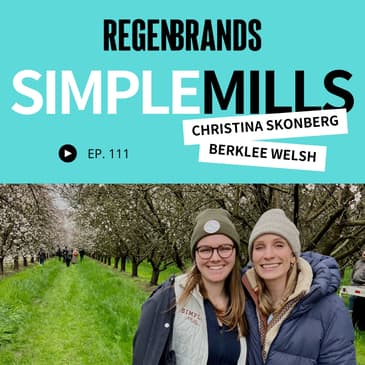
On this episode, we’re joined by Berklee Welsh and Christina Skonberg from Simple Mills — the number one cracker, cookie, and baking mix brand in the natural channel today.
We unpack how Simple Mills is focused on contribution over attribution, working with more than 4,000 farmers on 70,000 acres to build a regenerative supply that doesn’t necessarily translate into product-specific claims.
We talk about product innovation, how underutilized crops like buckwheat and red beans are making their way into cookies and crackers, and why designing for soil health starts with good product design.
You’ll hear how their ingredient-specific regen programs started with a few sunflower growers in the Midwest and have now expanded to almonds, cocoa, and coconut sugar — and how those programs are grounded in listening to farmers, not prescribing to them.
Berklee and Christina unpack how Simple Mills’ regenerative programs drive supply resilience, employee morale, product differentiation, and even ingredient quality — making the case for why Simple Mills invests in this work, even without on-pack claims.
This one is packed with quality insights from two top-notch sustainability pros.
Episode Highlights:
📢 Why regen at Simple Mills is about contribution > attribution
🌾 Agriculture makes up over half of Simple Mills’ carbon footprint
🚜 Farmers need brands to help de-risk regenerative transitions
💰 Paying regen bonuses to sunflower farmers in the Midwest
📦 Their regen programs now span 4 ingredients and 70,000+ acres
🔬 Designing regen into product innovation from day one
📲 Leveraging regen efforts in marketing and what is resonating with consumers
💸 The non-consumer-focused business case for regen investments
🤝 Why scaling regen = more meetings
🎯 How all flourishing is mutual
Links:
Future Farmers of America (FFA)
Regenerative Organic Certified®
National Young Farmers Coalition (NYFC)
Robin Wall Kimmerer - “The Serviceberry”
If you find this content valuable, please consider donating to support our work
Follow ReGen Brands on LinkedIn
Subscribe to the ReGen Brands Weekly newsletter
Episode Recap:
ReGen Brands Recap #111 - Why Contribution Matters More Than Attribution - (RECAP LINK)
Episode Transcript:
Disclaimer: This transcript was generated with AI and is not 100% accurate.
00:13
Anthony Corsaro
Welcome to the ReGen Brands Podcast, the place for brands, retailers, investors and other food system stakeholders to learn about the consumer brands supporting regenerative agriculture and how they're changing the world. I'm your host, AC, thanks for tuning in. Now let's get into today's conversation. On this episode we're joined by Berklee Welsh and Christina Skonberg from Simple Mills, the number one cracker, cookie, and baking mix brand in the Natural Channel. Today we unpack how Simple Mills is focused on contribution over attribution, working with more than 4,000 farmers on 70,000 acres to build regenerative supply that doesn't necessarily translate into product specific claims. We talk about product innovation, how underutilized crops like buckwheat and red beans are making their way into cookies and crackers.
01:08
Anthony Corsaro
And why designing for soil health starts with good R&D. You'll hear how their ingredient specific Regen programs started with a few sunflower growers in the Midwest and have now expanded into almonds, cacao and coconut sugar. And how those programs are grounded in listening to those farmers and not prescribing to them. Berklee and Christina unpack how Simple Mills regenerative programs drive supply resilience, employee morale, product differentiation, and even ingredient quality. Making the case for why Simple Mills invests in this work. Even without those on packed claims, this one is packed with quality insights from two top notch sustainability pros. Lets dive in. What's up everybody? Welcome back to another episode of the ReGen Brands Podcast. Very excited today to have Berklee and Christina from Simple Mills with us. So welcome y'. All.
02:01
Christina Skonberg
Thanks for having us.
02:03
Anthony Corsaro
Absolutely excited to chat with you. I feel like of many of the folks we've had on Simple Mills is definitely a household name or very close to it. But for those that may be not familiar with the brand or those that need a refresher, can you share what kind of products y' all make today and where can people find them? Store wise?
02:23
Christina Skonberg
Yeah, we make a lot of different things. So we're in four categories. We make better for you. Crackers, cookies, snack bars, baking mixes. We've got, let's see, 10 product lines and 44 products. Now we are excitingly, we're the number one cracker, number one cookie, and number one baking mix brand in the Natural Channel.
02:47
Anthony Corsaro
Let's go.
02:48
Berklee Welsh
Yeah, love that.
02:49
Christina Skonberg
And we've got distribution in over 30,000 stores including Walmart, Target, Costco, Amazon. So it's becoming easier and easier to find this.
03:03
Anthony Corsaro
Yeah, yeah, definitely a brand that I think of as a standout of you know, raising kind of the category expectation or bringing different attributes to the category that a lot of consumers didn't have access to. So it's been amazing to be a consumer of the products, but also watch the growth over that period of time. And I need. I need the brief timeline, and I think it's helpful for the audience. Right. So the brand was founded when. And kind of the major milestones of growth. Can you take us. Can you take us through that just at a high level?
03:36
Berklee Welsh
Yeah, definitely. So our Founder and CEO, Katlin Smith, she started Simple Meals back in 2012, really focused on nutrition and personal health. She was a management consultant at the time. So traveling like crazy, eating at restaurants, eating a lot of packaged food on the go, and she just wasn't feeling well overall. And it actually wasn't until a friend of hers recommended me. Maybe you should think about what you're eating. That she kind of changed her diet and felt a lot better. And at that time, she actually made a list following this kind of realization of all of the ideas she had for how she could help other people eat this way, kind of experience that same revelation that she did. And luckily for us, why we're here today is one of the things on that list was starting a food company.
04:35
Berklee Welsh
And so she started just making baking mixes in her home kitchen, in her little apartment. She would bake up hundreds and hundreds of muscle muffins, probably thousands actually do demos and more demos to introduce people to simple mills and say more about, you know, what she was passionate about, the changes she had experienced personally. And I think that kind of scrappy attitude is definitely something that we carry forward through. Through today. And so, you know, were founded on this focus on nutrition, the impact of food on our personal health and how we feel. But a really important piece of this timeline is the addition of Planetary Health to that mission. And so back in 2019, Katlin herself actually went to a permaculture design school, and she really just dove. Yeah. Head first.
05:37
Berklee Welsh
I mean, it's not every day that you hear going to permaculture design school.
05:44
Christina Skonberg
You should hear her talk about the nitrogen cycle.
05:47
Berklee Welsh
Yeah, yeah. She's. She's still in touch with all the instructors from that school. And it's been really cool, I think, for them, too, to see, you know, her implementation, everything she took away from that course into our brand and. And as we grow. And so, you know, through that experience, she really learned about the connection that food plays, you know, between human health and the health of our planet. And so Stemming out of that experience, we updated our mission evolved to include these two kind of equal pillars. So that human health element that's been there from the beginning, but also now equal footing, the planetary health piece of this. And so our mission really is focused around, you know, how do we use our position as a brand in this space to bring about positive impact on both of those fronts.
06:44
Berklee Welsh
And you know, in terms of growth, Christine and I both joined in 2021. So we've been here about four years now. And just over that period, our team has grown really tremendously. We're now over 100 folks. And it's really exciting to see too, you know, as the brand grows, the mission and the impact that we're making is growing as well.
07:06
Anthony Corsaro
Yeah. And I commend y' all and Katlin's really vision and foresight for making those things a priority during that period of rapid growth. Because it'd be really easy to say like, hey, we just need to grow and get acquired or whatever the goals may be are really just around growth. But integrating all of that is commendable. And also I'm excited, I think, to talk about some of the potential overlap there probably is in that whole prioritizing of nutrition and prioritizing of planetary health. I definitely think, and I think most of the people that are in this work definitely think that the continued kind of convergence and co prioritization of those two things is like how we're going to make this thing stick long term. There's a lot of different tactical ways to achieve that.
07:51
Anthony Corsaro
But I'm also excited, I think, to dive into what y' all are working on because most of the people we talk to are doing identity preserved ingredients with some sort of on pack regenerative claim. And that's really not the case for y', all. But we need all of the different pathways to get more acreage under regenerative practices and principles and management. So yeah, just excited to. To dive into all of that with y'. All. When you all joined the team, was the sustainability function and your roles like really regen specific, like how has that, I guess developed as y' all have been there the last four years?
08:30
Christina Skonberg
Yeah. So I would say just as Katlin was getting really excited about this idea of regenerative ag and the role that so food companies can play in just impacting planetary health and that big kind of revelation that Berklee talked about, were coming in and learning about the outsized impact that agriculture has in our simple mills supply chain. So that is typically the case right for most food companies, where the impact is really skewed toward the farm level. So we know at simple Mills that our ingredients account for more than half of our greenhouse gas emissions. So prioritizing agriculture as this really critical opportunity for positive impact made a ton of sense. Right.
09:16
Christina Skonberg
And I would also say that over the years we've spent a lot of time talking to farmers, listening to farmers, and we've learned a few really important things that have shaped our approach to regenerative ag that we've built. Berklee and I and our third team member, Leah Wolf have built over the last several years. But I would also just say backing up a little bit because I know there are a lot of kind of definitions, interpretations of regenerative ag. The way that we think about it is really a holistic and principles based approach to farming and ranching that builds ecosystem resilience. So some of the things that we've learned, right, we've learned that simply asking or telling farmers to adopt certain practices often misses the mark.
10:07
Christina Skonberg
If you know farmers, I'm not going to generalize, but a lot of them don't like being told what to do.
10:13
Berklee Welsh
But you know, most of the farmers.
10:15
Christina Skonberg
We talk to are really interested in using regenerative principles. So things like, you know, diversifying their rotations or keeping a living root in the ground year round, they're bought into those concepts, but the context that they're operating in is not always conducive and it requires them to take really big risks that we feel at Simple Mills should really better shared across the supply chain. So if you think about things like corn and soy, right, like crop protection for those crops is really good. But for lesser used ingredients that we use like sunflowers and buckwheat, in the case of something like a weather event like that, protection is really limited or non existent in most growing regions. So growing something outside of the traditional, you know, US ag wheelhouse, a lot of the things we buy is a really big risk for these growers.
11:12
Christina Skonberg
And then market demand often isn't there, right. To support these diverse crop rotations. So if farmers are told to just maximize diversity, right, One of the principles of regenerative ag, but brands won't buy the buckwheat that you know, is making the phosphorus available in the soil. Or were just talking to a farmer that loves rye the other day and he likes it because the root system is breaking up compacted soil. But if there are no brands buying rye, then you know, what support does a farmer really have to add variety to their rotations. So all to say that we've taken a really deep look at the role we should be playing at Simple Mills to join farmers in their journeys to implement regenerative ag. And what we've come to is this idea that we should really be helping de risk their transitions to regenerative.
12:03
Christina Skonberg
So not just handing them, you know, a prescriptive list of practices that will advance our Simple Mills agenda, but actually meeting them where they want to advanced regenerative ag in their specific context. So just in terms of kind of the trajectory of that work, we started the regenerative ag work in 2020, actually, before Berklee and I showed up.
12:26
Christina Skonberg
So this is.
12:26
Christina Skonberg
This came from Katlin Spark with kind of a pilot scale direct trade program with just a handful of sunflower growers in the Midwest to whom we pay kind of a regenerative ag bonus to help them implement regenerative principles. We still have that program today, but five years later, you know, we now have these regenerag programs across four of our top ingredients. So almonds, coconut sugar, sunflower, and cocoa. And the programs have now reached more than. Keep me on this, Berklee, but 4,000 farmers, and they operate more than 70,000 acres. And just for that, you know, acres doesn't mean a whole lot to some people. So just for some context, on scale, that is about double the number of acres that it requires that's required to grow all of our Simple Mills ingredients.
13:24
Christina Skonberg
So said another way, it's nearly double our ingredient footprint at Simple Mills. So we're so excited about how that work has grown over. Over, you know, just a few years. But I'll say it's really dynamic. It changes often. Our farmer partners do not hold back, sharing very honest feedback about these programs, which is great. Right. So we take a really fresh look at the programs every year just to make sure that they're still, you know, serving the people in the places that we're really hoping to elevate.
13:56
Anthony Corsaro
Yeah, I mean, I can't even imagine the complexity you have to manage with the number of SKUs and the number of ingredients, even just those four ingredients you listed alone. The geographic diversity and probably the farmer continuum of decision making for. For all those commodities and ingredients is probably vastly different. So, yeah, big kudos to y' all for being able to manage that. Before we dive super deep into the regen ag strategy, I would love for y' all to just give quick, personal backgrounds and also maybe like, day in the life or focus area, because we want to do more episodes like this with sustainability professionals and I think it's actually a really important role.
14:38
Anthony Corsaro
It obviously is a very important role to get this work done, but it's less like a founder where you can kind of imagine exactly what the person might be doing on a day to day basis or there's less media out there about what this person might be doing on a day to day basis. So we'd love to have y' all just dive into that because I think it's just good learning for all of us.
14:58
Christina Skonberg
Yeah.
14:58
Christina Skonberg
Brie, you want to start?
15:00
Berklee Welsh
Sure. So I am a sustainability manager here at Simple Mills. Have been here for just about four years. Like I mentioned, kind of how I got into sustainability and regen ag. Like many people in the field, I think I'm a huge nature lover. I'm personally a big ocean person. I actually work as a scuba dive master in my free time outside of my simp mills world.
15:29
Anthony Corsaro
Yeah.
15:31
Berklee Welsh
So I like to say I am a fan of both soil and water across the continuum. And in college I was really lucky to kind of find this field of corporate sustainability and specifically within food. I grew up in Northern California in wine and dairy country. And so I was actually in FFA Future Farmers of America as a kid. Learned a lot about agriculture and saw firsthand.
16:01
Anthony Corsaro
There you go.
16:02
Berklee Welsh
Yeah. The impact, you know, that it has on the community and my family, my friends, families, all of the people around me. And that's kind of how I, I came to food and regen ag work specifically. And so my role is kind of focused around three major themes. The first is product innovation. So, so working really closely with our procurement team, our innovation team, R and D around that new product development process. The second is climate. So thinking about our GHG emissions, greenhouse gases, our annual inventory, thinking about what are our abatement strategy is going to look like. And then lastly, regional regenerative ag projects and in some of those top ingredients, so almonds, coconut sugar, and then working closely with our procurement team on the direct trade program that Christina mentioned.
17:00
Anthony Corsaro
Amazing. Thank you. How about you, Christina?
17:06
Christina Skonberg
Yeah, I always am like trying to look back and think how the heck did I get here? Because if you had asked me 15 years ago if I'd be working in business, I would have said no. But my foray into this kind of space of corporate sustainability kind of started as an interest in botany. So I, I studied ag science and undergrad grad school and I thought I might have a career hovered over a microscope doing research, which, who knows, maybe that will be my second or third career. But I'VE now been, you know, I guess I realized at some point that working for. For food companies was a really interesting way to influence what's happening in our agricultural system.
17:52
Christina Skonberg
So I've now been working for food companies in sustainability for 15 or so years for some really small companies like mom and Pop Jam companies, for some really big companies like General Mills, Ferrero, Starbucks, and when I was at General Mills, leading sustainability for two of their organic brands, Annie's and Cascadian Farm. That's where I met Berklee. So she was doing her summer internship at Annie's and that was just kismet. And I feel so deeply lucky to work with her on our team today. But yeah, I have the total privilege of leading our small but mighty sustainability and mission team at Simple Mills. I should mention that our third amazing pea in our, what we call our susty pod of three, Leo Wolf. That's what we're known as @simplewell.
18:52
Christina Skonberg
She's obviously not here with us, but her work that she leads is very much represented in this conversation. But yeah, I mean, our team is essentially responsible for. For, I like to say we're kind of architecting the way that we can maximize positive impact on both human and planetary health. So we lead all of our regenerative ag programs with farmers in close partnership, as Berklee said, with procurement. We work very closely with the innovation team to design all of our products with people and planet in mind. We spend a lot of time with our friends in marketing and legal working on, you know, some really good debates.
19:36
Anthony Corsaro
In those conversations, always the fun sustainability.
19:38
Christina Skonberg
Regulatory decisions, the trifecta, we call it legal, marketing, sustainability. Always a good time. Yeah, yeah, we work with those folks on just trying to make sure that our comms are really substantiated, credible, hopefully digestible. That's where marketing helps us. So yeah, wear a lot of hats. We are often squeaky wheels and we have the really, I'd say fun jobs of just making sure that our mission is at the heart of every decision that we make across the business.
20:13
Anthony Corsaro
Love it. I love the botany, scuba permaculture inroads to CPG sustainability and regen ag programming. That's great. And that was, I think, a really good segue into just us trying to unpack Yalls overall strategy and we're going to kind of talk about it at a high level and then hopefully talk about it in some detail. Yalls website does an amazing job, I think of breaking it down really well and really in a digestible fashion. So the marketing regulatory sustainability combo did a Good job with that. And we will link that in the show notes for people that also want to check it out. But just to get us started, can you give us the high level of what is the regenerative agriculture strategy and then we can maybe dive in from there?
20:57
Christina Skonberg
Yeah. Okay, so I'm going to take us back to 2023, which was only two years ago, but seems like months ago. So we put together what we call a mission strategic plan in 2023 just to get really clear on all the impact that we wanted to have on both human and planetary health over like a three to five year period. So all the activities that would lead to that impact, all the metrics of success that we wanted to track. And we landed on kind of three core pillars of our mission. So the first is all about changing how food is made. So Berklee mentioned this, that we make all of our products with the goal of using a wide variety of nutrient dense and underrepresented ingredients that encourage both biodiversity in farm systems and dietary diversity for consumers.
21:57
Christina Skonberg
So that's where you'll see things in our portfolio like buckwheat, butternut squash, red beans, et cetera. The second bucket is all about changing how food is grown. So you know, again, we know that ingredients are really where the bulk of our impact is coming from. So this is, this bucket is really about how we show up to share risk with farmers in their journeys to implement regenerative ag. And you know, our goal is really to help build a regenerative supply of ingredients in our key sourcing regions, whether or not those ingredients are making it directly into our products. Several of our regenerag programs are enrolling farmers who grow for simple mills and inevitably grow for other brands too. We do have some identity preserved supply chains, but we're really happy to have this kind of place based investment model.
22:57
Christina Skonberg
If it helps exposure expand the adoption of regenerative principles on additional acres, we're happy that's our goal.
23:04
Anthony Corsaro
Yeah, yeah.
23:05
Christina Skonberg
And then the third bucket is all about igniting positive impact beyond simple mills. So, you know, we know very well that a single company can only go so far right. In transforming our food system. So we're always looking to ways that we can kind of spark impact beyond our four walls. So that's, you know, through collaborations with other brands, policy advocacy and philanthropy. So those are kind of our three, the three buckets that make up our mission strategic plan.
23:38
Anthony Corsaro
Yeah, just a couple things for y' all to work on, you know, just a little bit of scope there. How food is made, how food is grown, how y' all engage with the world. Love those. I think that's super easy to understand and makes a lot of sense. So let's maybe dive in order how food is made. We've talked about product innovation a little bit already on the show, and that's clearly like an essential piece here. Cause if you don't design with that end in mind from the very beginning, when you're thinking about what you're actually going to make, it's probably not going to work out super well. And I love the dietary diversity kind of equals biodiversity line because there's that. That pattern I talked about earlier of the human and planetary health kind of co benefit intersection.
24:26
Anthony Corsaro
But for that how food is made, like, how do you actually integrate regen into those product development conversations and workflows?
24:36
Berklee Welsh
Yeah, so I can hit on this a little bit. Just like you said, we're really trying to think about this from the very beginning of a product inception rather than going back, you know, after it's been created. And so, you know, we know that brands like Simple Mills, other brands, hold this really huge power in what's on the shelf. And as a result, what consumers are eating and also what farmers are growing, that's going into those products. And so when were thinking about how we want to kind of institutionalize the this goal within our innovation process, we worked with a bunch of folks cross functionally to figure out, you know, how do we make this part of our usual innovation process just built in, automatic.
25:31
Berklee Welsh
And so we're thinking about this intersection, of course, of the nutritional side, but also the sustainability side at the beginning of each of those new products. So, so institutionalizing the design process is really important. So thinking about how do we create a framework that helps our team just automatically do this as part of the development of any new product. And so we built out a couple different kind of pathways are what we call them, towards implementing this into product design. Some kind of tactical examples of what this looks like. So one could be developing products with underrepresented crops like buckwheat. It's a favorite of our team. You can find this in our sandwich cookies. So the goal here to create that market diversity, you know, market demand for these crops that farmers want to grow, and also dietary diversity.
26:29
Berklee Welsh
So, you know, a consumer eating a cookie can also get a little bit of buckwheat in their day, which is really awesome.
26:35
Anthony Corsaro
Yeah.
26:36
Berklee Welsh
Another favorite of mine personally is the combo of butternut squash and red beans in our Popham's crackers. So they're not only delicious. If you haven't tried them, check them out. But we also love things like beans because they are nitrogen fixing. They bring a lot of really unique benefits at the farm level, but they also have nutritional benefits. So high fiber. And these are great examples of ingredients that we're really on the hunt for. How do we combine those kind of human health benefits that an ingredient can bring with the environmental benefits as well?
27:14
Anthony Corsaro
I feel like buckwheat has the best PR team of all. The alternative, like, row crops. Like, buckwheat is just so hot right now, but for very good reason.
27:24
Christina Skonberg
Make buckwheat lobby, man.
27:26
Berklee Welsh
Yeah.
27:29
Anthony Corsaro
I wish that was the case. Cause they're probably. We wouldn't have to be talking about it on podcasts like this, right?
27:34
Berklee Welsh
Yeah, but it.
27:37
Anthony Corsaro
It is such a wonderful crop, it seems, and a lot of the farmers in the growing regions that y' all are talking about, where some of the other things come from that need to boost that diversity or want to boost that diversity, creating a market for that crop just seems like such a. Such a catalytic, you know, task. And, you know, can you speak more about that specifically, like, some of the work that you all have done around. Around Buckwheat?
28:03
Berklee Welsh
Yeah, totally. And I think buckwheat is a really great example of the way that we work with farmers, not only around growing our ingredients, but also as a source of product innovation for our team. So through that direct trade program that we mentioned earlier, I'm sure we'll talk more about it in a bit. We talk a lot with farmers. We're on a text basis. Call them, hear from them, how things are going.
28:30
Anthony Corsaro
Love that.
28:31
Berklee Welsh
And, yeah, it's brought a lot of benefits beyond the supply chain. And one example of that is innovation. And so from these growers, we work with them to source organic sunflower seed. We heard over and over again that buckwheat is a really interesting crop. They want to grow it, but there's just not a market, especially in the US for buckwheat, you know, and this is a few years ago, and there's still a lot of huge opportunity for buckwheat, even now that we have the. The buckwheat lobby, to keep growing the demand for this crop in the market. And so, you know, we took that feedback from the growers that we work with, took that back to our R D team, and thought, okay, farmers want to market for this ingredient. They want to be able to grow it.
29:19
Berklee Welsh
It works really well in the Rotation with the crops that we're already buying. How can we make a product with this ingredient? And, you know, this. I think it's another great opportunity to just highlight the, you know, perseverance and time it takes to implement this kind of work into product development. You know, these I examples of like ideation and conversations happen, you know, years before we see these kind of crops come to market. So it's really important that we're always looking for these new kind of crops, getting inspired around how we might be able to use them in new and interesting ways. And so we, like I mentioned, were able to commercialize buckwheat in our portfolio in 2021. You can find that in our sandwich cookies. They're delicious.
30:12
Berklee Welsh
And it's just a great example of, you know, learning from growers what they're interested in, what they want to grow all the way towards, how can we use it in our products? And on top of that, in a delicious way that consumers love to eat.
30:30
Anthony Corsaro
And is it like, is there a specific chronological order it needs to happen, where it's like, identify the crop, identify the nutrition profile and identify like the product function, or is it kind of not really chronological and it's almost like a triangulation that has to happen all at the same time?
30:48
Berklee Welsh
Yeah, I would say it's totally happening all at the same time. You know, maybe we wish it could be super organized and like one step after the other, but unfortunately it hasn't happened that way in practice. But, you know, I think that's a great example of the challenge of this kind of work is this is definitely not the easy route. Like product innovation is hard enough as it is. I think any brand can attest to that, let alone adding in the additional complexity of super nascent supply chains of really unique taste and texture profiles, and a lot more, you know, getting so involved in these crops, especially when it's at such an early stage that, you know, we're just exploring them. We don't know if we're even going to use them or trying to learn about a huge swath of ingredients.
31:42
Berklee Welsh
You know, it takes a lot of time, it takes a lot of effort from our team, but this is the hard path that we've chosen to, you know, make that change that we want to see in the landscape of our farms and our diets.
32:00
Anthony Corsaro
Yeah, and I, I feel like we can't highlight, double stamp, bold face capitalize the importance of nailing that product format enough with this stuff, because that's a huge reason why I think A lot of these healthy or underutilized crops, like never make it is because we put them into products that just don't satisfy the base level of consumer desire or demand as to format, function and taste. And so my assumption would be that's why it takes so long to bring stuff to market is because you just have to iterate and iterate for a really long time to get, you know, those crackers that the buckwheat are in to where the consumer's like, yes, like this. This meets my expectation of what I believe a Simple Mills product should deliver. To me as a consumer.
32:45
Christina Skonberg
Eating these crackers, you hit the nail on the head. AC I think one thing we're really proud of at Simple Mills is that we hold taste and quality to conventional standards. So these products have to be totally, amazingly delicious for us to feel proud to put them out in the world.
33:07
Anthony Corsaro
Talked about how food is made. I think that was a lot. That was really helpful. Let's talk about how food is grown. And I think y' all mentioned the ingredient specific programs you have going on and that's probably a good place for us to start with those four. So. So break that down for us, if you don't mind.
33:23
Berklee Welsh
Yeah. So like we mentioned earlier, Simple Mills ingredient portfolio is pretty vast. We have a lot of different ingredients. So ye, it can be really hard to prioritize and figure out where we're going to, you know, pinpoint our time and our effort and our resources. And so in deciding, you know, where we want to do that, over the past few years, we've thought about a couple different factors. So one, of course volume, you know, almonds for example, huge crop for Simple Mills, something that we're really well known for. But we're also thinking about things beyond volume. So our cocoa program is a great example of that. Cocoa is not necessarily a huge volume ingredient for Simple Mills, but we know that cocoa has really outsized impact because of all of the areas for opportunity issues in the supply chain.
34:16
Anthony Corsaro
Right.
34:16
Berklee Welsh
So we're thinking about kind of a mix of different factors in determining where we want to set up these programs, where it makes sense for us to focus. And a new lens for that too recently is thinking about emissions. So we're always trying to add more data to that process of figuring out where to focus. One challenging aspect of this that I'll mention for a company like Simple Mills is that most of our major crops to the rest of the world are considered specialty. They're not considered major. And so because of that there's not always super extensive information out there about the supply chain of these crops and especially the sustainability state or, you know, opportunities there, you know, for some of these ingredients. The supply chain has just been created. So there's a huge gap in that data.
35:09
Berklee Welsh
But one kind of silver lining of that is that oftentimes for us to learn and get really steeped in that, we are diving really deep into the supply chain ourselves, learning more directly from our suppliers, our farmer partners around where are the areas for opportunity there? And this is also really helping ensure that these programs are not only impactful, but they're very grounded in the realities of what these farmers are experiencing, what they're working on. And so I think that's a really important piece of our kind of regenerative projects is that they're very focused around context. So we are always looking to farmers first to figure out the ideal structure, you know, the things that we want to focus on in this programming. So, for example, tactically, we know that water is a really critical issue in almonds in California.
36:04
Berklee Welsh
And so our work in almonds is really focusing, you know, working with other supply chain partners, like scientists, other brands, growers, trying to learn more about soil health practices. How do these practices implemented in the context of almond orchards in California? How can these practices, you know, bring about benefits for soil health and biodiversity, but also, you know, farmer profitability, how does that affect water? These really critical kind of contextual elements that need to be centered in a program in almonds. But, you know, then when we look at something like coconut sugar indonesia, there's a totally separate, you know, set of priorities and things that are important there. So, you know, there farmers are dealing with aging stocks of their palms and a really kind of hyper focused source of income. A vast majority of their income is coming from this one crop.
37:06
Berklee Welsh
So there we're really focused on agroforestry, helping our partners implement, you know, more diverse crops in their system. So that's creating ecosystem benefits, of course, but also diversifying their income, you know, making harvest safer, more accessible to bigger range of the community. And so that is one of the principles of Regent Ag, but also just a broader kind of theme that we think about in developing these programs is context and, you know, celebrating that they're going to look totally different in different areas of the world in different cropping systems.
37:44
Anthony Corsaro
Yeah, I love how we just added an additional layer to the dietary diversity, biodiversity, farmer diversity. And so, like, now we're getting like a triple win, right in some of these Systems. So I love that Christina, looked like you were about to share something before I started chat.
38:01
Christina Skonberg
I'm just in agreement.
38:03
Anthony Corsaro
Yeah.
38:05
Christina Skonberg
How.
38:05
Anthony Corsaro
How did it evolve from the original direct trade Sunflower program to the four that y' all have today?
38:12
Berklee Welsh
Yeah, so Direct Trade was our first program, and we launched that in 2020. From there, honestly, we just started having a lot of conversations with our supplier partners, farmers in our supply chain, to, you know, learn more about where we should be focusing this work. Like I mentioned before. And so in addition to thinking about our volume, and we also are thinking about, you know, where do we have those relationships in place and that trust that has been built over time to start building programs like this. So another example of that is our work in almonds. We started that with a project called the Almond Project, and that was launched in 2021, I believe. And, you know, that's when the project was launched.
39:00
Berklee Welsh
But the relationships and the trust that was built there happened years and years before that did in order to kind of grow these projects. So just like the ingredient pipeline we talked about, this kind of work also takes a lot of time and, you know, trust building in advance before we can actually get to the implementation.
39:25
Anthony Corsaro
And I think the last time we talked, there was. There was two things. One, funny one, serious, you mentioned some of these crops don't necessarily have the sort of data that others do. And I think the day that we chatted Berklee, you were like neck deep in doing GHD accounting. That would be nice to have some of that data that you didn't have.
39:44
Berklee Welsh
Totally.
39:46
Anthony Corsaro
And, you know, I just say that because it's funny one and two, like, we need to invest in building those pools of data to make some of these things easier for folks like y'.
39:55
Berklee Welsh
All.
39:56
Anthony Corsaro
And two, I think you mentioned there was some real learnings from the direct trade experience about, like, I have it in my notes, like multi year commitments, multi crop contracts. Can you talk. Talk to us about those things?
40:08
Berklee Welsh
Yeah, definitely. So just a little background about direct trade. So, like we said, it was kind of our first major program. So now in 2025, we're in our sixth year of that program, which is super exciting. Yeah, really cool to see the impact just, you know, from the beginning to now. Here we are today, we have worked with 15 farmers, more than 3,500 acres on these contracts. We're now at four states. So we started just in one state in Minnesota, but we're now, we have growers across four states. And the goal of that program really is to just forge These direct relationships, sourcing relationships with growers in our supply chain, we're thinking about, like Christina mentioned, how do we share the risk of growers implementing regenerative principles?
40:59
Berklee Welsh
And so what that looks like for us is not only creating that market for their crop and those relationships, but also covering the cost of planting seeds. So signaling that upfront commitment. In a system where oftentimes growers have to plant before they have any kind of market or confirmed, you know, buyer for their material. We're also providing that regenerative bonus payment to help offset some of those costs that the farmers are incurring. Again, you know, an important thing to note here about context is that the specific practices that any given farmer is using those funds for look really different. So, you know, in any year we have some growers who are using that for livestock fencing to integrate animals onto their land. We have others using it for machinery that can help, you know, decrease tillage. We have cover crop seed.
41:53
Berklee Welsh
There's a huge range of what those funds are used for. But that's really exciting to us. We want to give farmers the opportunity to innovate and, you know, try these things in practice in the way that makes sense for them in their context. And I think also through these conversations with growers over the years now, we've learned that a lot of these growers, they are already bought into the merits of regenerative and trying this system on their land. What they really need from brands and other partners in the supply chain is co investment in the upfront, you know, cost of putting these practices into place. They need a market for their crop and they love to have visibility to just where it's going. Right. It's not just a thing that gets dropped off at the elevator and that's the end of their work.
42:49
Berklee Welsh
But, you know, they have visibility all the way through the brand that it's going to the product that is on shelf. You know, they, we hear a lot that they love to go to the store, pick up, you know, our cracker product and say, this is, you know, where my food goes. That's really special to see that all the way through. And, you know, there's a reason why these kind of programs are not common in our industry. They're really hard in the, you know, traditional commodity system, the buyer buys the ingredient and that's the extent of their involvement in the supply chain.
43:26
Berklee Welsh
On the other hand, here our team is very deeply involved in the supply chain, you know, navigating issues with the seed storage, with crop failures and weather events and all of these things that come along with agriculture honestly, but our relationships that we've gained through this program from conversations with the growers, it's been really instrumental in shaping our strategy, how we center our work around farmers and their insights. And, you know, I think those relationships are really special, because at the end of the day, all of these different supply partners, we can learn from each other across the value chain. And this program brings us a lot closer together.
44:16
Anthony Corsaro
Yeah, I, I want to just pull out a, a few things that I heard along the way that I, I want to highlight. Which one, not just ensuring the market, which we talk about a lot on this show, but also the regenerative bonus payments, and it sounds like those are happening upfront to actually like do that de risking that Christina talked about earlier. I think a lot of times that's the second step that a lot of folks don't get to either from an understanding or an execution standpoint. And I also love the idea of, yeah, we are really trying hard to get those, get that actual supply into our ingredients, into our products. That's not always possible. But we're also trying to do the de risking of the practice adoption for the farmer so they can just incorporate it overall.
45:01
Anthony Corsaro
And if the product doesn't go into our supply, it's still, you know, it's still good for them, good for the world, good for the nutrition of the crop that they're growing. And that's a challenge. So I commend y' all for kind of being flexible and open minded in that approach. So I think it'd be a lot easier to be like a little bit micromanaging of that and having to make sure that supply comes to you and make sure you can get that credit. But ultimately, you know, if the practices are really good for that farmer, we want them to adopt them on their entire acreage, not have to segregate acreage or do some of these things. So just love those highlights.
45:41
Anthony Corsaro
Anything else on how food is grown that feels like a good amount to me, but anything else you all want to add before we go to the next one? Okay. Cover said how we engage with the world. So I think y' all articulated that as kind of like what's beyond simple mills or how can we have an impact beyond just our internal operations? How do y' all think about, like your responsibility and influence beyond the supply chain?
46:10
Christina Skonberg
I really like AC how you've rebranded that pillar for us, how we engage with the world. That's a good Articulation. I think we need to consider that. Berklee. This is why we work with marketers. We need their help. Yeah, I mean, I would say we at simple mills feel a huge responsibility to work beyond the confines of simple mills. So this is really where we think about this concept of contribution over attribution. So that's a really handy.
46:42
Anthony Corsaro
I like that. I gotta pause you there. I like that. Contribution over attribution. That was a. That was a cooler, simple way of saying what I was trying to say.
46:52
Christina Skonberg
I can't take credit for it. So it's actually a really handy framework from the social impact sphere that was introduced to us by our friend and consultant, Mariko Thorbeck. But we love it, we use it all the time. And you know, the idea is that we care a lot more about kind of collaboratively moving the needle than we care about getting sole credit for the impact. I really love how Robin Wall Kimmerer, the author, she talks about that concept in her book the Service Fairy, which is a great book if you haven't read it. Really short, quick read. But the way she puts it is that I think she says all flourishing is mutual. So said another way, a rising tide lifts all boats.
47:39
Christina Skonberg
There are a lot of ways to say this, but the idea is that the work is much bigger than simple Mills and driving systemic change is really critical for mutual flourishing across the food system. So one of the ways that this work comes to life for us is through our policy advocacy. So we are. Oh gosh, we are so proud to partner with our friends at the National Young Farmers Coalition. We partner with them to sponsor young and racially diverse farmers and their work to advocate for basically more equitable and more climate resilient ag policy.
48:20
Anthony Corsaro
Nice.
48:21
Christina Skonberg
If you. I'll just put a plug in for them. Like if you are looking for a food system org to support, I highly recommend checking out nyfc. They are doing such incredible work that I think will really help regenerative ag spread across a lot more acres.
48:39
Anthony Corsaro
Amazing. Yeah, we'll definitely put that in the show Notes. Beyond policy, I want to say there's like pre competitive collaborations like the almond project. Is there any other big buckets of kind of things in that how we engage with the world?
48:55
Christina Skonberg
It includes our philanthropic work. So you know, every year we choose actually we poll employees to select some organizations that we want to support. So that's always a fun kind of way to give folks some agency and where our dollars are going. And you're right that there is kind of some overlap between this bucket and the how food is grown bucket Berklee just talked about in our almond project work, which is highly collaborative, pre competitive, so we. We actually had an internal debate about where that one falls.
49:32
Anthony Corsaro
Yeah.
49:34
Christina Skonberg
But yeah, this one is really about policy, philanthropy, and then, you know, in full transparency, Berklee's been putting in all this incredible work into our kind of climate tracking and putting together a potential climate plan. We are in the early stages of that work, but the way that we're thinking about that work is very much within this bucket of like, how can we consider our unique and impactful contribution to addressing climate change more than we're thinking about what impact can be attributed to simple mills with a single company target. So a lot more to come on that, but really exciting work ahead.
50:19
Anthony Corsaro
Per usual. Sounds like y' all are taking on more responsibility than most or what. What maybe is the status quo. So, you know, commend you for that. I. I want to talk about really. One key question goes back to something I plugged maybe early on in the episode is like, y' all don't have any regenerative products air quotes. Right. You have a lot of regenerative ingredient supply mixed in mass balance into a lot of the products. So if it's not, the value of this work is we're making a claim to a consumer that we think this term is going to mean something and really drive premium pricing or whatever for, like a specific sku. What is the business case?
50:58
Anthony Corsaro
When you all sit down in the sustainability pod and then go interface with the other functions of the business, you're saying regen ag is a worthwhile investment because of what?
51:09
Christina Skonberg
I love that you're calling us the pod. Yeah, I mean, I'll. I'll say a couple of things. So one is that, you know, we make composite products with several ingredients. So pursuing something like, you know, regenerative organic certification, which we love those guys. We applaud the work they're doing and all the brands pursuing it. It would be a lot easier for us to pursue if we had a single ingredient SKU or a SKU with, you know, two ingredients at our scale. It's. It's often really hard or impossible to fulfill our demand with certified materials. So. But, you know, we're always keeping our eye on just supply availability and any opportunities for us to dig into that space. Space.
51:52
Christina Skonberg
But I would say to your kind of question about the why or the business case, like, oh, my gosh, we see so many good reasons and business cases for us to pursue regenerative ag beyond kind of Engaging with the consumer. And part of the way that we see it is that we really can't afford not to invest in regenerative aggressive. So of course there are the well known benefits of regenerag and addressing climate mitigation, climate adaptation, building soil health, biodiversity, farmer prosperity, the list goes on. Right?
52:28
Anthony Corsaro
Yeah.
52:29
Christina Skonberg
But all of these things are critical for continued stable ingredient supply for us. So our business prosperity wholly depends on that. So there's a big supply resilience piece there. Yeah.
52:45
Christina Skonberg
But I would say there are also.
52:48
Christina Skonberg
Some other really fun benefits. So Berklee alluded to just the innovation inspiration piece. Right. So our use of ingredients like watermelon seed, red beans, buckwheat.
53:01
Anthony Corsaro
Yeah.
53:02
Christina Skonberg
That all came out of conversations with regenerative farmers looking for more market demand. And now those are really cool differentiating elements of our products.
53:12
Anthony Corsaro
Right.
53:13
Christina Skonberg
So that innovation piece is something we talk a lot about. I'd also say like we've seen our internal team get really motivated and energized by our work in regenerative ag, which is worth a lot. So our programs in regene ag that Berklee so eloquently walked through, some of the farm visits that we take folks on connected to those programs, they have sparked so much internal learning and just I think a lot of internal pride too. And then there's you know, the visibility that we are getting to the farm level of our supply system and our key growing regions. So that visibility has actually really helped us improve ingredient quality and find places where we can, you know, for example, like reduce contamination. So there's no shortage of benefits.
54:11
Christina Skonberg
And I would just say we'd be really excited if we had like a big unlock around how to very clearly communicate this to a consumer. But we are not going to wait for that opportunity to fall into our laps to advance this work.
54:28
Anthony Corsaro
Yeah. And we're, we, our team, whatever does net positive increase of regenerative acreage is a win whatever path to get there. Like let's just do that. Like all, all is good that ends with that. I'm happy you flagged some of the marketing efforts because I'm curious to kind of ask as y' all interface with them, how do you think about levering, leveraging the sustainability work in the regen ag specific stuff in the marketing efforts? I know there's some romance copy spotlighting on the back of some packaging of certain products. Yalls impact report is really well done and really cool. So how do you think about that one? And then this might be a tougher question.
55:08
Anthony Corsaro
Cause I know Sometimes this can be a little bit of a black box, but like, is the marketing team sharing what is actually resonating with consumers, what customers are saying? Do people make comments on any social media or send emails? Like, is there any idea of one of those efforts really is moving the needle with folks?
55:28
Christina Skonberg
Yeah. Well, I think in full transparency, most of our consumers are not showing up for our regenerative ag commitments. Sadly, we're not.
55:40
Christina Skonberg
Right.
55:40
Christina Skonberg
So our products really lead with messaging about taste in human health.
55:46
Christina Skonberg
Right.
55:46
Christina Skonberg
That's what we call the four me benefits over the kind of four we benefits. But when eaters find out that we're a brand committed to regenerative ag, that's a big bonus for them and we hope that is driving loyalty. But as you said, we actually do a ton of communicating about Regen Ag in other contexts Pack. So you mentioned we put together our annual people in Planet Impact journal shout out to Leah, who leads that. We go into a ton of detail there about our RA programs. Our social team is doing a lot of great work to talk about this piece of our mission on all the channels. We're on a. Our team is on a speaking circuit.
56:34
Christina Skonberg
So I think for us it's about kind of engaging a whole ecosystem of people on this topic of regenerag, not just the consumer who's making a split second decision at the shelf. So if, you know, if we're in conversation with other brands, if we're talking to and learning from NGOs, if we're sharing our blueprint for impact, all of those kind of touch points and conversations, we call that a win.
57:05
Anthony Corsaro
Well, those of us that want to have you on podcasts appreciate that. So thank you for that. I also believe hasn't there been some influencer farm trips thrown in there in the mix too? Which I think that's a really fun strategy that y' all have done as well.
57:17
Berklee Welsh
Totally. Yeah. I think our influencer trips are quite unique. We love that our influencer trips are farm visits. And you know, I think for a lot of people, agriculture is really far removed from their daily life. It's not something they think about day to day. They probably don't know how something goes from soil to the shelves of the grocery store. And I think for that, like seeing is believing. You know, we can tell people all day long. And I'm sure a lot of other folks who've been on the podcast, you guys can resonate with the fact that you can tell people how regenerative fields, they feel different. They look different, they smell different, they sound different. But being on the farm is priceless in terms of that education and that experience.
58:09
Berklee Welsh
And it can be really difficult to articulate that feeling through a lot of technical words, you know, language that is often inaccessible feeling. But influencers taking people out to the field, it really creates these moments. You know, we get feedback from past trips that we've done that these are experiences that they're going to remember forever. They tell their children about it, and I think that's really where a lot of real impact can happen. You know, with these huge audiences, there's such an opportunity to just educate people. Like even just starting with what is regenerative ag, why does it matter how and where our ingredients are grown?
58:49
Berklee Welsh
You know, just reconnecting the consumer with where food comes from is a huge first step in terms of getting us to a place where, you know, consumers care about this and it's something they look for in what they're purchasing. We're really stoked on that, too. We're about to head out in two weeks to one of our growers in Minnesota for another trip. So. So look out on social media, I'm sure, for lots of fun content coming out of that.
59:16
Anthony Corsaro
Yeah, I. I love it, really, for two reasons. One, I feel like a lot of UGC content is very tired and very the same now. It's like, hey, I'm in front of my fridge and here's something I just bought and I'm going to eat it. Watch me eat it. It's like, okay, cool. So it's like a much different take that actually has the potential to stand out, I think, in that. That realm. And also, this is purely anecdotal, but most of the people I've met in this space that are very passionate about regenerative agriculture, it starts with some sort of initial awakening around diet and human health for themselves or a family member. And then the next, like, major tipping point for them in their level of commitment happens. Their first farm visit.
59:58
Anthony Corsaro
Right when they do go engage those senses themselves at a farm, they're like, oh, my God, like, this is. I can't. I can't unsee this. So I love that y' all are focused on kind of giving those influential people that opportunity in person, but also having them relay that to their audience that maybe, you know, we're not going to get all of those people out to farms ever. But it's very powerful.
01:00:18
Christina Skonberg
Ac you hit on something that we actually see with farmers, too, and how they get into regenerative so we hear from so many of our farmer partners that they made the transition in their practices for human health reasons. So they were seeing impacts to their children or their spouses or themselves and really came to this idea that maybe they should rethink the chemicals that are being applied, rethinking tillage. So I think that's a really interesting parallel between consumers and farmers that these groups at both ends of the supply system are motivated by a lot of the same things.
01:00:58
Anthony Corsaro
I want to pivot to something that I'm very personally curious about and it's maybe a challenging question because it can be very broad, but I find it amazing even from the little that we've talked about in this conversation and having talked to you both previously or heard you speak at events, the amount of cross functional communication, the amount of interfacing that sustainability professionals like you have to do in a brand like Simple Mills is breaks my brain kind of just to try and think about it. And I would love for you both to just share your perspective on maybe some of the successes and challenges and best practices there. Because yes, I think there's good direct information for people that are doing that tactically as well.
01:01:39
Anthony Corsaro
Then I think there's probably lessons there that can be applied to this work more broadly that we need to.
01:01:46
Christina Skonberg
Yeah, cross functional work. I, I mean I think the really boring answer is that we have a lot of meetings with our cross functional partners. I know meetings get a lot of shade, but I love meetings, they're really fun. That's my PSA on how great meetings are. But in all serious, complicated, sometimes the.
01:02:13
Anthony Corsaro
Answer is simple, you know.
01:02:19
Christina Skonberg
But yeah, I mean I think a huge piece of this is like Berklee shared. We have really clear institutionalized guardrails for.
01:02:27
Christina Skonberg
How our products are designed.
01:02:30
Christina Skonberg
So necessarily our teams, procurement, marketing, innovation, sustainability, legal, others, we all are in lockstep at the earliest stages of innovation and identifying ingredient sources. And that innovation structure I think is kind of the glue holding us all accountable and holding us together as cross functional partners. But I think too that it helps that we really have the same very clear North Star goals in mind. Right? So we all, our teams, want our mission to be sustainable, tenable into the future as we grow. And for us at Simple Nails, that does sometimes mean going beyond kind of niche identity, preserved products and thinking about like how can we build impactful programs, products while being part of a growing company that very nimbly responds to disruptions like tariffs, wars, countless other supply disruptions that are totally heroic. Procurement team faces all the Time.
01:03:38
Christina Skonberg
So I think something Berklee and I have learned and worked on along the way is that we have to recognize that supply flexibility and supply diversity is going to be really important for our procurement team and vice versa. They recognize that sometimes we're going to have to take the much harder way, less efficient path to sourcing something like a newly commercialized or little known ingredient so we can play our part in adding crop diversity to the food system. So I think there's a lot of like meeting each other in the middle.
01:04:14
Anthony Corsaro
Yeah, love it. Berklee, what do you think?
01:04:18
Berklee Welsh
I would say the same. Honestly. I echo the meeting a lot of time just talking about these things and I think it's really shown for us too. Now that we're several years into this work, the impact that it's had to continuously bring it up over and over again. Like Christina mentioned, these you know, frameworks and processes that were once new things that were trying to build are now the way that our company does business. Which is super exciting to see, you know, things that we designed many years ago turn into just the process. That's how Simple Mills does business. And so I think that's really strong and really motivating too.
01:05:04
Berklee Welsh
As you know, anyone out there is trying to figure out how to institutionalize things like this within a business is just start somewhere that makes sense and keep doing it and it, you know, faster than you think becomes just the process.
01:05:22
Anthony Corsaro
I mean very anti meeting culture in corporate America right now. But like I'm all for meetings, very self serving comment because I'm a verbal processor and I'm the guy with the podcast. But I do think there's a very natural human need to have to verbalize and think through things out loud in conversation. Especially when you are trying to institutionalize almost like a new way of thinking versus just some very set in stone black and white process. And that to me is more what we're talking about here. You guys have obviously move the work to specific processes in many ways I'm sure but it still is. You're trying to constantly iterate, recreate, you know, a way of thinking more than like two plus two equals four every time.
01:06:05
Anthony Corsaro
And we know that and we can use chat, GPT or something to just do the work for us or whatever.
01:06:11
Christina Skonberg
Because you're a fellow meeting lover, I will just share a fun fact that Berklee's and my one ones often expand end to two hours and we have it set up for like 30 minutes and two hours later we're like, oh, we haven't eaten any food today. We, we need to go do other work. So we love a good chat.
01:06:30
Anthony Corsaro
Yes, yes, love that. Well, I'm going to go to our last question, so one of the things we need to do is have more meetings. That's very clear. But other than that, I will ask the final question that we ask everyone and I will say the definition of ReGen Brands is anyone that is doing work that brings a product to market that has impact on increasing return of acreage. So how do we get ReGen Brands to have 50% market share by 2050? How do y' all think we do that?
01:07:05
Christina Skonberg
Take it first.
01:07:06
Berklee Welsh
Yeah.
01:07:07
Anthony Corsaro
Synchronized unview on that was a beautiful thing to witness.
01:07:11
Christina Skonberg
You got it, Berklee.
01:07:13
Berklee Welsh
Like we said, we practice a lot in our one ones, I would say. I mean, there's so many thoughts here. I'm sure we could make a whole podcast episode just about this. But I think one thing that we love to talk about, which is funny that I say that, is talking about it. We have a favorite climate scientist, her name is Catherine Hayhoe, and she has a really impactful talk where she says, you know, the number one thing that we can do about climate change or regen ag XYZ is the one thing that we're not doing, which is to talk about it more. You know, I think especially for people in this space, it can feel like an echo chamber. You know, it feels repetitive. We're saying the same things over and over again, but we should not stop bringing it up.
01:08:02
Berklee Welsh
You should talk about it to anyone who will listen. Because, you know, there, for so many people, you know, there's a human health, there's an element that brings this up for them the first time, but they have to hear about it somewhere. Right?
01:08:15
Christina Skonberg
Right.
01:08:15
Berklee Welsh
And so I think that's also a unique role that anyone can play. Regardless of your job title, your place in the supply chain, whatever you do on a day to day basis, everybody has the power to talk about regen ag, to talk about the impact of our food. And even if it feels like you're saying the same thing over and over again, do it more and more. And I think that's a really powerful lever.
01:08:40
Anthony Corsaro
Yeah, I'm like smiling ear to ear as you say that, because I'm imagining the meme of the Netflix show about Pablo Escobar where he's like sitting in the bench with like his hands in his head. And my version of that is like, no one will talk to me about regen ag or whatever.
01:08:55
Berklee Welsh
You'll be very happy to know that I actually sent out that meme in advance of a farm visit this year. Like me at the party, hoping somebody will talk to me about soil health. So, resonating deeply with that.
01:09:10
Christina Skonberg
I wholeheartedly agree with everything Berklee said. And I also think that we have to look upstream in the supply chain. Right. And, and think about how we can create the conditions for these regenerative ingredients to grow. So brands can't be regenerative, right. Unless farmers have the tools that they need to create a regenerative ingredient supply. I think one of the biggest unlocks there is actually improving land access for young and diverse farmers. So we talked about the National Young Farmers Coalition. They've done some really cool research to show that something like over 80% of young and bipoc farmers are prioritizing regenerative principles as part of the primary purpose of their farm's existence. And at the same time, those farmers are citing access to land as the primary barrier they face to farming.
01:10:08
Christina Skonberg
And at the same time, we're expecting more than, I think it's more than like half of US farmland to change hands in the next two decades, partly because we have this aging farm force. But I think we need to find, you know, better, more equitable ways like policy changes to get land in the hands of these young farmers who are really leading the regenerative movement.
01:10:34
Anthony Corsaro
Love that. Love it. Appreciate the work that y' all are doing. Appreciate y' all being willing to show up and share super transparently about it. And yeah, just keep it up. And thank you so much for joining us. Really appreciate it. For transcripts, show notes and more information on this episode, check out our website, regen-brands that is regen-brands.com youm can also check out our YouTube channel ReGen Brands for all of our episodes with both video and audio. The best way to support our work is to give us a five star rating on your favorite podcast platform and subscribe to future episodes on Apple podcasts, Spotify and YouTube.
01:11:16
Anthony Corsaro
You can also subscribe to our newsletter, the ReGen Brands Weekly and follow our ReGen Brands LinkedIn page to see stay in the know on all the latest news, insights and perspectives from the world of regenerative cpg. Thanks so much for tuning in to the ReGen Brands Podcast. We hope you learned something new in this episode and it empowers you to use your voice, your time, your talent and your dollars to help us build a better and more regenerative food system. Love you guys.