
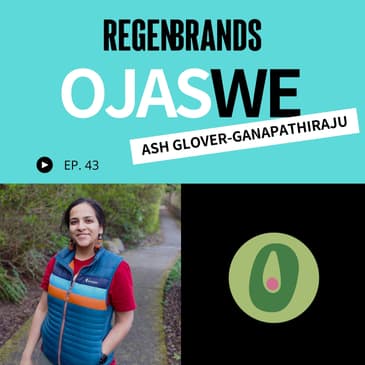
On this episode, we have Ash Glover-Ganapathiraju who is the Founder and CEO at Ojaswe.
Ojaswe is supporting regenerative agriculture with their lineup of pantry staple items like pancake and muffin mix made with regeneratively grown chickpeas.
In this episode, we learn about how Ojaswe’s product mix is truly farmer-first and regeneratively inspired, Ash shares how being a queer, BIPOC, and immigrant founder has shaped her journey, her brand, and her products, plus we dive deep into the most urgent issue facing the immediate and long-term future of regenerative brands.
Episode Highlights:
🥞 Ojaswe’s pantry staples made with regen chickpeas
🤯 Moving from India to Arkansas
☕ Working in big CPG and turning down sustainability roles
👏 Empowering everyday eaters through regen CPG
💯 Why food is emotional and there is no “one right answer”
🔥 How smaller brands are paving the way in regenerative
🎯 Building products based on the needs of farmers
🙏 Ash’s experience as a queer, BIPOC, & immigrant founder
👉 The biggest (certification) problem facing all regen brands
🤠 How brand collaboration and retailer support get regen to scale
Links:
Episode Recap:
ReGen Brands Recap #43 - South Asian-Inspired, Regenerative Chickpea Pancakes - (RECAP LINK)
Episode Transcript:
Disclaimer: This transcript was generated with AI and is not 100% accurate.
Kyle Krull - 00:00:15
Welcome to The ReGen Brands Podcast. This is a place for consumers, operators and investors to learn about the consumer brands, supporting regenerative agriculture and how they're changing the world. This is your host, Kyle, joined by my co-host, AC, who's going to take us into the episode.
Anthony Corsaro - 00:00:34
On this episode, we have Ash Glover-Ganapathiraju, who is the Founder and CEO at Ojaswe. Ojaswe is supporting Regenerative Agriculture with their lineup of pantry staple items like pancake and muffin mix made with regeneratively grown chickpeas. In this episode, we learn about how Ojaswe product mix is truly farmer first and regenerative inspired Ash shares how being a queer, BIPOC, and immigrant founder has shaped her journey, her brand, and her products. Plus, we dive deep into the most urgent issue facing the immediate and long term future of regenerative brands. Damn, that's a good cliffhanger right there. Let's go. What's up everybody? Welcome back to another episode of The ReGen Brands Podcast.
Anthony Corsaro - 00:01:05
Super fired up today to have our friend Ash from Ojaswe with us. So welcome, Ash.
Ash Glover-Ganapathiraju - 00:01:29
Thanks AC. I'm so excited to be here with you and Kyle huge fan of the podcast and I'm very, very glad to be talking and regen brands with you.
Kyle Krull - 00:01:37
We love talking to regen brands, which shouldn't surprise anybody because we literally have a podcast called regen brands. Um So, you know, we're super stoked to have you here. Um I'm gonna go ahead and call it out, you know, last we, we tried doing this episode yesterday and because we had some technical difficulties, um we're now this is Take two and this is the first time we've ever had a take two officially like this. So it could mean we're gonna have like the best most buttoned up interview ever or we're gonna be like way off track, trying not to make the same jokes we made yesterday. So I already know that's gonna happen. So we'll just have to see how this plays out. Um But, you know, as we are super stoked to have you on what, what, which feels like the second time um to talk about and your story and the efforts you're making in the regenerative space and the challenges of being a super new Regen startup, you come from a place of a lot of different expertise and a lot of experience in CPG. But this is your first time as a brand, your own brand pushing this thing forward. So we're excited to have that conversation. Um So for those who are unfamiliar with Ojaswe, give us a quick lay of the land. What sort of products are you making?
Kyle Krull - 00:02:31
What flavors do you have? Where can people find your products today?
Ash Glover-Ganapathiraju - 00:02:47
Yeah, I'll start with the easiest you can find all of our products on www.Ojaswe.com. That's ojaswe.com. What we make at Ojaswe is, um, Indian inspired or South Asian inspired regenerative pantry items. Our first line is a line of savory pancake mixes, um, with cookies and South Asian spices in them.
Kyle Krull - 00:03:13
I love that. We were just talking about lunch before we hit record and now I'm wishing we would have had this for lunch. Um It feels like it would be a fantastic lunch right here, some savory pancake in the afternoon. Um Now I think you also have one additional product line outside of the pancakes. Is that correct? Yeah,
Ash Glover-Ganapathiraju - 00:03:32
that's right. We just launched a, it's on preorder right now, but it's a masala muffin mix. So it's a muffin mix with, with a South Asian twist, which is kind of our steak. Um It's very much, it's also chickpea flour based and we make our own flour and it's about South Asian spices and you can do whatever you want with it. It's vegan and gluten free. And our goal with that is to make it as inclusive as possible to the largest number of um folks as possible.
Kyle Krull - 00:03:58
Love that. I've never had a savory muffin before and I'm excited to try my first one as a huge chicken chika masala fan, uh and muffin fan. This sounds like a win-win partnership for me.
Ash Glover-Ganapathiraju - 00:04:09
Yes. Uh So muffins are confusing to me because they just feel like mini cupcakes. Um, it just feels like an excuse to eat more cupcakes, which yes, everyone should eat more cupcakes. Masala muffins are just a, a baking version of our pancake mix. Honestly,
Kyle Krull - 00:04:26
I actually had a heated debate about the difference between muffins and cupcakes at a party once. Um, and really it's hard to define, you know, one has more of like a, they're because they're, they're both sweet. They're the same shape like. Is it the heartiness? Is it the fact that it's supposed to be breakfast and not dessert? You don't put a candle in one. I don't know what the difference is. You don't
Ash Glover-Ganapathiraju - 00:04:45
put icing on one and just call it a few. I don't know. I don't know.
Anthony Corsaro - 00:04:51
Ash are the, are the products just add water or do you have to add other ingredients to the mix?
Ash Glover-Ganapathiraju - 00:04:56
Uh, they are just add water that you would like and the most traditional way of eating a, so a chila is a pretty, there are other cultures in the world that have some version of it. A chila is typically made with, um, chickpea flour, really fine chickpea flour and you would add vegetables to it just to make it more hearty. Um, the most traditional, the way that I've grown up with it is to add tomatoes and cilantro to it. But I live in North America now I've lived here. This is home. Um, and tomatoes are not all around season. They don't taste really good in the winter, for instance.
Ash Glover-Ganapathiraju - 00:05:19
Um, I've done canned tomatoes or I've done things like zucchini, um, bitter, bitter greens, rule things like that in the mix do. And it totally works. They're just add water. You see.
Anthony Corsaro - 00:05:39
Yeah. Well, having, having the pleasure of knowing you outside of this podcast interview that the product line is really interesting to me because it's kind of the perfect culmination of your personal story or like it's just very evident, right? How these things came to be once you know that background. So um give the audience the feel for just your story and how you kind of went from your previous background to NBA to CPG to founding your own brand.
Ash Glover-Ganapathiraju - 00:06:05
Yeah, I'll keep this as short as possible, but I'm a cultural anthropologist by training. Um I did not think I would ever have my own company, let alone my own CPG brand. I was born and raised in the south of India and spent, I've spent most of my adult life um in the US, mostly in Arkansas, a short stint in Indiana and I now live in Seattle. So I went
Kyle Krull - 00:06:37
no experience in the United States from India. What time did you leave India? What time in your life? Uh
Ash Glover-Ganapathiraju - 00:06:44
very early twenties?
Kyle Krull - 00:06:46
OK. The early twenties and the first US experience you have is Arkansas. Arkansas. Tell us about some of that culture
Ash Glover-Ganapathiraju - 00:06:53
shock. Oh, gosh, that was a long time ago now. Um I am. Well, I just turned 40. Um, so it's, yeah, I've spent exactly half my life, I think here, almost, almost half my life here and almost half my life elsewhere. Definitely gonna run. Thank you. Um I am, I think for me moving to bed was a little bit of a culture shock. Um Because at the time I thought I was going to be visiting for a couple of months. I have family there at the time. And the only thing I could find about, find about Ben online was on a myspace page and it was, you know, a picture picture of the Town Square. This is definitely date gonna date me. But um
Kyle Krull - 00:07:37
I had to make the same joke I made yesterday because I still need to know who was on Bentonville top eight myspace page. Uh still back 10 years ago. I, I, we need to know somebody's got to dig that up.
Ash Glover-Ganapathiraju - 00:07:51
Yes. And someone does dig it up. I'd love to hear what
Anthony Corsaro - 00:07:55
I need to know what the profile song was. And if it was party like a rock star, like my last myspace song was in like seventh eight.
Ash Glover-Ganapathiraju - 00:08:03
Oh my God. I have no idea. That's probably for the best. Uh I think for me though, the big, the big culture shock was not so much moving from a city of 13 million people to a city that had, I don't know, population 4000, 40,000, 15,000. I don't even remember anymore. Um It was food, right? It was, I was coming from one food culture to a completely different food culture. And what ended up happening is I think a little bit of what you see with those three products too. I started to be and this is not an uncommon immigrant story, right? You take the ingredients around you and you sort of make them make the recipes you're familiar with using the ingredients that you have access to. And that's kind of how my food evolved over time.
Ash Glover-Ganapathiraju - 00:08:39
So my now wife food is also my food because I, I love being in the kitchen. I love preparing food. I love lunch, new recipes. Um my food sort of took a little flavor of Arkansas. It took a little flavor of Indiana, a little flavor of, of Western India where, you know, I, I have family who taught me how to cook there. Um and it's sort of what you're going to see in o products as well.
Ash Glover-Ganapathiraju - 00:09:05
So which is why I hesitate to classify them as truly Indian products. I think that's, that's kind of misleading. It's definitely Indian.
Kyle Krull - 00:09:26
Mhm. That makes a lot of sense. And I think it's, it speaks to the level of authenticity and tension you have in the brand, right? You want it to be accessible to many like you mentioned earlier um with a level of authenticity like this is truly like a, I think you yesterday called it like a South Southeastern Asian.
Ash Glover-Ganapathiraju - 00:09:45
Yes. Yeah, definitely. South Asian. I Yeah.
Kyle Krull - 00:09:49
Right. So you, you get to Bentonville um you go to school, I think you start with the MB A program there and then I think you have plans to be a doctor. How did that all happen? And then how did you end up in CPD from there?
Ash Glover-Ganapathiraju - 00:10:00
Oh, good question. So I actually started on an ma and I finished an ma in Comparative Literature and Cultural Studies. As I was saying before, cultural anthropology is really where, where, where my career in academia comes from. Um And it really is about people, right? And understanding people and the behavior of our behavior and how it shapes the cultural random. And I thought I wanted to go be an academic because nobody loves a good book in research like I do. Um And I, when once I started down that path though, I realized really quickly that what I wanted to do was take, take um all of these skills around understanding behavior and put them into practice in a way that made more everyday and lived experience sense to me. Um It also coincided with um with some personal stuff that I had going on. I was about to have a baby. So I moved back to Arkansas and decided to, you know, like I said, I had family there at the time.
Ash Glover-Ganapathiraju - 00:10:47
It just made sense for my personal logistics and I ended up meeting a few people who had gone through the NBA program and went through the NBA program there. Arkansas back in the day, it tended to be a very, very CPG focused school. I mean, JB Hunt is there, um, Walmart's there, Mason's headquartered in Northwest Arkansas so much, um, so much logistical and supply chain expertise and experience exists in that area. If you kind of sort of just get funneled into CPG once you, or at least that used to be the case when I, when I graduated uh with, with an MB A from the University of Arkansas. Um and that's how I landed up in CPGI. I did my internship at Unilever. I worked for a small CPG company before moving to Starbucks. Um I was really drawn to starbucks' human centered um, value system in the way that they spoke about the company and the mission of the company.
Ash Glover-Ganapathiraju - 00:11:38
Um It's what brought me out to Seattle and then, um, through the acquisition to, through the partnership with Nestle, um I ended my CPG career in 21 I wouldn't say. And then I somehow find myself back in CPG again, but uh with Big CPG in 21 right at the, um, right as we were coming out of the, the sort of supply chain crisis with the pandemic um, I decided to sort of take a pause and pivot my career and think about, you know, kind of what else is out there that aligns with my values that aligns with me wanting to work um, on the food system in a more direct way.
Anthony Corsaro - 00:12:29
Hm. And that, that was around the time that we had our first conversation.
Ash Glover-Ganapathiraju - 00:12:34
That's
Anthony Corsaro - 00:12:35
right. II, I wanna just give the audience the background that when you made, when you took that time away. CPG was not the first thing on your mind. You and I actually talked about a couple other ideas. They were all around climate and they were all around return of agriculture but would love to hear you kind of touch on that journey and why you came back to CPG. Um because I know you did a lot of conversation and research and the the customer feedback is really what led you back to, to this space.
Ash Glover-Ganapathiraju - 00:13:01
Yeah, it absolutely is. And you're right ac I think we spoke just as um you had started at RF SI maybe and I had uh you know, like time is so weird post pandemic. Yeah. Um I didn't start out, you're right. I didn't start out saying, oh, I wanna go found my own CPG brand. Um I think for me, it was much more, I want to go work in sustainable or climate change related work, but I didn't know exactly what that was and historically, um I had several opportunities in my career to be in sustainability roles. But every single time I found myself backing away or turning them down, just because in a lot of cases, uh sustainability is sort of an auxillary function. It's a thing that happens not forward to the business and that, that's not to say, yeah, very much so. Um nice to have. Right. It's, and it's, which really also means that's not where the money is being generated. It's seen as a resource strain and when things are getting cut, that's the first thing to go. Um For me, that's not how I wanted to work in sustainability.
Ash Glover-Ganapathiraju - 00:13:55
And I knew that and I think in retrospect, I can say, yep, that's what puts me away from sustainability for years um as a whole. Um I think for me once I quit and started going down this path of what, what exists in climate. I ended up one thing led to another honesty and I ended up doing climate farm school with Tara huge shout out to Tara. Um climate farm school changed the way I felt about our food system. And kind of drew me back to this area of food. Food has been an area of personal interest. We talked about it just before hopping on. Um Food is kind of how it's culturally embedded in me. I'm very much a South Asian mom in that I want to ask everyone um oh, what did you eat for lunch today.
Ash Glover-Ganapathiraju - 00:14:36
And it's, it's a way of me saying, expressing interest, right? And saying, oh, how can we make this food better? And um it is so integral to, to our lives. I think often that we forget to think about it and farm school sort of slowed my role there going in. Um thinking about what does it mean to be part of a food system and the way that I was in the pilot course and there was so much that they were still ironing out, but it was beautifully curated, huge shout out to Laney. Um She put together this incredible curriculum with amazing educators and on farm experiences. And when I, I had the good fortune of spending two weeks working or helping with work on a farm in the San Juan. And that really was my first exposure to farming at all.
Ash Glover-Ganapathiraju - 00:15:22
I've been a city girl through and through and we talked about this a little bit and take one. I think my um growing experience was, I don't know, growing apart the plant once every other year. I being so excited about the one tomato that I grew. Um I think going from there to
Anthony Corsaro - 00:15:57
the Well, I think about to sorry to interrupt is the two main brands you worked on CPG wise before that were coffee brands. And so those supply chains are really so disconnected from North America because you're sourcing mainly that coffee from Central or South America. Right. So, like, it's also interesting just to, just to see that contrast. Right. For,
Ash Glover-Ganapathiraju - 00:16:15
you know, that's absolutely true. And when you think about, um, finding food too, even when, when I was looking for, let's say I went to like a South Asian store or an Indian store to buy groceries and to buy vegetables that were, that I had kind of grown up with. Those don't grow here either. There are tropical vegetables that are being, you know, slept from halfway across the world. Um There are some, this is a little bit of a side bar, but there's some incredible nurseries here now in the in North America that grow uh culturally rooted foods and vegetables. And there are a couple that I know in the Bay Area actually that do incredible work on farms is one of them. Um And there's nursery, I think they're called the.
Ash Glover-Ganapathiraju - 00:16:47
So there, there is efforts being made to integrate where we live with what we can grow and keeping it culturally relevant, which is its own soapbox that I can be on, I think. Um But once I went through farm school, I think it became really obvious to me that where my skills would be best used is to connect um everyday people, people who are not who, who are like me or where I was, but don't have the luxury of like taking time off to go through farm school, finding a way for them to connect with our food and our food system direct way. Um So you're right. We didn't start out with CPG. I started out with education and experience. Um, and that was both online and in person.
Ash Glover-Ganapathiraju - 00:17:32
But the thing that we kept hearing over and over again and the thing that I kept hearing over and over again is this is great. But what does this mean when I go back up to my kitchen or when I go to my kitchen, I have to cook something for myself from going to the local farmers market or like shopping at my local co-op. What can I do to support regenerative agriculture? And that became the impetus for me to, to continue to ask people and have this conversation about how do you make everyday people um care about and at least adopt even if you don't have the band that they care about the details of what, where every ingredient on your plate has come from. How do you make it easy for everyday people to make choices that are better for the environment?
Kyle Krull - 00:18:26
I think it's a really interesting like journey from like how to have the biggest potential impact, you know, ac and I obviously talk a lot about the power and the importance of regenerative brands and the ability they have to play this critical role in our food system where they have this, this ability to educate and connect people to their farmers and, and just like you mentioned in a way that is convenient for most people's shopping habits because you know, some of us may not have the time energy effort or accessibility to the farmers market or to be able to connect directly with our farmers for a variety of different reasons. So I think it's just really interesting to hear your story and how that brought you to feeling like the highest potential impact you can have is to create your own brand that supports regenerative agriculture. So I just want to comment on that. I think it's super interesting
Ash Glover-Ganapathiraju - 00:19:11
that
Anthony Corsaro - 00:19:12
as your your brand also and and just it, it makes me think of um the the farmers market is the farmers' market is the farmers' market. And what I mean by that is you might go to one in Missouri and go to one in California and they're a little different, but like it's the same kind of a deal, right? It's I'm a local farmer, I bring my product here with Regen brands. You know, we can have a meat brand that like has a heavy Costco business. We can have a totally e-commerce brand, that's a pantry staple brand like that. There's there's more flexibility which I also think is, you know, it increases that accessibility, right? And I think we're a long way away from solving the price and accessibility problem of regenerative food or better food or whatever we wanna insert in there. But I but I do think Regen brands, you know, are a lever there.
Anthony Corsaro - 00:19:44
So just that, that thought was coming to mind as y'all were talking about that,
Ash Glover-Ganapathiraju - 00:19:59
you know, that you both of your points are so well made and it's making me think of. It's also a little bit about what part of the plate we're looking at, right? It is when you go to a farmer's market or even for the for the folks that may not be able to access or afford farmers' markets because you're right, food access is a whole, it's a connected but a whole different uh road that we can walk down. Um But when you look fat folks that can access fresh food and can go to farmers markets, that's still only a portion of the plate. So there is still a portion of the plate that we're not talking about. And that is um and that's sort of the area that, that I became interested in. Um It's things like grains and lagoons and things that you're not likely to always find um in your farmers' markets, right? Like you're not gonna go there and find, you know, people growing rice if you live in the Pacific Northwest. Um And I think those things become so complex too because food is complex. One, is it one of my favorite things?
Ash Glover-Ganapathiraju - 00:20:49
One of my favorite exercises to do is this is the teacher, me and the academic and me coming out. But if I showed you an apple right now, I want to put you both on the spot here and say, OK, think about an apple. It's a red
Kyle Krull - 00:21:16
apple for lunch. So I am ready for this exercise.
Anthony Corsaro - 00:21:19
I'm an apple guys, Kyle.
Ash Glover-Ganapathiraju - 00:21:22
Um OK, tell me where you're not an apple guy. You see.
Anthony Corsaro - 00:21:25
Oh man, I grew up in a giant warehouse full of them and every other fruit and I just love berries. I mean, I'm a berries person like that's just, it's just really, it's nothing against apples is more. I just like berries better.
Ash Glover-Ganapathiraju - 00:21:36
Ok. So why did you eat an apple for lunch?
Kyle Krull - 00:21:39
Uh One of my favorite snacks is apple with nut butter growing up like apple and peanut butter though. Today it was uh from local, local shop in Envy Apple uh Varietal with Tim Richards, philosopher foods, Stone Ground, crunchy almond butter, um which is like the best snack ever.
Ash Glover-Ganapathiraju - 00:22:01
Hey, you both are definitely not plants in the audience for, for folks looking at this, but those are exactly the answers I could have hoped to get. Right. Food is emotional. Both of you talked about how your love or dislike all apples, not dislike ac M definitely words in your mouth to your childhood. It is and it's also related to your culture. Like to, to my daughter who's now 11. Um She's on apples and you know, um not butters as a snack or apples and peanut butter as a snack, I can do that. So to me, I have no emotional attachment to an apple. It's not my first go to snack.
Ash Glover-Ganapathiraju - 00:22:28
That's super
Anthony Corsaro - 00:22:41
interesting. Wow, that's a really, that's awesome. Yeah,
Ash Glover-Ganapathiraju - 00:22:44
it is because food is emotional and this, this idea that food should mean the same thing to everyone is it's ridiculous and every food is not going to mean the same thing to everyone. And so I think that's, that's such a good point.
Kyle Krull - 00:22:59
I need to interrupt you to talk about like the, the relevancy of the story. This is totally fortuitous again, not planted. Um When I worked in Thailand as a dive master, we constantly had people from different cultures, people from France, Germany, Russia, United States, England, all on the boat at the same time. So there's all these different food cultures happening. And I, as a token American would every day eat an apple with peanut butter and most of the other cultures are like, what are you doing? That is a combination I have not seen before. It is super weird and one of my favorite things to do is to share it with everybody else so they could try and experience a little bit of my culture. So actually, exactly to your point, like, why should it be uniform?
Kyle Krull - 00:23:26
And one of the most fun things to do is to share, you know, a, a an emotional positive from my childhood with all of these other people that I'm, you know, trying to make friends with.
Ash Glover-Ganapathiraju - 00:23:46
It's exactly that right. We are in an increasingly globalized world. The fact that the three of us, which with such varied backgrounds and varied, um sort of upbringing can have this conversation is, is points to the fact that we're, we're in a deeply globalized world. So for me, the question that we're trying to answer with and the question that I think about all the time is in such a globalized world where we all have such complex identities as people. How do you create aurally relevant food but is still also climate friendly on a deeply quickly warming planet. And, and that's such a big question that I don't think any one brand or any one type of food can answer it in a, in a satisfactory way.
Kyle Krull - 00:24:38
I think trying to answer that question in its two parts in any of the singular parts is already such a hard thing to do. So the fact that you're trying to do both at the same time with the cultural relevance piece and the climate uh awareness piece is like, you're not making this easy for yourself. You know, this is, this is a hard project, right? But it's a passion project and that's why we're all here like Regen is not easy. Um And I can only imagine like how difficult it must be to try to like answer both of those questions at the same time. And really like the answer is, oh right.
Ash Glover-Ganapathiraju - 00:25:11
I mean that's the hope, right. It is, it is O GB, it is brands like OGC because I think the other piece about being regenerative for me is being in, in a network of supported brands. I think we're um the other thing that our world needs is to move away from, from this model of endless growth and perpetual growth to a model of um controlled growth. Because we, we're like coming up on uh over, over short day, sorry, my pens will twist it and we're talking about using up every year, we use up the resources that we should be using quicker and quicker. So we're, we're working on borrowed time here and there is no one way. I mean, as much as I want to say yes. So just is going to be the brand that provides um that answers the question. I certainly hope not.
Ash Glover-Ganapathiraju - 00:25:49
I hope there are other brands out there that are, you know, answering different parts of the same question that we can collaborate and work together. And it, it it as an early Sage brand. I think I've gotten one of two reactions to it. One of which is, oh you're just being naive because you have to steal share from someone. Um and you're not lucrative enough because you're not thinking about an endless cycle of growth or you're not thinking about pan growth in, in like, I don't know, two years and those are absolutely valid considerations for the, for the economic model in which we live. But they are also completely unsustainable when we're trying to build a system that doesn't exist in a way that is good today. So do that.
Kyle Krull - 00:26:50
Ac you go ahead, I'm dominating in the movie. I was just uh
Anthony Corsaro - 00:26:53
you're good. Um I was just gonna say it's a really good segue into what inspired your first product, right? Like I think that's a perfect, like that was, that was philosophy and theoretical, right? But like you're actually doing the work and you went to a farmer or a farm family and you, you got told exactly what they needed, help commercializing and then you basically contextualize that with the cultural relevance. So share that with the audience because I think it just brings that, that theory and, and philosophy to life.
Ash Glover-Ganapathiraju - 00:27:19
Yeah, I think I have you to thank for this because back when I was still in my exploratory phase, you introduced me to a um which was uh this company run by a couple of food MB A uh folks Clara and ISA. Um And through them, I met the accent family. Um they live in Saskatchewan. They do an incredible job of regenerative uh nuanced, very nuanced, regenerative a um It was beautiful to talk to, to, to the accent family and to learn from both Derek and Tani kind of what their struggles had been, what their journey was and what they were looking to achieve with the stuff that they're growing and they're not atypical um in that, you know, farmers that are putting in all of this blood sweat and tears into, uh switching to more regenerative practices. They do want to see that product end up in places that are, that are valued that are, you know, that are not just tipped off the commodity markets and sold to a, an unknown end. But more so there is joy that, that, you know, we, we talked about this with Derek and there's such joy in knowing this is exactly where your product is or your grain la or whatever you're growing is ending up. Um knowing that um black chickpeas or is, is one of the things that they were trying to move. There's not a huge market for black chickpeas in North America, but black chickpeas.
Ash Glover-Ganapathiraju - 00:28:38
Um
Anthony Corsaro - 00:28:49
I didn't even know there was multiple kinds of chickpeas. So we said that yesterday and I'll say that because I, I heard that most people just know about like regular chickpeas, garbanzo beans, right?
Ash Glover-Ganapathiraju - 00:29:00
Yep. That's exactly right. It's because it's not um practically they're not like new to the world. There is a variety of them that grows uh or that comes from Italy, from the south of Italy and we grow it in Montana. Um We, I say we not America, there are not American farmers from here in Montana and there is a varietal that comes from, um which is, um which is really a dark brown, really shriveled up looking, um, ugly looking little leggo. And next, next to a Garbanzo, we talked about this a little bit too next to Garbanzo, it just doesn't look like you should even be eating that thing. Um But it is so deeply nutritious and there is cultures all over the world that have cooked with these ingredients that have sort of disappeared from urban tables, right? Like they're, they're a varietal of rice and varietals of um grains even that just don't exist anymore because we've emphasized scale over everything else right now. Um And talking to them and it just the light bulb just sort of, I got lucky. I mean, if they had said there are a couple of other ingredients that they do grow that I did not have familiarity with.
Ash Glover-Ganapathiraju - 00:30:05
But here was one that I, that I had recognized from my grandmom's kitchen that I knew what to do do with or at least had a hypothesis on what to do with. And it was growing right here in my backyard. Like why would I not take advantage of that? And they were also super willing to take that bet with us, you know, with a small nobody that showed up and said, hm, will you sell me £1000 of this? So I can experiment with it? Um And I think that was, that was a crucial moment for me of meeting that farmer and having an ingredient um and being able to take it from there to, to, you know, to the next step and to bringing it to the market.
Kyle Krull - 00:30:45
So I wanna, I wanna kind of like summarize a little bit. So as you decided, like, hey, I wanna start AC PG brand, you went out to talk to regenerative farmers to say like, where can I source something that is regenerative, that sort of feels familiar and authentic to me. And then once you found that you sort of built the brand or sorry, the brand and the product around that specific ingredient and supply chain. Is that correct?
Ash Glover-Ganapathiraju - 00:31:10
That feels very neatly bottled up. It certainly wasn't that neat. It wasn't, it was such a messy process, how it was such a messy process because I didn't, um, even, even when I went with Visa to visit the accents, it was less about, oh, I want to start AC PG brand, I think even then I was like, oh, C PV, like, am I really going back to C PV? Because it, it kind of is, I, unfortunately, there are days where I wake up and I wish I had never worked in CPG because so so much of you don't know what you don't know. Right. And you have so much enthusiasm for it. There are days where I wake up in sweat because I know exactly what I'm up against in trying to do this. Um I think for me, the process was a lot messier. It was much more um what ingredients are available and how can we bring them to consumers?
Ash Glover-Ganapathiraju - 00:31:44
And then the more I started to talk to consumers, people were like, what am I gonna do with Brown chickpeas? Sure, I'll take them from you for a gift, but I don't have the time to be Googling the Brown Chickpeas recipe every day like I have other shit to do. Um And it was I think a combination of both of those as it evolved um which led me to OK, here is the thing I know how to do it much like your apple story that I want to share with other people. I know how to eat apple with not butters. And I'm going to share with other people who and share my culture and share a piece of piece of this amazing snack, which everyone should have. And that's kind of how um the the basin Chila mix was born
Kyle Krull - 00:32:39
and gotcha
Anthony Corsaro - 00:32:40
for, for the uneducated, not CPG heavy person like the three people on this call. That's the complete opposite of what's, what's normal, right? What's normal is you do a bunch of category analysis, you figure out what the gaps or the white space in the category is, or you figure out what's working and you slap your brand on it, whatever what you're doing is the opposite and you're saying, let's go to the farmer, let's send the farmer, let's center the environmental outcome, right? And you know, if we bring Deloitte or mckenzie or one of them into this conversation, they're gonna say, well, that's not what you should do, right? Um And while that may be true from a conventional business perspective, like we're not gonna solve the problems that we have by doing it that way. Um And so while it's the harder road, I just think we at least need to acknowledge it and commend you for it because um once again, we're not gonna solve the problems that we have unless we approach it that way.
Ash Glover-Ganapathiraju - 00:33:29
Yeah, I I think so many of the brands that you've had on the podcast have said some version of this right there is the work of this road is being done right now by small brands. The work of saying, hey, we want our supply chain to dictate what goes out into the market is being done by the smaller, more emerging brands. Um and even brands that I look up to. So we use diaspora spices in our mixes and diaspora is such uh an incredible brand that I look up to because they started with a similar question, right? And, and because of the authenticity that they embody in saying, hey, what, how do you decolonize supply chains? How do you uh specifically around the spice um industry? How do you bring fresh spices to people in the world while ensuring farmers get equitably paid. It's those difficult questions. I think it's a double edged sword, CPG.
Ash Glover-Ganapathiraju - 00:34:11
Smaller emerging brands in CPG are a better position to answer it because um so most of us are just trying to do things because they're the right way to do things in a larger stakeholder driven public company. That's a much more complex situation because your incentives are missile aligned there. Your incentives are not aligned to. How do I create a restorative um supply chain and it would require changing supply chains that are hundreds of years old right now. Um
Kyle Krull - 00:34:59
There's a few questions I wanna ask you. There's actually like 1200 questions I wanna ask you. This conversation is shocking. There's a lot of directions we can go here. But for the sake of trying to stay on point with the podcast and to make sure that the, the listeners really understand the benefit of of products for both themselves and for the environment, give us kind of a comparative view of like how is a conventional chickpea grown and how are these regenerative chickpeas grown? And why does that matter from both a human health perspective and an environmental perspective?
Ash Glover-Ganapathiraju - 00:35:33
Good question. Oh This is a great question. I'm gonna keep, try to keep it again as concise as I can and feel free to jump in both of you because you both have aspects of depth of knowledge in this area. But I certainly don't. I the big difference of for products and I'll get to the regenerative piece here in a second. The big difference is worth thinking about end to end. So we're thinking not just about where is this Chickpea coming from? How is it grown? We're also thinking about how is this being packaged. And what is Kyle going to do after he uses this bag? Is it just going to go in the landfill or can he throw it in? You know, a compost pile are bags compostable. It drives up our costs significantly.
Ash Glover-Ganapathiraju - 00:36:04
And this is a conversation I have with um with fellow food businesses in Seattle, not necessarily CPG, compostible are nearly 10 times the cost of petroleum based plastics and it's wild to make that choice. On the other end, farmers are making, returning farmers are making that same exact choice. I think the investment that goes into whether that's sweat equity or those 1st 4 to 7 years of transition, the investment that goes into converting land that has been heavily tied or heavily um put through an industrial system of agriculture. It's intense, it's monetarily intense. It is education and knowledge wise, intense. And the the big thing, a big way, the big difference on the regenerative side is these farmers that grow chickpeas for me are taking care to use practices that are good for the soil.
Ash Glover-Ganapathiraju - 00:36:58
It is soil centered, it's the health of the soil. We we oh just we, we call ourselves a regenerative uh food company that's rooted in cultural fusion. And this is the regenerative piece of it. It is being focused on the earth quietly literally whether that's um using minimal till or using um or not using, you know, not giving a spray and pray approach and making sure, you know, and are taking care of your soil microbiome, making sure your coal planting and you're thinking about your rotation of crops. Um and chickpeas by themselves are in leggos in general are incredible because they fix nitrogen in the soil. And what that means is they are restoring the the the soil microbiome in a way that doesn't if that helps farmers minimize uh the use of synthetic uh nitrogen or chemical fertilizers on their soil. Um I love that the axent say they are loyal to the soil.
Ash Glover-Ganapathiraju - 00:37:54
I it definitely shows the quality of product that, that you get from them, right? It's, it's just beautiful, it's so fresh, it is so incredibly flavorful. And at the end of the day to sweet pancake mix is chickpea flour with two different types of chickpeas and spices. So if you wanted to go buy store bought chickpea flour, you perfectly do that. But we've had consumers say they can taste the difference that they can actually like they, we people come back and say, yep, we will buy from you because we know you're supporting this incredible farm work. But also we can fully recreate this at home in a way that's, that's quite so that feels so nutritious and healthy and clean and thankful on what?
Ash Glover-Ganapathiraju - 00:38:49
So
Anthony Corsaro - 00:39:01
11 thing you didn't mention Ash that II I know a little bit about the actions. Um and this is, I think a lot of times people like us that are in the space overlook this to, to note it, which is just like crop rotations, very basic. But you can educate me if you know more specifics like I know that the accents have a very intense crop rotation. And that is one of the biggest issues in our grain economy, right? And in our grain agronomy is most people are just planting corn, soy wheat over and over and over and over again. So if you just have a crop rotation, right? It's gonna boost biodiversity. It's gonna boost soil organic matter.
Anthony Corsaro - 00:39:23
It's gonna bring different nutrients in the soil like the nitrogen that you just mentioned with the lagoons. And so with the commercial content for that though, is that then we have to find markets for all those products, right? So why do those farmers grow the same commodity over and over and over again? Because they can harvest it, they can send it to the sale barn or the commodity uh to the elevator, excuse me, if it's grains, right? And they don't need to think about it. They might need different equipment for a different crop, you know, they need a different market for a different crop. They need different seed, they need a different level of expertise.
Anthony Corsaro - 00:39:57
And so I wanna just make sure I like, think a lot, a lot of our audience knows that, but just to one draw attention to it to salute the farmers and just show like how, how big of a difference that makes. And three like to me and I want to be careful to check my privilege of like not ever being a farmer but like that seems like um low hanging fruit that we can get a lot of these grain farmers to do. It is like, can you just get a crop rotation? Like can you just get a basic rotation rolling? Because I think that like the the investment or the switching cost there versus like the ro I is like pretty, pretty compelling
Kyle Krull - 00:40:41
man. I was just at the casad family farms and she Kate was talking about uh some government incentive. I can't remember if it was national or just the state of Oregon, but they were offering 100 $125 per acre to plant a cover crop to have a rotation. And that barely covers the cost of actual implementation. But the farmers adopted it wholeheartedly like they didn't need a ton of push to like start to make these transitions. So Anthony to your point like there is a lot of low fruit or in this case, Lohan Beans because we're talking about um great great joke. I'm gonna call that out. Um But, but anyways like these incentives can work and there's proof that like these, they it can happen and there seems to be buying from the farmers who understand that these changes are beneficial for them long term. And at least in talking to people like Kate and people like Ash, who had these connections to the farmers, like it feels like they want to do the right thing if we can just make them, make it that much easier for them to start the conversion.
Kyle Krull - 00:41:30
Like there's a whole world of opportunity out there where we can make improvements for the land, for, for people, for flavor, you know, in, in every, every capacity that matters.
Ash Glover-Ganapathiraju - 00:41:50
Yeah. You know, I wouldn't pretend to be a farmer. There's, there's a reason that I'm after working for two weeks on the farm, I, I knew that that was not one, I'm not cut out for it. It's incredibly intense work and two, that's not a good use of my skill set. But I do know that just from talking to the handful of farmers that I've had the privilege of talking to there is so much heart in the work that we general farmers are doing today and there's so much and that for them too, it's an uphill battle. I certainly don't know the nuances of, of, you know, incentive and costless is um adoption. But I I do agree with you in the pot that I can speak to is that markets are a huge portion of this. Creating a market for. This is a huge portion of it. Creating a market is not just, you know, making sure that mills are accessible to buy, that's a portion of it because he has a huge portion of, of folks do wanna cook with ingredients.
Ash Glover-Ganapathiraju - 00:42:37
There's a huge, a big, big part of our foodie consumer would love to try out new flavors and ingredients. But at the same time, a huge portion of consumers just don't have the time or the bandwidth for it. And it's our lives are broader structurally within the consumer market. The lives are not set up to be um to allow for that sort of uh high touch adaptation of things. And that's I think where packaged food brands can come in and sort of make a difference and, and change the way we're thinking about things.
Kyle Krull - 00:43:24
Absolutely. And, and I want to bring it back to the brand thing, the brand side here and focus a little bit about how you know you mentioned before, how you can't believe you're back in CPG. It's such an uphill battle. Sometimes you wake up with this way like how and why am I doing this? And I want to acknowledge the fact that you came from Big CPG working for Starbucks and Nestle, who I mean, I would assume you had all of the resources you could possibly imagine, from a data perspective, from a marketing perspective, from your category management background and to go from having like, like if I think about a sports team playing football, like you had an all-star crew and now it's like you're just a quarterback with a one lineman trying to like, score a touchdown and it feels impossible against a full defense, right? So, like, how, how do you navigate that now? Coming from, like, you've really walked into this with both eyes open, whereas a lot of people who are in your position haven't played in the CPG space before, you know what the other team has. How do you, how do you reconcile that and how has it changed your strategy in like moving forward? Like, where do you see this?
Ash Glover-Ganapathiraju - 00:44:28
00 God, what I was gonna say Kyle is, I'm just gonna take that ball and go home and nobody else can play. That's it. But I'm going home, only my family can see this now. Um With kidding aside, I think it spot on, right. I think the not only are large CPG companies well resourced. They have an incredible pool of talent. I've worked with some incredible, incredible people in that specialize in the things they do. And I think the thing that um happens when you decide to start your own business or brand or whatever is you're kind of wearing all those hats and I, they certainly don't have, they, they are part of this that I'm figuring out as I go. But I think the big difference to me coming, coming from a category and brand background um was the lack of data. I think the things that thing that I missed the most was being able to like go pull a report from, from like a Nielsen and say, oh Laurie White space. This is where we should launch.
Ash Glover-Ganapathiraju - 00:45:21
And in the absence of that, I think you, you do what you can. And for us it's been very, very scrappy. I had an intern um a couple of times ago and she and I just sat down and sent out all of these packages to friends of friends um and had that cool Zoom interviews and asked about taste and texture. And what do you, where would you use this and what does this remind you of? And it helped to inform, I think both the formulation of the product, but also how we are talking to people about it. I'm small enough now and we talked about this a little bit yesterday. I'm one of the earliest, oh, just is one of the earliest stage brands that's been on the podcast night. Thank you for this platform. Um We, we're still small enough that we do farmers markets.
Ash Glover-Ganapathiraju - 00:45:57
Um And that's an in a great way for me to meet people who care and understand and want to know the story of it and you know, wanna hear this or are and for me to understand what they think of the product, right? Because we always sample our, our conversions are incredible when we sample, we've sold out three times and I've had to like slap all my stuff back to the commissary kitchen to make stuff. Um but I think what you get from it is teaching people and it's, it's the, it may not be data in aggregate, but it is data in the particular, it is very qualitative feedback and what I want to now go test and this is where I think oh, funding would help, funding for CPD brands would help. Um Is it allows us to take this little hypothesis that we tested and try to put it out to a broader audience and say, OK, does this work at scale? Because the the scale piece and acceleration piece is what is so highly capital intensive,
Kyle Krull - 00:47:14
right?
Anthony Corsaro - 00:47:16
It it's a good segue into um I wanna give you as, as unprompted of a setup here as possible. Um You know, you are a queer Bipoc bootstrap founder, right? Which is a very different experience than a lot of people have. Um We could talk about how that affects sales and marketing. We could talk about how that affects fundraising, how that affects all kinds of things. But I really, I just want to turn the mic over to you, Ash and to say how has that experience been and how has it been in the regenerative space? Because, you know, I think Kyle and I certainly understand like a lack of biodiversity in terms of humans and in terms of plants and animals is, is been a big reason why we are having the problems that we have now and like we need to fix that. So would love to just hear your thoughts on that.
Ash Glover-Ganapathiraju - 00:48:01
Yeah. Um I think it is gosh, where do I even start? Um Just a bit of a soapbox. You see, I think being a, being a queer immigrant parents founder, I'm definitely checking all those boxes on like just this and this and this and this. Um I think you can feel like I feel overwhelming at times, right? Because it's kind of like um I would say is, is kind of sort of my baby and at some point I'm gonna let him walk on its own, but it feels very much like um the feedback we get around it just once in a while which is, oh, you're not Indian enough or South Asian enough, like you're not playing enough a authenticity in that way or you're not CPD enough like why are you using compostible packaging when you could be, you know, you could reduce your cost to 10 of what they are right now. And it feels a little bit like that to occupy all of these different identities I mean, I certainly have had my share of privilege. Um in that I am in the top 1% of the world. Honestly, I, I live in the United States, I've had the privilege of having um an incredibly um valuable education. I live in a time and space where I can openly say, hey, this is my wife and this is my child and not fear for our safety.
Ash Glover-Ganapathiraju - 00:49:10
Um And that's still not true in several parts of our country and the world. Um, for me, the biggest way in which it has informed me and the thing that I keep going back to often is it makes me really aware of all of the people that came before me that have to lay the foundation down for me to be able to be in this place. And for all of the people that are doing the work even today and for all of the people that will continue to do the work and that is, uh, I don't know, it kind of is what our role is now, right? We, we, our parents and their parents will maybe not live with their parents because we're queer people. That's a complicated issue in its own, right. But, um, folks that came before us paved the way for it, fought the fight, we stand on the shoulders of giants and then it's our turn to continue to, you know, shoulder that responsibility for future generations because I certainly want my, I don't want my 11 year old to not have a planet where she doesn't know what fresh food is or to have a planet that's so devastatingly, um, affected by climate change.
Ash Glover-Ganapathiraju - 00:50:09
Um, it is, it, so I went back to India, you know, the AC, I went back to India for, um, a good decade, more than a decade recently. Um, and we had, I was in a couple of cities that I grew up in and they had the most um intense flooding and monsoons that I have ever seen. I don't remember seeing anything like it, monsoon season is a whole thing in India, but this was it, we're devastating and it's um we heard about rice exports from India being shut down except for Basti. It's triggered like this whole all of these memes honestly on Instagram right now about Costco setting out of rice. Um And it's, it's right. It's funny but it's also so stressful because you want it sometimes being in this, this intersection identity makes me feel like I'm seeing things that other people may not be.
Ash Glover-Ganapathiraju - 00:51:17
Um and it's frustrating but it's also uh it's an opportunity for me to live through it and say, ok, maybe this is a thing that I can um work on and this can be food systems can be what I do with, with the remain of my days on this planet. Hm.
Kyle Krull - 00:51:48
I, I think it's really amazing to hear your perspective and the fact that you acknowledge like the fact that I think the way you said it was, we, we're sitting on the shoulders of giants and all the work that has been done to allow you to live the life that you want to live. And the fact that you want to be one of those giants to help the next generation in a different capacity and to continue, obviously, the work that has been done previous but to, to try to solve these food system problems that really go beyond the food system. Um I mean, it goes into like, you know, food deserts, cultural, I can't even really articulate what I'm trying to say very well right now. But it's, it's the system that we talked about. Like we talk about how Deloitte or some big consulting groups might not view what you're doing as potentially lucrative because the whole system needs to change. Even the economic system needs to change like capitalism for capitalism's sake. Eventually we will run out of things to sell if we continue to just consume mindlessly forever. So it really does feel like it's a monumental task of like work that we have to do.
Kyle Krull - 00:52:37
And the food system feels like a really tangible way where we can start to make those changes. And I've talked about this before in previous episodes. But what I love about the fact that you saw food as an opportunity to impact climate is the fact that we all make food decisions every day. You know, we might be able to purchase an electric car once a year or once every 5, 10 years, you make that purchase decision. But food, I mean, you're, you're consuming 35, 10, 12 things a day and every single one of those things is an opportunity to make a different choice. I mean, a potentially beneficial choice.
Kyle Krull - 00:53:07
Um So as somebody who works in food and feels similarly, I really just align with your mentality of like, this is an opportunity for us and we should be paving the way for future generations and,
Anthony Corsaro - 00:53:30
and hopefully those choices are communal. So not only is it an individual opportunity, but we hope that you're sharing those meals, you know, even if it's just one meal a day with other people and other humans, which, you know, Courtney from a I just said it on the last episode, which is like the dinner table is the best piece of connective technology that's ever been built. And it's like, that's so true, right? And um it, for me, it's kind of like a cynical approach of like, if we can't solve these problems in food, I don't have hopes that we can solve them anywhere else because of that.
Ash Glover-Ganapathiraju - 00:54:04
Yeah, that's a hell of a lot of pressure to put, put yourself down with, you know,
Anthony Corsaro - 00:54:10
I'm, I'm very good at being a perfectionistic overachiever that puts too much pressure on myself. Oh, my God,
Ash Glover-Ganapathiraju - 00:54:16
you're right. Why am I surprised? Um, but, you know, it's, there's so much there though, food has such a power to bring people together and we're seeing such vast amounts of, you know, polarization and the inability to have conversations even when, when you don't, especially when we don't agree with each other. Um, I think food has the opportunity to, to help everyone slow down and be mindful. You're right. Like I think I've used that exact analogy before which is to say you can go out and buy a car, I can't go out and buy a car, I can't go out and buy a house. Um, but I can make a decision on even if it's just one decision about one piece about of one meal of one snack or one teeny tiny thing yet on, on my plate, it makes such a huge impact. And I think the other, the, the other thing that I sometimes worry about when it comes to food and food systems, right?
Ash Glover-Ganapathiraju - 00:55:09
Is, is even within the world of food, there is this um sort of judgment that we fall into of each other um of oh this food way that you are practicing is incorrect, correct, better than the most perfect way of doing things. And that is such a, to me, such a harmful way to do anything, let alone food. It, it just destroys is the idea that we can all be slightly imperfect. We, we, we don't need everyone to be a perfect environmentalist. What we do need is all of us to be making imperfect prices that are better for the planet in little ways. And I think because food is such an easy way to get there.
Kyle Krull - 00:55:57
I think that's beautifully said. And I know ac and I are just sitting a nod on their heads because I mean, you're, you're very much speaking our language. Um And it makes me want to ask like, how do you feel about a as a young CPG founder, young brand founder, the regenerative certification landscape today? And I'm curious from like a bootstrap startup with the philosophy you just mentioned and like the cost of certification, like walk me through how you navigate that as a as a small, you know, bootstrap brand
Ash Glover-Ganapathiraju - 00:56:28
um with great conflict. Um I think for me, it is, I recognize the value having come from, you know, my background in, in understanding people and consumers, right? And having worked on brands, having worked in brand roles. Um I understand the value of certification. It's a simple way in a sea of choice to signal something really quickly. Um It has a positive signaling effect. At the same time, certifications are kind of limiting and kind of um specifically for the farmers that I work with and the folks that I don't directly work with that are farmers can be a limiting way for them to respond to what their soil needs from and boxes them into a specific criteria, that specific set of criteria. So I think at some level, I do have a slight allergy to certifications. Um And I also acknowledge that on the consumer side of things, there is it there's value in signaling for instance that this is gluten free because if someone is um uh like these are naturally a gluten free um frame. Uh but we process them in a chef facility which means every batch we make, we have to get tested and make sure that it is CD A friendly. Um And the only reason we started doing that is because we got questions about, hey, is the CD A friendly.
Ash Glover-Ganapathiraju - 00:57:49
Um I, so I recognize the power that it can have in those decision making uh frameworks for consumers. I'm not, yeah, I, I don't know. I we're not pursuing regenerative certification right now. One, yes, it is expensive but two, it's also not how I want um farmers to be thinking about the soil. Like I love that the farmers that we have traceability and having those personal relationships is incredibly important to me and much like, like I don't want someone standing over my shoulder and saying is that the right color for your brand? Is that the right shape for your logo?
Ash Glover-Ganapathiraju - 00:58:25
I also don't want to be standing over my farmer's shoulder. I'm going hm Is that the right thing for your soil. I don't know, I trust that my farmers are going to do the job that they are doing and um we will do the job that we are doing. And we, I think this is where um I think said this right. She talked about on a previous episode of, of relational, how, and I'm paraphrasing here but how important relational um structures are so that people can take care of the people that don't have. Um And so that we can support each other in the system.
Ash Glover-Ganapathiraju - 00:59:00
So I certainly, I think and off the school of thought that yes, if you, if a certification is what floats your boat, go for it, get it done. That's awesome. It's a great way to standardize measurement. But standardized measurement does let a bunch of nuances fall through the cracks and I'm not sure that I'm comfortable with it for, for brand that I'm building.
Anthony Corsaro - 00:59:39
Well to, to also just add like a peak behind the curtain is one. But my, not, not that anyone ask for my opinion, but my opinion would be that the ro I for your brand specifically is, is not past the threshold of it being worthwhile no matter what certification it would be. And two the actions are not certified Organic and that's the big, that is the big grain debate, right? Is all the non organic grain people think they're more regenerative because they don't sew and all the organic people think they're more regenerative because they don't spray and, uh, I don't have an opinion either way. I've heard compelling arguments from each side. But, you know, we, we, we are due for a reckoning and I do think that and not to be completely cynical, but there's a ticking time bomb in terms of regen certification and integrity of regenerative claims because right now we live in a world where regenerative claims have proliferated and regenerative integrity has not moved at all. Right. And if those things don't scale together, right, the verification doesn't match the claims in some sort of way.
Anthony Corsaro - 01:00:35
Um We will be the nest natural and, you know, for, for us personally, we'll have wasted a lot of personal time, but for the world, you know, we'll have lost a great opportunity, which is the bigger issue. Um So, you know, and I have, have a, have a theory of change on that which we've talked about on other episodes and, and with other people. But, you know, it's a, it's a real problem and I, I'll guess I'll just round it out with none of the certifications are going to win. Right. We, we are not going to end up in a scenario where one of the 56789, 10, however many you want to count at this point are gonna just be the winner and that's gonna be the end. All be all right. Um And, and that is the strategy, right?
Anthony Corsaro - 01:01:10
Now that's the strategy being employed individually and the strategy being employed collectively because there's no other strategy. And that's a, it's a major problem.
Kyle Krull - 01:01:30
I want to expand on that a little bit. Ac, and again, nobody asked for my opinion either. Um, but I think it's important to, that's why we host a podcast
Ash Glover-Ganapathiraju - 01:01:37
because we,
Kyle Krull - 01:01:39
right, I, I think it's important for the non CPG listener to understand why there's not gonna be one winner and why it's different than non gm, why it's different than organic wine, it's different than gluten free. Now, those are binary things and regenerative is so context based, it's so there's so many variables in play, you know, growing chickpeas in Canada might require different practices than growing chickpeas in the south of the US or in India or wherever else. So when you try to standardize a particular set of practices over something that it, you know, can change based on elevation based on rainfall based on soil type and all of these other things, it is doomed. It will always fail. And we actually need to embrace the fact that we have these competing certifying agencies because they can all have their specialization in certain places in certain crop types, in land based versus um sea based versus animals versus plants. Like we need to honor all of that work and find a way for us to work together to succeed, to allow what ash like said perfectly before allow for the nuance of food to be communicated because if we can't do that and we continue to, like, operate in this again, efficiency, profit minded sense where like, everything has to be uniform. We are doomed to fail and binary.
Ash Glover-Ganapathiraju - 01:03:02
You know, this is making me think of three different things. Um, just gonna assume you ask for my opinion. Here, you all. Um,
Anthony Corsaro - 01:03:13
yeah. Yeah, it was implied.
Ash Glover-Ganapathiraju - 01:03:15
One is when you think about who is at the table making these certifications and if we don't source from um just doesn't source from um South Asia today except for the spices and they come through diaspora. Um It's definite having grown up in a culture where um you know, being colonized, being a colony of Great Britain is a very real part of the culture. There is a reason that so many folks today in India is so fluent in it in English, that's only the smallest. So bring the surface to scratch. Um But when you think about smallholder farms in other parts of the world that have our indigenous farms that have for millennia, used these practices that are, are specific, specific to their soil systems. As you pointed out, Kyle, I it certainly rubs me the wrong way to say, oh, wait a minute, we are here going to make um all these standards that you have to not only follow but pay for in order to get certified. And that's just a disproportional way to that, the privilege in that is so not distributed equitably.
Ash Glover-Ganapathiraju - 01:04:26
The, the, that just seems to me like an absurd ask to ask someone who has, whose culture has for millennia followed these practices to pay so that they can get a mark that shows that they have followed these practices. That's just a backwards way of looking at it to me. Um The second piece is about nuance. Um I've heard Julia Collins, um who runs plan forward, um say that he sees the nuance of uh the lack of certification as a positive thing. And I think it is because um I'm definitely paraphrasing what I've read here, but it is for these reasons, is it, it is because there, there is so much difference between what's right for my soil. Heck, there's so much difference between what's right for one little soil bed in one path of my backyard versus the, the soil bed right next to it. It's because those two soils are going to be so different even in that little microclimate.
Ash Glover-Ganapathiraju - 01:05:20
Um And the third piece is communicating this nuance to consumers is always going to be hard because the thing that you will hear over and over again is when a consumer is looking at a shelf and making their decisions about, let's say eggs, for instance, there are so many different certifications on those eggs. It's impossible to expect one consumer to know exactly what the difference between one and the other is, so I do worry that we're shooting ourselves in, in the foot for, for, you know, with, with all of the, with expecting consumers to understand all of these nuances when petitioners themselves cannot agree on them. And, and I aren't really much like you. I do worry that this is gonna make us, make regenerative the next natural, but it doesn't have to be, I think there is a, there's a great deal of um Yeah, I have a great deal of optimism that nuance can be a good thing and that we can hold nuance and expect more from people in our collective systems
Anthony Corsaro - 01:06:34
and to, to continue paraphrasing. But I I was there when Julia said that quote and she not only said it was a positive, she said it was our greatest strength or our greatest, you know, it was, it was like a resounding positive. Um But we could, we could talk about that for a long time. Um Ash, I want to bring us home with the final question that we, we ask everybody uh which, which that segues really well into, which is how do we get Regen brands at 50% market share by 2050.
Ash Glover-Ganapathiraju - 01:07:00
Gosh, I've been thinking about this since you asked me it um 2050 feels both like a very long time away and like right around the corner, right? I think there are a few things that I can think of. I think at least for the, the near term, I see emerging brands as being the um the sort of tip of the spear when it comes to. It's such a, I have problems with aggressive analogies like tip of the spear. But you know, they, the American brands are doing the work of rethinking our food supply systems. Um finding a way to resource those brands, whether that's from retailers creating um self sets and, you know, sort of, it's been said before on this podcast too by other brands. Um so yet retailers have the power to influence decision making for shoppers that are walking into the store. So getting retailer support for these emerging brands that are doing the foods equitable, amazing time friendly food systems work.
Ash Glover-Ganapathiraju - 01:07:47
That's one way that's absolutely got to be done resourcing um emerging brands with um even larger CPG, right? Because there is all of this, we, we, one of the things that I struggle with is this notion that every brand, even every American brand that's working on CBG is trying to like do the same things but do it their own little silos and their own little ways if there is a way to share those lessons and learnings of resources across the board, like if there was, I don't know if we were all one massive connected feature like the power of that is so incredible. I don't have a theory, I don't have a concrete answer. I have theories on how to make it happen. But I'd love to see a world where that becomes the model of growth versus, oh, I'm gonna guard my little product here and you can guard your little product there and we will fight for the same consumer. Why are we doing that?
Ash Glover-Ganapathiraju - 01:08:40
That's not a sustainable way to grow. Um And finally, I think finding incentives that are, that are that enable consumers, I think to make that choice right? For us, we know that it's health, it's taste and it's convenience. Those are the reasons people are buying um from cake. It is they love the taste, they using it for health. Our ingredients are incredible and taste and, and, and, and being able to make it really quickly, just add water.
Ash Glover-Ganapathiraju - 01:09:10
Anyone can do that myself
Kyle Krull - 01:09:24
included and I'm not a pro cook. Um I think that as an opportunity to reiterate where people can find Jess, um, it's Ojaswe dot com. Um I will certainly be picking some up because I've only had savory pancakes once before and that was at a cafe in Auckland, New Zealand and it was absolutely mind blowing. Um So I will absolutely be buying some and uh looking forward to it.
Ash Glover-Ganapathiraju - 01:09:48
You need to tag that cafe in your show notes.
Kyle Krull - 01:09:51
I do, I think something burned. Um I, I'll find it. We'll figure it out, but thank you so much for the time. Enjoyed the conversation. I feel like we kind of weaved way off our usual path here, but I think it was for the best. It just felt like a really great natural conversation. So, yeah, thank you so much for the time for doing this essentially 1.5, almost two times now. Yeah,
Ash Glover-Ganapathiraju - 01:10:12
it's my pleasure. Thank you for having me 1.5, 2 times
Anthony Corsaro - 01:10:18
for show notes, episode transcripts, and more information on our guests and what we discuss on the show. Check out our website regen-brands.com, that is regen-brands.com. You can also find our Regen recaps on the website. Regen recaps, take less than five minutes to read and cover all the key points of the full hour long conversations. You can check out our youtube channel Regen Brands podcast for all of our episodes with both video and audio. The best way to support our work is to give us a five star rating on your favorite podcast platform. Subscribe to future episodes and share the show with your friends. Thanks for tuning in to The ReGen Brands Podcast brought to you by the Regen Coalition and Outlaw Ventures. We hope you learned something new in this episode and it empowers you to use your voice, your time and your dollars to help us build a better and more regenerative food system. Love you guys.