
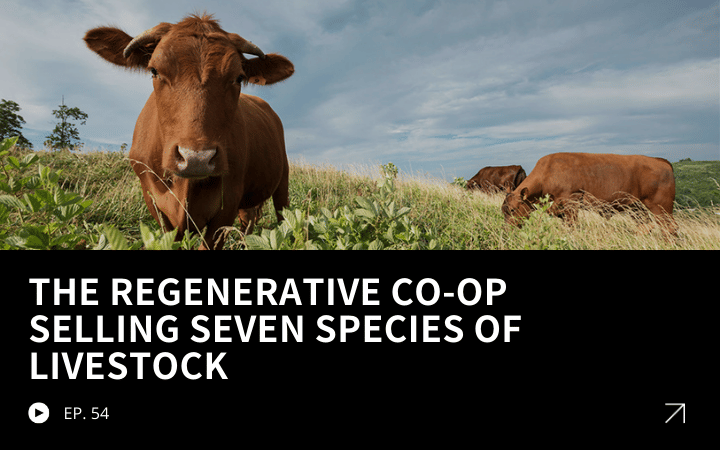
Cody Hopkins @ Grassroots Farmers Cooperative
The Regenerative Co-Op Selling Seven Species Of Livestock
Cody Hopkins is the CEO and Founding Farmer at Grassroots Farmers Cooperative. Grassroots is supporting regenerative agriculture with its regeneratively raised protein products. Grassroots currently produces pasture-raised and grass-fed beef, lamb, and bison. They also sell pasture-raised pork, chicken, duck, and turkey.
While the bulk of Grassroots sales are direct-to-consumer, they also have some wholesale, white-label programs with several e-commerce and food service companies. The cooperative is vertically integrated from production through processing.
Solving Small Farmer Problems With A Cooperative Solution
Like many in their generation, Cody and his wife Andrea sought to do something that would make a difference. Inspired by Joel Salatin and Michael Pollan, and wanting to stay in rural Arkansas, they launched a direct-to-consumer farm business on 40 acres of leased land, starting with pasture-raised chickens.
After several years of selling to local restaurants and at farmers' markets, they became frustrated by the hurdles of getting products from farm to market. Scaling their “mini” vertically integrated model became less feasible, economically and operationally.
The idea of creating a cooperative surfaced naturally, inspired by Cody's natural inclination for collaboration and a few additional factors. First, they had already established a group of farmers collaborating informally to buy feed and transport animals together. Secondly, through his research, Cody saw other models having success with these kinds of approaches, most notably Zingerman's Community of Businesses. The decision was made to create the co-op when a large order was placed that couldn't be fulfilled by the existing, informal, collaborating farms.
Building an Ecosystem
In 2014, after conducting extensive research (funded through a Value-Added Producer Grant from the USDA) and getting help from Heifer International and Heifer USA, the Hopkins and six other local farms formed a co-op.
While Heifer is known mainly for its international work, the organization had been looking to make investments in regenerative ag and support small farmers in the U.S. Getting financial support from Heifer allowed Grassroots to do critical foundational work and build a lasting infrastructure (without being saddled by the obligations that would have come from a different, more financial-returns-focused investor).
“I think they're figuring out ways to piece together creative capital stacks, but we still have to figure out how to align the idealism of regenerative ag with the reality of running a business. Heifer's philanthropic funds allowed us to get to a certain scale where we can hold onto certain values that we probably wouldn't have been able to hold as tightly if we were bootstrapping from day one.” - Cody
Today, Grassroots has roughly 50 farms from Arkansa, Missouri, Mississippi, and Oklahoma. Their products are sold across 48 states, with California being one of their largest markets. Grassroots also has minority ownership (49%) in their processing partner, Cypress Valley Meat Company. Cypress operates one poultry facility and two red meat facilities, all federally inspected, plus two custom facilities that focus on small-scale, customized processing.
“Through our co-operative, we have built a more sustainable model for our farm and our community. We enable the farmers to really focus on being great farmers. Over time, we’ve partnered with experts in processing, marketing, sales, distribution, customer service, without having the farmers lose oversight and ownership.” – Cody
Creating a Standardized Yet Flexible Production Model
While the need for standardization is debated by many in regenerative agriculture, Cody emphasized that efficiencies and standardization must be reckoned with in any successful business model, regardless of your path to market.
That’s why Grassroots has an internal department that works with farmers to ensure they’re meeting the co-op’s defined standards. They’re also making sure farmers have the technical assistance they need to understand what’s expected and make it a reality in their farming operations.
The co-op has also established guaranteed contracts and “common pay rates” based on a cost-of-production model, which differs from typical procurement strategies focused on market pricing and the scale of the selling farm. As Cody explained, some farms are selling 100% of their production to Grassroots, others just 10%. Farmers can choose what makes the most sense for their operation.
“Being focused on cost of production, we have to push for efficiencies – whether it’s better feed rations, adjustments to infrastructure, breeding, whatever. We really get into the weeds with our producers to help figure out how we can help reduce that cost of production. We know that we can only sell our products for so much out there. The lower our cost of production, the more affordable we can make it for folks and the more volume we can move for farmers.” – Cody
National, but Local
To achieve efficiencies and scale regenerative agriculture, Cody believes we must also look at ways for regional products and producers to succeed within our decentralized food system. Grassroots has lots of interest from farmers across the country and Cody would love to see them establish co-op “clusters” to service regional markets.
But there are plenty of roadblocks standing in the way:
How do you preserve the brand while leaning into the regional story?
“Local” resonates more than regenerative with consumers – but how do you build scale and efficiency?
How do you make regional work given all the economic and logistical complexities of a centralized food retail system?
Too often, consumer demand and retail density doesn’t exist in the markets where you have the producers to sell regional goods, or the costs of production just don’t support it.
How do you get past the purist principles that regional must be small-scale? Grassroots and other aggregator livestock brands are great examples of the benefits of scale, vertical integration and efficiency, while still doing things equitably and regeneratively.
“We started from zero, going to farmers markets and selling to restaurants, and it’s probably a decent way to get going if you're starting from scratch. Grassroots is a place farmers can ‘graduate to’ by accessing a direct-to-consumer model that pays more than wholesale. We're able to bring in farmers that are not super scaled and work them up.” – Cody
Finding the Right Certification
Core to every Grassroots decision is customer need, and certification is the latest hurdle they’re tackling. After looking at the options, Grassroots chose to onboard with Land to Market™ and EOV™.
“The regenerative verification space is messy right now and there's not a clear winner. When it comes to customers, pasture-raised performs high from an SEO perspective. The regenerative piece is absolutely growing, but it’s not clear where it fits in the hierarchy of what consumers care about. Definitely the most important things our customers care about are health and flavor. That’s where you really got to start. Supporting small farmers in rural America is important, but that’s not the primary driver of purchase decisions.” – Cody
How We Get Regenerative Brands to 50% Market Share by 2050
Finding a way to clearly articulate the health benefits and superior nutrient density of regeneratively grown food – not just to consumers, but to policymakers, governing bodies, and the food industry as a whole - is a major challenge. Moving the needle here will most likely require philanthropic capital funding. It will also take a shift in mindset and behavior – getting consumers to recognize the premium value (and price) of healthier, more nutrient-dense food.
“The thing that frustrated me over the years is just like, we're doing the really hard work. We’re actually investing in processing, we're investing in farmers, we're helping farmers get access to capital, we're helping them improve their production models. We're doing all kinds of things to help build the food supply chain that other companies and competitors in our space just don't do – but they piggyback off and use that same kind of messaging.” – Cody
For Cody, it’s all about consumer demand and getting consumers “to vote with their fork.”
“We wanted to regenerate the land. It's one of the reasons we've gone direct to consumers because this landscape is so confusing. Understanding the labels – what is free range versus cage-free versus organic – it’s almost impossible for a consumer. Having a direct relationship with our customers allows us to build that trust and really explain how we do things.” – Cody
This ReGen Recap was written by Kristina Tober
You can check out the full episode with Cody Hopkins @ Grassroots Farmers Cooperative HERE
Subscribe to future episodes of the ReGen Brands Podcast on Apple Podcasts, Spotify, or YouTube. You can help support our mission of growing regenerative CPG brands with a 5-star rating!
Stay engaged in the conversation by subscribing to our weekly newsletter, The ReGen Brands Weekly, and connecting with us on LinkedIn: ReGen Brands, Kyle, and AC