
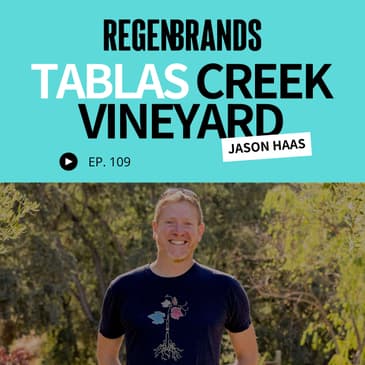
On this episode of the ReGen Brands Podcast, we’re joined by Jason Haas – Partner and General Manager at Tablas Creek Vineyard. Tablas Creek is located in Paso Robles, California, is one of the pioneering wineries in the U.S. for regenerative organic farming, and was the first vineyard to become Regenerative Organic Certified®.
Jason shares the incredible origin story of Tablas Creek, born from a partnership between his father and the Perrin family of France. We explore how they brought Rhône varietals to California and why they started a grapevine nursery to supply their own vineyard and the broader wine community here in the US.
We dive into the challenges and opportunities of regenerative viticulture – from managing tillage, to animal integration, to water retention. Jason also unpacks the complexity of managing 270 acres while bottling 29 different wines. Plus, he shares insights on the economics of DTC versus wholesale channels, and how they're balancing high regenerative and organic standards with industry-wide transition support.
If you're curious about how regenerative farming shows up in your favorite glass of vino – and what it takes to make that possible – this episode is for you.
Episode Highlights:
🌱 Pioneering Rhône grape varieties here in the US
🍇 Becoming the first Regenerative Organic Certified® vineyard
🧪 Launching a nursery to grow better vines and accelerate domestic adoption
🌿 How organic and biodynamic laid the groundwork for regenerative
🐑 Grazing sheep to boost soil fertility and water retention
🍷 Bottling 29 different wines a year, the way nature intended
🥂 Growing their “Wine Club” to 11,000 members
📦 How DTC makes up 50% of their volume, but 80% of revenue
💡 Using “neighborhood” blends to help other growers transition to organic
🌍 Collective strategies to scale consumer demand for regen-certified wine
Links:
Demeter Biodynamic Certification
Regenerative Organic Certified®
UC Davis Foundation Plant Services
If you find this content valuable, please consider donating to support our work
Follow ReGen Brands on LinkedIn
Subscribe to the ReGen Brands Weekly newsletter
Episode Recap:
ReGen Brands Recap #109 - The Regenerative Organic Vineyard Pioneering Rhône-Style Wine - (RECAP LINK)
Episode Transcript:
Disclaimer: This transcript was generated with AI and is not 100% accurate.
Anthony Corsaro - 00:00:13
Welcome to the ReGen Brands Podcast, the place for brands, retailers, investors, and other food system stakeholders to learn about the consumer brand supporting regenerative agriculture and how they're changing the world. I'm your host, AC. Thanks for tuning in. Now let's get into today's conversation. On this episode of the ReGen Brands Podcast, we're joined by Jason Haas, Partner and General Manager at Tablas Creek Vineyard. Tablas Creek is located in Paso Robles, California, is one of the pioneering wineries in The US for regenerative organic farming, and was actually the first vineyard to become regenerative organic certified.
Anthony Corsaro - 00:00:42
Jason shares the incredible origin story of Tablas Creek, born from a partnership between his wine importing father and the Perron family of France. We explore how they brought Rhone varietals to California and why they started a grapevine nursery to supply both their own vineyard and the broader wine community here in The US. We dive into the challenges and opportunities of regenerative viticulture from managing tillage to animal integration to water retention. Jason also unpacks the complexity of managing 270 acres while bottling 29 different wines in a single year. He shares insights on the economics of d to c versus wholesale channels and how they're balancing high regenerative and organic standards with industry wide transition support. If you're curious about how regenerative farming shows up in your favorite glass of vino and what it takes to make that possible, this episode is for you.
Anthony Corsaro - 00:01:41
Let's dive in. What's up, everybody? Welcome back to another episode of the ReGen Brands Podcast. Very excited today to have our friend Jason from Tablets Creek with us. So welcome, Jason.
Jason Haas - 00:02:01
Thanks. Nice to be here.
Anthony Corsaro - 00:02:03
Good to have you, man. Always the first question we ask for those that are not familiar, what products do y'all produce and where can people find your products today?
Jason Haas - 00:02:12
So we are a winery in Paso Robles, California. We make, wines. That's pretty much what we do, though, we do also I mean, as a part of this, we we do grow some sheep, so we sell a little bit of, biodynamic and regenerative lamb here at the winery.
Anthony Corsaro - 00:02:30
You
Jason Haas - 00:02:30
find our olive oil in a few places. But, no, we mostly make wine, which we sell about half of here direct to Tablets Creek, but you can also find it out at restaurants and and some independent wine shops around the country.
Anthony Corsaro - 00:02:42
Nice. And I I purposely didn't say the full Tablets Creek vineyard because I feel like that would've given away, you know, the first the first answer. But, but we can we can address that now. I I really enjoyed learning about the history, in our first conversation, and I think y'all do a nice job covering it on the website. But there's a really cool story between really your family history and this family in France that is the reason this this vineyard exists and the reason that the brand exists today. So we'd love for you to have, for you to detail that for us if you don't mind.
Jason Haas - 00:03:15
Yeah. So we are a partnership at Tubeless Creek. We're equally owned and run by two families. One of the families is my family. My dad was Robert Haas. He was an importer, mostly French wines, but once from around the world all the way back into the nineteen fifties. And the other partners in Tableau Sprique are the Perrin family from Chateau de Beaucastelle in Chateau Neuf Du Pape whose wines my dad introduced into The US market in the sixties and with whose proprietors he became friends. So it was was on their trips to California to sell their French wines in the seventies and eighties that they became convinced that there was this opportunity to focus on the same grapes that they were using in the South Of France in California. And whatever, ten, fifteen years later, they finally decided to to to try it themselves. So that's how we how we ended up focusing on Rhone varieties, specifically Chateauneuf Du Pape styled blends in principle, here in Paso Robles, California.
Anthony Corsaro - 00:04:12
If anyone's looking for me to have the the nice French pronunciation of any of these words like Jason does, you've come to the wrong place. But I'm happy you could you could handle that for us, brother. I You grew up
Jason Haas - 00:04:23
with a you grew up with a dad who was a wine importer with a lot of French suppliers. You realize that your opportunities are a lot more exciting if you speak French. So, you have a little added incentive.
Anthony Corsaro - 00:04:32
Yeah. Do you do you speak French fluently or just like the key terms like that or
Jason Haas - 00:04:37
at all? I'm pretty fluent. I'm a little rusty at this point. I haven't I mean, I Yeah. It takes me, I don't know, four or five days to to really feel like I'm fully comfortable, but I've spent spent about a year of my life there all told. So, yeah, I've heard that pretty good.
Anthony Corsaro - 00:04:50
Amazing. I I wanna actually get the dummy one zero one varietals explanation from you right away because this is not something I'm familiar with, and I don't know what what level of a wine consumer you really need to be to be familiar with it. And and it it does seem very tied into the history of why specifically was there a desire to grow these types of grapes here. Can you just, like, break that down, I guess, into macro and then why those Rhone varieties are so unique or special or why that was and still is such a cool opportunity for y'all?
Jason Haas - 00:05:24
Yeah. The I think the thing which is surprising to people is is learning that there are something like 2,500 grape varieties that are used to make wine around the world. Wow. You ask the average American wine even the average American, like, wine lover, they could probably name, like, 10. So, and in some cases, there's a one to one tie between a grape and a place. So if somebody likes Burgundy and they like red wines, they'll they'll know that that's Pinot Noir. It's the only red grape you're allowed to grow in Burgundy.
Jason Haas - 00:05:46
There's only one white grape you're allowed to grow, and that's Chardonnay. It's a little more complicated if you go to a place like Bordeaux where the lead red grape is Cabernet Sauvignon, but there's also Merlot. There's also Petite Verdot. There's also Malbec. And then there's two whites that are allowed in Bordeaux. The Rhone is more complicated because depending on which region in the Rhone you're in, there's anywhere from 13 to 22 grape varieties that are allowed.
Jason Haas - 00:06:11
And the the Southern Rhone is kind of this crossroads culturally where you have a lot of influences coming down from more continental parts of France, and that brought grapes like Syrah, Viognier, and Marsanne. And then you have influences coming up from Spain, which brings grapes like Grenache and Morvedre and Grenache Blanc. And then you've got grapes that evolved locally, in the South Of France that are that are added to this mix. So
Anthony Corsaro - 00:06:51
Mhmm.
Jason Haas - 00:06:52
The most Chateauneuf Du Pops are mostly blends. They they don't have to be. There's no reason why you couldn't make one that was a 100% Grenache. It's just not the way it's typically done. And that's why it's often convenient to refer to them as, like, Rhone style wines because it's not like you could just name a grape and be confident that that wine is going to be made from just that grape. So that's when when we started, we realized that one of the things that we needed to do was, like, start by importing grapevine cuttings because there were several of those traditional run varieties that had never been used in America before. Mhmm. And that that led us to also take a deeper look at the key varieties which were here, and we concluded that, like, yeah, maybe there was Grenache here, maybe there was Morvedre here, but they maybe weren't the best clones of those things. So all all of this allowed us Yeah.
Jason Haas - 00:07:40
Well, encouraged us to to go in and take new cuttings of everything from Bocastelle, bring them into Talvis Creek, wait three years for them to clear quarantine, and then build a grapevine nursery, which, like, that was not originally part of the plan. We thought we were gonna be just growing grapes and making wine, but it turns out that when you bring grapevines into the country, you're not allowed to bring in the thousands that you need to start planting a vineyard. You're allowed to bring in six of each type, and then you need to propagate those into an after plant. And that led us into a second business and a whole different relationship with kind of the the the California and Paso Robles wine community.
Anthony Corsaro - 00:08:17
Yeah. It's super interesting. And am I understanding correctly just at the very basic level, Rhone then as a word refers to that area of France where the varietals come from, and then it also is a word that refers to the group of varietals as we're talking about it from, like, a wide perspective. Right?
Jason Haas - 00:08:34
Yeah. The Rhone is a river. So it's a river that flows west out of Lake Geneva and then goes basically west to the city of Lyon and then turns south and flows south from there into the Mediterranean. Okay. And it the if you see someone if you see a wine that's labeled as a Cote Du Rhone, Cote just means slopes. So sort of the slopes around the Rhone River. And because there's a family of grapes that all kind of reached their apex there, became popularized there, people will refer to that family in shorthand to saying, oh, those are Rhone grape varieties.
Anthony Corsaro - 00:09:07
Mhmm. Okay. And did you grow up always thinking, hey. I'm gonna be kind of a winemaker, vineyard operator. I'm definitely not gonna do that. Like, what was your personal background, and kinda when did you enter the business personally?
Jason Haas - 00:09:20
So my dad was an importer when I was growing up, not making wine. Got it. Tableau Street didn't get started till I was finishing up high school. So this was not salient really as I was growing up. But at the same time, again, I I did tend if I didn't get myself another summer job in in high school and in college, I did tend to get sent to France to to work at a winery.
Anthony Corsaro - 00:09:43
Not a bad option.
Jason Haas - 00:09:44
I mean, it was pretty great. I I thought my I thought my dad was just trying to get me to to work on my French, but, clearly, there were deeper deeper designs in here. So it's interesting because he was as an importer, he was buying and selling other people's wines, and I never really saw myself doing that. But I loved wine people. I loved the the family nature of it, the multigenerational nature of it, the connections that it had to history and culture. And so it was was on a summer when I was actually staying with and working with the Perrens at at Beaucastel.
Anthony Corsaro - 00:10:23
Yeah.
Jason Haas - 00:10:24
That was summer in between junior and senior year of high school, where I I was like, okay. This piece of this I can see. Like, I can see really sinking my teeth into the making of wine and the and the business of of of a family winery. Yeah. But I also didn't wanna go straight into a family business right out of school, and I wasn't sure what aspect of this I wanted to do. I didn't think I didn't think that, like, being a kind of technical winemaker was really my path into it. Yeah. And so I decided after I graduated from college in '95. And at that point, we didn't even have a winery building yet.
Jason Haas - 00:10:59
We had we had some new vineyard planted. We didn't have any grapes in production. Yeah. It wasn't really a business. There was nothing nothing particularly to do unless I wanted to come out and study grape growing. And so I went to grad school, got a master's degree in archaeology, which I thought would give me a chance to travel and teach and and work on languages some more.
Jason Haas - 00:11:17
Yeah. And then graduated, got my master's in '98, and it still wasn't really ready. Tablets Creek wasn't ready for me to be involved, so I went and worked in tech for four years. So Okay. Got recruited to teach web programming languages. And that I I went thinking I'd get a good technical education and Yeah.
Jason Haas - 00:11:39
Ended up getting what was in essence business school, joining this little tech startup where I was the seventh employee and staying for four years and leaving when we had 80 employees and offices in six cities, and I got a chance to manage people and manage projects and write and teach and market and make a million mistakes. And then by 02/2001, Tubeless Creek had had grown into a business, and more than that had grown into a business that was more complicated than I think my dad had originally thought. He he spent all of this time and and worked with the parents to do this work, bringing in the right clones into California, planting the grapes in the right way, and building our kind of winery and and making wine. And I I think his assumption was that because of the association with Bocastel and his own experience working as an importer and with distributors, the sales side of it would kinda take care of itself. Yeah. And it turned out to be a lot harder than he just thought because we were we were making blends, which didn't really have much of a category on the marketplace from a part of California that nobody knew.
Jason Haas - 00:12:37
Yeah. The grapes that people hadn't heard of and couldn't pronounce with French names on the labels that didn't mean anything to them. So Yeah. Like, we had four strikes against us. And, like, the people some people in the trade were excited, but it was a pretty heavy lift to translate that to the end consumer. So we had inventory backing up. We had distributors complaining.
Jason Haas - 00:13:10
So my dad essentially asked me to come out and figure figure it out from kind of a business and marketing standpoint.
Anthony Corsaro - 00:13:22
Yeah. Yeah. That's, coming from a family business as well, there's some there's some interesting ties. Not the not the same, you know, different details, but same kind of overall, themes there. Potentially, another dumb question on the agronomic side. When you bring those varieties over and you talk about having to have them in quarantine, does that mean they can literally be in the ground and be planted, or are they literally, like, in a root cellar somewhere where they, like, can't be, you know, access to the outside world? And then I guess another question is, once they're in the ground, is it five years, ten years, fifteen years, one year before they're, like, production ready and and producing fruit that can be actually used? Like, what what are those timelines like?
Jason Haas - 00:14:04
So the quarantine happens at USDA licensed facilities, which are basically research universities. So there are three stations that are right now do this quarantine process. One is, in Geneva, New York associated with Cornell. One is in Davis, California associated with UC Davis, and then one is at, I believe, Oregon State, Pacific Northwest. So they're in greenhouses because they're what they worry about is viruses. They don't want
Anthony Corsaro - 00:14:34
Yeah.
Jason Haas - 00:14:34
They don't want you to inadvertently bring in a virus that might spread and wipe out your wipe out your industry. Yeah. Once you get them released to you, once they've done all the tests that they need and and know that the material is clean, then it's released to you. And it takes it took us a couple of years to propagate enough vines to start planting the vineyard. So we got the vines out of quarantine in '94 sorry, '92. And by '94, we finally had enough to plant one hillside. So, like, five rows of each variety up the side of one hill, just a couple of acres. And then we took cuttings off of those vines as well as the vines we still had in pots in our greenhouses to plant most of the rest of our vineyard in '95, '96, and '97.
Jason Haas - 00:15:04
And then it takes once you plant it, it takes three years to get your first crop. But that first crop is not usually a super big crop, and it's not usually a great crop either. You hear people talk about old vines, and the reason why old vines is a good thing is that the roots are deep down into the soil, and they're pulling a lot of character out. And a three year old grapevine is not gonna have roots deep down into anything. So, in France, they often don't even start including the the grapes from a block into their top wines until the blocks are, like, 15 years old.
Anthony Corsaro - 00:15:47
Wow. Grape
Jason Haas - 00:15:48
vines then have an basically, a human lifespan if there's not something that that kills them. So, they they you can expect them to live for thirty, forty, fifty, sixty years.
Anthony Corsaro - 00:15:59
Yeah. That's wild. When when you do a cutting, how difficult is that process? What part of the vine are you taking? How are you planning it? Like, I'm just super curious.
Jason Haas - 00:16:10
It's it's actually fairly easy. Grape vines are I mean, they're they're they're vines. They're they're vigorous. They're they're sprawling. They grow in a bunch of different ways. So all you need is a single bud of, of a cane. And then if you take that bud, then and you put it in the right medium, roots will spread out of the bottom, and a new shoot with leaves will spread out of the top. So you can get dozens of cuttings off of a single vine in a single year. And it's not it's not hypertechnical either. When when we were doing this in a in a serious way, we were basically just, like, taking the cuttings, keeping them in the dark in potting soil until they spread a piece, and then, and then planting them into little pots. I mean, it's it's a it's it's an ancient way of reproducing certain kinds of plants that do not breed trudotype from seed.
Jason Haas - 00:16:55
So, if you have a grapevine that makes a let's say you have a grapevine that makes Syrah, if you take a seed from one of those Syrah vines, it may or may not be Syrah. One of the parents is Syrah, but the other one could be some other kind of pollen that blows in. So you don't people don't propagate grapevines from seed. They take cuttings, and then the cuttings are clones of whatever you started with.
Anthony Corsaro - 00:17:26
That's super interesting. Then what was the context of being in Paso Robles? Was there, like, no vineyards there when y'all started? Were there some? I my understanding today is there's a few brands there and it's relatively developed in terms of winemaking, but were y'all kind of an early entry into that AVA at that time?
Jason Haas - 00:17:47
We were early without being one of the first.
Anthony Corsaro - 00:17:50
So
Jason Haas - 00:17:50
Yeah. I think when we started, we were winery number 17 in Paso. Mhmm. And there are vineyards here. There's a there's a old bonded winery here from the eighteen nineties. I mean, it's Wow. There we are at the intersection our vineyards at the intersection of two roads called Adelaide Road and Vineyard Drive. It's called Vineyard Drive because there were vineyards that were on there from before before prohibition. So, there's a grape growing history here, but I think it's fair to say that it was not really on most people's radar when when we started here as not on the radar as, like, the next great thing in California. But it's grown enormously since we since we moved here. So if we were winery 17, there's now probably 270 wineries here. Wow.
Jason Haas - 00:18:27
And it's gone from about 5,000 acres of grapevines to something like 45,000 acres of grapevines.
Anthony Corsaro - 00:18:43
Wow.
Jason Haas - 00:18:43
So it's the third largest nexus of of grape growing in America after Napa and Sonoma.
Anthony Corsaro - 00:18:51
Yeah.
Jason Haas - 00:18:52
We have about the same number of vineyard acres here as there are in the whole state of Oregon, just by that just for for comparison. Yeah. And the reason why we chose this spot was that this is where we found the right combination of soils and climate and rainfall that felt like it would be the best match for the the Southern Road because it's a Mediterranean climate there, and, they have a long growing season for France. They have a lot of sun. Paso Robles does as well. And it's just, it was just for us a question of trying to match the raw materials up as as well as we could and figured that the rest would take care of itself, which took took a little more effort than that. But Mhmm. Did ultimately work. It's been super exciting to see the community grow up around us. Mhmm.
Anthony Corsaro - 00:19:41
Has those those things that you knew that were a match basically between the climate and the genetics, has that relatively stayed the same, like, through the years as y'all have developed, you know, the business and the systems and the ergonomics as well, or has there been significant changes or things that have kinda changed that calculus at all?
Jason Haas - 00:19:58
No. They've stayed consistent. I mean, obviously, the climate is changing, and we have to be conscious of that. But by and large, the the the essential research that my dad and the parents did to to choose this spot, I think, has been validated by by what we found and by the other by the other winery vineyards and wineries that have moved to the area to focus on the same grapes.
Anthony Corsaro - 00:20:23
And I believe the last time we talked, you told me y'all have been organic since inception or very, very close to inception. Was that, you know, because your dad has an in or your, your family as importers, like, thought that those wines were higher quality? Was it because the French family thought that that was the right way to do it? Like, where did that come from? And maybe how has, like, the that approach evolved over time?
Jason Haas - 00:20:46
I mean, yes to both cases. Yeah. So, at Bokastel, they've been fully organic since the nineteen fifties. Wow. And and they only used chemicals briefly after after World War two, and the the patriarch of the family at that time, whose name was Jacques Perrin, decided in the mid fifties that it just didn't feel right. Even though all of the farm bureaus, all of the government agencies, all of the all of the the the neighbors were saying, like, use these use these products. They are going to make you modern. They're gonna protect you from disaster. They're going to protect all of us from disaster. Yeah.
Jason Haas - 00:21:14
It just didn't feel right to him, and he went without using chemicals for a year in the fifties and was blown away with how much more those wines tasted to him like Beaucastel, like that place that he's been making for the the previous handful of years. And for them, that was it. That was the moment. They said, well, our our goal is to make wines that could only come from this place. Putting these products on these these synthetic products on, like, that muffles whatever the expression is at the place. Therefore, we're not gonna do it. We gotta find another way.
Jason Haas - 00:21:42
Yeah. So we didn't know what the expression was going to be of the terroir here. Terroir, that's the classic French term, like the the the character of place that shows through in a consumable product. But, we didn't know what that expression was gonna be here in Paso Robles, but we wanted to give ourselves every chance we could to show it. So we knew we're gonna farm organically. And as we got deeper into the process, we realized that as organics is typically practiced where you're replacing chemical synthetic chemical inputs with nonchemical inputs, It's still pretty input intensive, and we have been for the last twenty years essentially trying to eliminate one input after another to maximize the expression of this plate.
Jason Haas - 00:22:11
So that sort of led us to biodynamics, which, led us to regenerative, and where we are now.
Anthony Corsaro - 00:22:43
Mhmm. Yeah. The it's funny. The the wine category in a way almost seems more advanced than others in in my opinion, which couldn't could be totally wrong. But because of the advancement in biodynamics in that category first and how it kinda laid the framework to maybe, not change a ton of what's being done and just kinda call it that term instead of having to do this this long journey of of transition. What what has that specific transition been like for y'all specifically?
Jason Haas - 00:23:14
Yeah. I I think it is true that wine has been able to be at the forefront of this. And I think there's two reasons. One is what you mentioned that there is a pretty long tradition of biodynamics in wine. The other is that I think it's pretty easy to explain the benefits of farming better to the consumer in wine because they're used to thinking of it as coming from a specific place. It's not just about you do you're doing something that's better for the world. Like, yeah. But you're you are almost certainly making a better product in a way. I think that's would be more difficult if you're talking about a product that like cotton or soybeans or Yeah. Or something which is then processed into something else.
Jason Haas - 00:23:46
Like, yes, I try to buy, clothes made from organic cotton, but do I think that they make better clothes? Like, I oh, that probably not. But with with wine, I think it's easy to translate that. And I know that when when the regenerative organic alliance reached out to us to join the pilot program for regenerative organic certified in 2019, like, they did it because we were already farming and certified biodynamic. We were already doing most of the things that they were interested in, and it wasn't going to be a, like, this massive, transformation in what we did. They were looking for a winery, a vineyard and winery that could offer them feedback on the regenerative standards that they had and Yeah.
Jason Haas - 00:24:30
And let them know how well they worked for wine.
Anthony Corsaro - 00:24:41
Right. What what is the most challenging or challenging as a group agronomic practice, for Vineyards specifically? What what presents the the hardest kind of path to adoption on the regen side?
Jason Haas - 00:24:56
So the where we are, it is hot and dry in the summer. Yeah. It stops raining in April. It does not usually rain again until November.
Anthony Corsaro - 00:25:07
Yeah.
Jason Haas - 00:25:08
So water is water is critical, where we are. And one of the things that we are still figuring out is how we reduce our tillage while still, while still protecting our crop from competition with weeds and other things that are going to further reduce the the the water resources. Mhmm. And further complicating that is that often when you don't till, you're leaving this permanent cover for burrowing rodents like, gophers and ground squirrels. Yeah. So, we we know I mean, we we we try not to change everything without, a kind of a test period where we can evaluate the results, but we know from neighbors who kind of precipitously just decided to go no till in blocks that they have lost significant numbers of vines to the competition from the the plants and competition from the rodents. So I would say that the the tilling piece has been the one that we've offered the most feedback to the regenerative organic alliance because a lot of the studies that have been done on no till farming have been done in places like Virginia where it's wet and Yeah.
Jason Haas - 00:26:16
You don't like, you you have the extra ground cover is actually probably helping you concentrate your your grapes if you're growing grapes, but it's not necessarily the same issues that we're dealing with out here.
Anthony Corsaro - 00:26:47
Are you guys irrigating at all to get some water, or is it all dry farmed? Or
Jason Haas - 00:26:52
So about half of our vineyard is planted relatively closely spaced on trellis with irrigation lines. We have tried to wean those blocks off of irrigation, and we've gotten to the point where now that the vines are 25, 30 years old, if we get good rain the winter before and we don't have too extreme a summer, we can go an entire season without irrigating at all. But, the other half of the the vineyard block the other half of our vineyard acreage is much more widely spaced and head trained, so no trellises. And that's planted without any irrigation infrastructure. And those, we only irrigate for the first couple of years in order to get the roots down just through that topsoil down into the limestone, layers where there's where there's more moisture. That that we do either by laying temporary irrigation lines just that are gravity fed from a tank or in many cases, just by using these five gallon plastic buckets with a hole drilled in the bottom that we fill with a water truck twice. Yeah. So, not very high-tech. But, the, so so yeah. So we basically we can irrigate about half the vineyard.
Jason Haas - 00:27:54
We try not to, but if there's multiple years of drought or if we have a big heat spike coming at a critical period, we will give the vines some water in order to keep them going. We're not we're not going to dry farm just to prove a philosophical point and and kill the vines or lose a crop because of it.
Anthony Corsaro - 00:28:19
Yep. Has the animal integration helped with any of those things that you've kinda just taken us through, or has it made it harder? What what is that?
Jason Haas - 00:28:29
I think it's helped with everything, honestly. It's because what you're doing we we got our first flock of sheep, small flock of sheep in 2012. And by 2016, it was big enough that we had we were a 150 sheep. We had to hire a shepherd to to run the animal program. So the there are a whole bunch of benefits of integrating grazing animals into a perennial crop like grapevines. You are returning a huge amount of nutrients to the soil. You are seeding the soil with with all these healthy microbes that live in the sheep's stomachs, year round, And you your your additional, organic matter in the soil also allows the soil to hold more moisture. So you've got you have the the benefits in terms of water retention as well as the benefits in terms of fertility and soil microbiology.
Jason Haas - 00:29:18
So I think it it helps with everything. It also is a good way of maintaining of, getting rid of some of those weeds or at least keeping them from growing too aggressively without having to run a lot of tractors through. And Yeah. We have, a new vineyard block that we've planted where we've trellised the vines up high, up, up at, like, six feet,
Anthony Corsaro - 00:29:52
which
Jason Haas - 00:29:53
will allow us once those vines are are are older and in production, will should allow us to keep the sheep in the vineyard, through the through the summer, as opposed to now with the blocks that are trellised lower or head trained lower where we've gotta get the sheep out of there at bud break. So no. I think it's I think it's that's been probably the biggest success of all of the things that we've done. It's been that animal integration.
Anthony Corsaro - 00:30:17
And the the lower trellis, you have to remove the sheep just because of the nature of where they're going to be in relation to the vines or because the the under canopy like vegetation is too high? Or
Jason Haas - 00:30:27
because they will happily switch from eating grass to eating the new leaves and clusters and fruit. So So we right now, we only have the sheep in the vineyard after harvest. So typically on October, we get them back in the vineyard. There's not a lot of grass that really starts growing till January, and then we really need the sheep intensively in, like, late January, February, March, and early April. Yeah. And then by mid April, we've had bud break, and we've gotta get them out or else they'll start to do damage.
Anthony Corsaro - 00:30:57
Yeah. We don't want them eating the expensive stuff. That's that would be a no no.
Jason Haas - 00:31:00
No. No. We we we do not wanna be a very expensive farm for, 200 sheep a year. Like, that would be that that wouldn't that wouldn't work.
Anthony Corsaro - 00:31:10
Yeah. You don't wanna be vine fed, lamb. That's not what you're trying to sell here.
Jason Haas - 00:31:14
It's not.
Anthony Corsaro - 00:31:16
I saw the alpaca is in the mix too. Is that, like, one or two alpacas that are, like, vineyard pets, or we got, like, full large amounts of alpacas in a green dough with the sheep?
Jason Haas - 00:31:24
At this point, it's the it's the it's the former. Yeah. So we we were at one point given 10 alpacas by a neighbor who was moving to town and didn't need the alpacas anymore, and he'd they were like, well, you've got sheep already. Like, alpacas are perfectly compatible with sheep. You should, do you want them? And we're like, sure. Why not? They they kinda like big sheep.
Jason Haas - 00:31:36
And it turns out that while sheep are followers, alpacas are free spirits. And so, like, you move one sheep and all of the sheep follow, and the alpacas scatter chasing butterflies. And so, like, we realized pretty quickly that we were spending more time moving 10 alpacas than we were moving a 150 sheep.
Anthony Corsaro - 00:32:05
Yeah.
Jason Haas - 00:32:07
And so we basically haven't replaced the alpacas as they've died of old age. Mhmm. Yeah. They also aren't as fertile as sheep are. Sheep, you you tend to get a lamb pretty much every year from from each of your ewes. And with alpacas, we only had two alpaca babies born here at Tublas Creek in, like, a dozen years.
Anthony Corsaro - 00:32:28
Yeah.
Jason Haas - 00:32:29
So they don't replenish themselves. They're a little more fragile. They need more veterinary care, and they're harder to to move. So we're down to one or just our last the last alpaca that was born here, like, six years ago, and he's become kind of our flock mascot. He's very photogenic. He's pretty tame because he he was born here. He's very comfortable around people.
Anthony Corsaro - 00:32:49
Yeah.
Jason Haas - 00:32:49
And so, like, if you if if people go up to take a picture of the sheep, like, the sheep are kinda skittish, and they, like, run off to the other side of the the enclosure and the alpaca just sort of, like, saunters up. He's like, hey. How's it going? So we have, like, the alpaca in so many of our pictures because he's so photogenic and so friendly. Yeah. But I don't know that I would particularly recommend large numbers of alpacas as a an effective animal integration further than you.
Anthony Corsaro - 00:33:13
Yeah. It sounds like a difficult resource allocation and labor adjustment to really bake into your cost of goods and your operating model, unfortunately. But, the the loan the loan alpaca is still bringing some some fun value other places right now, so that's that's cool. I I also feel like I can't speak to the manufacturing on the winemaking side as well as I'd like to, and we've touched on it in a couple of the other wine making episodes that we've had. And I would say what was illuminating in those conversations was, for lack of a better way to say it, like, how bad conventional wine manufacturing kind of is, and there's a lot of chemicals and a lot of additives and, where potentially, not not related to the people that we've talked to. You know, you you could be doing a lot of good things on the agronomic side, and you're kind of, you know, air quote, ruining it with the manufacturing. So I don't know. I would just love for your thoughts on, like, what do y'all do? How is that maybe different than kind of standard procedure?
Anthony Corsaro - 00:34:10
And how do you think the winemaking interplays with the agronomic side, on the regenerative organic side of things?
Jason Haas - 00:34:24
That's interesting. That that take is more pessimistic than I think I would be about in general how wine is made. Wine is wine is not a particularly industrial product even I mean, even, like, a big corporate winery, I mean, they're probably adding yeast. Like, they may add a few nutrients. It's possible that, I mean, they're gonna do their best to stabilize a wine by adding a certain amount of sulfur, which gets been added to wine for thousands of years. Yeah. And they may filter or fine a little more than than a than a smaller, more kind of boutique oriented winery would be. But it's still in the grand scheme of consumable product, it's still a very unprocessed sort of a Yeah. Sort of a sort of a beverage. Mhmm.
Anthony Corsaro - 00:35:12
So
Jason Haas - 00:35:15
that said, what we do is is very hands off. I mean, we we ferment we we pick the grapes. They're all picked by hand. They are driven down in bins on the back of a tractor to to where the winery is. If they are white grapes, they are pressed right away, so dumped into a press and squeezed, and then the juice goes to barrels or tanks to ferment. If it's red grapes, they have to be destemmed first because you wanna ferment them with the skins of the grapes, skins and seeds, but you don't wanna ferment them with the stems, which have these bitter
Anthony Corsaro - 00:35:47
Mhmm.
Jason Haas - 00:35:47
Bitter tannins to it. So those get destemmed and then pumped into tanks to ferment. And we don't inoculate with any yeast. We just use the the native yeasts that are are around in the environment, and we wait. Yeah. Yeah. You you have to for red wines, you have to make sure that they stay mixed a couple of times every day because the otherwise, the carbon dioxide bubbles that form in fermentation will attach to the skins and float all to the top. Mhmm. And that's where most of the flavor and character is.
Jason Haas - 00:36:16
And so you've gotta keep that mixed with the juice that's below a couple times a day if you want it to continue to extract properly. But you can do that in a bunch of different ways. You can physically just, like, push those grapes down into the juice, or you can pump the juice from the bottom over the top, or you can splash the cap of skins apart. You have to do that a couple of times a day until the until you've gotten the level extraction that you want, which is usually ten days or two weeks, and then you press that off, and then it just goes into barrels to age. So, like, there's no there are no additives there except for a little bit of sulfur, which and the reason that wineries add sulfur is that at low levels, sulfur allows the yeast that do fermentation to proceed, but inhibit the action of vinegar causing bacteria. So
Anthony Corsaro - 00:37:06
Okay.
Jason Haas - 00:37:08
You you there's a narrow tolerance. You have too much sulfur, and then nothing will grow. And you have no sulfur, and everything grows. You don't really want that either. So you want this sort of narrow band where there's a little bit of sulfur that that keeps your fermentation on a fairly straight straight track. But beyond that, like, there's really nothing that gets added. We'll put our blends together the following spring after things have have done fermenting, and we have a sense of what their character is like. And then those blends go back into large barrels to age for a little bit longer, and then they get bottled. So it's it's a, but I guess it is technically manufacturing, but certainly doesn't feel like manufacturing in any way that I I Yeah. Normally interpret that term.
Anthony Corsaro - 00:37:49
Yeah. The the entire timeline, the amount of time between fruit picked off the vine to it going into a bottle is then what?
Jason Haas - 00:37:57
It varies. It varies. So a a rose or a lighter white that doesn't need or benefit from aging time might be six months. You might release it in, like, late winter or early spring right after harvest. Okay. A richer white that needs a little more time in barrel to to deepen might be nine to twelve months, and that might also be the same time frame for some of your lighter weight reds. And then a red that particularly an ageable red that has a fairly large amount of tannin that you need to integrate and soften, that'd be more might be more like eighteen months to two years after harvest due to release it.
Anthony Corsaro - 00:38:35
Wow. And there's, like, a sommelier winemaker type person that's kind of constantly moderating the the fruit as it's being, you know, made into wine to to say, okay. It kinda tastes like this. Here's where we're at. You know, like, is that just like a very specialized job that someone has to kind of, like, control that process and, I don't know, QC, QA that, or what's that what's that dance like?
Jason Haas - 00:39:02
So I think that's an area where you would see a bigger difference between a, like, a larger, more corporate winery and a smaller small to medium sized winery like us, where for us, like, we don't have a specific set of flavors that we want each one to become. Mhmm. If that if you were making millions of of bottles and you were expecting every bottle to taste exactly the same from year to year, then there are certainly lab trained people who are measuring individual flavor components saying, no. This needs, we need to put this move this out of here, put it into new oak to get a little more of that flavor. Like, no. We need to add a little more of this particular yeast to bring out this flavor.
Anthony Corsaro - 00:39:45
Yeah.
Jason Haas - 00:39:45
For us, we are monitoring it because we wanna make sure that things aren't going off the rails. Like, we don't wanna we we wanna make sure that things are are fermenting. We because you can end up with a fermentation that for whatever reason, the yeasts decide they're done, that there's still some sugar left, and that's probably not what you want. Or you could end up with one of the wild yeast strains that we have that, like, all of a sudden takes off and takes over and might start tasting weird, in which case you gotta get it out of that barrel that it's in. Maybe you need to filter that and get it in with something else that has is going in the direction you want. So we we're just making sure that things are, like, within our our tolerances, but we're not aiming for specific flavors. And so it's not until the following spring that we really care what it tastes like. It sounds like a weird thing to say. Yeah.
Jason Haas - 00:40:29
But we're we're we're care
Anthony Corsaro - 00:40:40
in the process.
Jason Haas - 00:40:41
Yeah. We we care that it's connecting properly and and trust that we're gonna like the end result, but it's it's in the spring where we then take all of these 150 different components that we might have had during harvest and then put them together to make the 20 ones that we're gonna make for the year. At at that point, there are usually six or eight of us around a table making these evaluations. And it's not it's not like, like, we're running it through a a piece of machinery that's telling us you've got x amount of this component flavor, the y amount of that component flavor. It's just us tasting it and saying, okay. This is a very rich and powerful, but pretty tannic. We should probably be blending it with something that's fruitier and friendlier to make a wine that has, like, the best of both worlds.
Jason Haas - 00:41:23
It's a it's very much a kind of an iterative process based on our tasting and our discussions.
Anthony Corsaro - 00:41:38
Yeah. Yeah. That's fun. I wanna shift to the commercial side of things, and I'm sitting here thinking of literally, like, a thousand plus questions that I could probably ask. And I'm thinking back to when you first showed up and your dad was like, hey. Help me figure this whole sales sales and marketing thing out, which sounds like that was at least, what, twenty twenty plus years ago.
Jason Haas - 00:42:00
Twenty to twenty three years ago.
Anthony Corsaro - 00:42:02
So I'm sure there's been quite a few learnings, pivots, lessons along the way. Maybe maybe the best starting starting question there, Jason, would be, can you just articulate, like, how how the revenue channels are are broadly split up without without giving anything proprietary or confidential way? But, like, you guys do some ecommerce. You do some, you do some on premise. You do some off premise. You do, like, some some direct selling maybe at the Vineyard. Like, can you articulate that at a high level and maybe we can dive into some channel specific questions or take it from there?
Jason Haas - 00:42:38
Sure. So if you look in terms of volume, we sell roughly a quarter of our volume in each of four ways. Okay. A quarter of it goes out through wholesalers around the country and a few export, export customers and then to restaurants. A quarter of it goes out through wholesalers and goes to retail. A quarter of it gets sent out, in our wine club shipments, semiannual wine club shipments, basically, subscriptions that people have that will get either one or two or three shipments a year from us. And a quarter of it either goes out from our tasting room or from supplemental orders that we get over our website or by phone, from people, many of whom are also wine club members who may get a bottle of six different wines in the spring and really fall in love with two of them and wanna get six more bottles of each of those two. So so it's basically a quarter wholesale to restaurants, a quarter wholesale to retail, a quarter wine club, and a quarter other sorts of orders, tasting room and and and discretion would think of as discretionary orders. Yeah.
Jason Haas - 00:43:55
It is it's important to note though that because a quarter of our volume goes out in each, it does not mean that each brings in a quarter of our revenue. Yeah. The direct to consumer side of things, even though it's only half of our production, is something like 80% of our revenue. Wow. And that's true because even I mean, we we're selling at retail. Even though we're giving good discounts to club members, we're still doing a lot better than we are if we sell at wholesale, which then, because of the way that alcohol has to be marketed in The United States, has to go first to a wholesaler and then to a retailer or a restaurant and then to a consumer.
Jason Haas - 00:44:16
You have to basically back out all of those markups for your original selling price. Mhmm. And then partly because in general, in the wholesale market, the all the incentives are there to sell your least expensive wines.
Anthony Corsaro - 00:44:46
Right.
Jason Haas - 00:44:46
So those are the things that are generally the most available for restaurants to pour by the glass, which is more volume than if you just get a placement on a list. Those are the things that a retailer might feel confident enough that they could buy a three k stack of instead of, like, I'll buy six bottles and put it on the shelf. So, compared to that, when people come to our tasting room and and and people who sign up for our wine club, they're generally interested in buying the best and most distinctive things that we make, not the cheapest things that we make. So you have a skew also in the kind of product mix, as well as the fact that we're selling at a a a discount off of retail instead of at wholesale.
Anthony Corsaro - 00:45:25
Mhmm. I I feel like that's a very interesting piece of trying to think of this whole regenerative thing, with wine is the sales and marketing tactics tied to regenerative or regenerative organic certified specifically probably could be or almost needs to be different for all four of those slots because it's a different purchasing decision really or it's different purchasing decisions across the chain that kinda gets you to someone actually drinking the wine. How how do y'all think about that specifically to being rock and, like, trying to tell that story and trying to use that for differentiation?
Jason Haas - 00:46:02
It's really interesting. I I think it adds essentially a tailwind for certain customers Mhmm. In all of the different channels. Yeah. But the degree to which it's important is incredibly heterogeneous. Like
Anthony Corsaro - 00:46:20
Yeah.
Jason Haas - 00:46:20
There are there are retailers who could not care less that the wine is is is rock certified. Right. There are also retailers for whom that's a decision factor, and everywhere in between. Like, there's there's a lot of others who are, like, who are happy to know that this wine that they like is also produced in this in this way that they feel good about, that they could talk to their customers about. In general and it seems weird to say, it is I think restaurants are by and large less concerned with that because people don't see the bottle until they order it.
Anthony Corsaro - 00:46:55
Right.
Jason Haas - 00:46:55
Right. They are more I mean, they again, they they're happy to know that, but they're not usually using the fact that it is farmed in a particular way as a selling point. Mhmm. And then in terms of our direct sales, I mean, do I think that, we we've gained a lot of wine club members because because of the way that we farm and the way that we talk about our farming? Absolutely. Yeah. But we're choosing which wines to send them.
Jason Haas - 00:47:19
And in our tasting room, again, some people come in specifically because of our of our farming, and they wanna learn more, and they wanna support a winery that that is regenerative and biodynamic. And there are others who don't know anything about it until we start telling them. But it I I feel like it's never a negative. It's it's something which just matters in widely varying degrees to different customers and gatekeepers.
Anthony Corsaro - 00:47:50
Yep. And it it seems like, especially in wine, the direct to consumer interactions, it does carry more weight because it's so tied to place, like you said. But, ultimately, my assumption is and correct me if you you feel differently. For those for those consumers, for those customers, they're really saying, like, I'm buying this from Tablas Creek, and I think they farm in this really cool, unique, sustainable way. They're not necessarily saying they're organic, they're regenerative organic. Maybe maybe they are saying they're organic because I think we're at a different place there than than rock. But it's more so loyalty and retention around they farm this way. That's the Tablas Creek way more so than they farm this way with any insertion of the word regenerative into it. Is that you agree, disagree?
Jason Haas - 00:48:36
I would agree. I would agree at least in in broad strokes that we are more and more getting people who are aware of regenerative. And That's great. Once they become aware of regenerative and start to start to search in the wine world, it doesn't take them very long to get to Tublas Creek. Yeah. Yeah. So I I think it's become a little bit more of a driver. And it's also been valuable in that it gives us a a kind of a, like, a a defined set of protocols that we can that has a name that can represent what what we've been doing. And and that's helpful.
Jason Haas - 00:49:16
And it's helpful also, I think, that it's it's divorced from some of the mystical elements of biodynamics, which I I think I think can be there are people who are all in on that, but it also can be a turn off for people. And it's nice that regenerative is is more science based than that.
Anthony Corsaro - 00:49:34
Yeah. We see on the natural channel grocery food and beverage side of things that retailers and category, you know, category buyers, category managers are specifically saying, hey. We are looking for regenerative certified products to increase our selection of them. Are you seeing that on the wine side on the wholesale side as much or or not yet?
Jason Haas - 00:49:57
Yes. But, so, we are seeing it. But what they really want is they want, okay. Like, we want this one that is regeneratively farmed, and there's a certification on the label, and we want it for $15. Right.
Anthony Corsaro - 00:50:11
Right.
Jason Haas - 00:50:12
There there's still, there's still a lot of kind of price driven buying. And by far, the largest segments of the wine world are are under $20, where the economics of farming regeneratively and producing a wine at $20 is is really challenging. Yeah. So, I I think I think there is a desire there, but I don't think it has translated in a particularly meaningful way into changing the sets on on the chain retail grocery shelves towards regenerative.
Anthony Corsaro - 00:50:54
Mhmm. And I think, like, I I have a curiosity around it's very clear. Tablets Creek is doing a good job and continue to do, an even better job of marketing itself, and there's just, like, very clear basics. Like, you're a business. You should market what you do, and rocks a part of that. When you think about just, like, the wine category and creating more demand for rock, what do you think are the levers there? Like, is there, like, some sort of in with sommeliers that we gotta do? Is there some sort of in trade, like, collaboration?
Anthony Corsaro - 00:51:17
Like, I it actually seems to me from being someone that puts together a weekly newsletter and follows press releases that a lot of the rock winemakers are doing a really good job touting it at least in trade media and and even collaborating, with each other, like, via the one block challenge and and other things. That that seems more b to b though than on the on the demand side. Like, what do you see as opportunities there specifically to wine?
Jason Haas - 00:51:51
It's interesting because I I I agree that I think a lot of the communication has been kind of within the within the community, within the grape growing Yeah. Wine making community. I I have been hoping that the retailers for whom this should be a driver, kind of think the Whole Foods of the world would, would play a larger role in this. And and I think it will happen, but I don't think it's happened yet.
Anthony Corsaro - 00:52:19
Yeah.
Jason Haas - 00:52:20
So I that's that's a place where I feel like there's real opportunity, in some of those more kind of organic leaning, natural leaning, chain retail.
Anthony Corsaro - 00:52:31
Yeah.
Jason Haas - 00:52:34
But, again, that's such a the price is such a consideration. If you still if you go to Whole Foods and you look at their wine set and you look at the percentage of the wines that sell for $30 and above, like, in most of the ones that I go to, it's, like, less than 10% of the wines that are there. And so Yeah. They're they just I don't think they felt like they can yet ask their customers to make that leap. They've I think they've made the leap in a large way into organic, at least. Mhmm. And we've all benefited from the improvements to the kind of organic grape growing.
Jason Haas - 00:52:56
It used to be in order to use any sort of organic certification or say organic at all on the label, you had to also be no sulfites, which meant that a lot of those early wines were volatile and, not very good. Paid more for the organic market than for the fine wine market, but that's, like, that's really changed in the last fifteen years. And I think That's good. Consumer perception has changed with it. But there's a pretty big leap between, like, made with organic grapes and regenerative or biodynamic in terms of the investment that's required.
Anthony Corsaro - 00:53:44
Yeah. I I think, you know, I'm very interested also to see how specifically the agronomic adoption happens in wine, because I think there's some very unique dynamics with the category. I think there's very unique dynamics with kind of the AVAs and the cultures and the families and the vineyards and the, I'm sure the the the pride that's associated with a lot of those things. And I've seen publications and articles where, people in the wine community that are rock or are some high integrity regenerative standard are are worried about greenwashing and kind of lower lower barrier to entry regenerative standards, I think, are totally validated. And it's like, how do we how do we encourage transition and reward transition while also holding the highest bar and making sure people are still advancing to that? I was something I saw on the website that peaked my curiosity. I'm looking down at my notes here.
Anthony Corsaro - 00:54:37
Y'all work with eight to 12 other growers, to sell some $28 a bottle of wines that aren't necessarily all rock or all organic, but it is a tool, hopefully, to help some of those folks transition to more of those practices. So I would love for you to just maybe talk us through, like, that project or the idea behind it and also how you think about being one of those standard bearers of the highest bar, but also, like, hey. We're trying to help the whole industry be better here, but also there needs to be kind of integrity, honesty, and differentiation from those that have earned
Jason Haas - 00:55:13
it. Yeah. For sure. So the these wines, they're we call them Patalen de Tablas, and Patalen is French slang for neighborhood. So these are all that we source from our neighborhood. Yeah. And, typically, all from growers who bought grapevine cuttings from our grapevine nursery. So these are, like, the descendants of the vines that we brought in just planted in a in a handful of vineyards around Paso Robles.
Anthony Corsaro - 00:55:38
That's cool.
Jason Haas - 00:55:39
And so we started this back in 2010 when there were maybe three organic certified vineyards in Paso Robles, and none of them had any fruit for sale. And there were not many more than that that were even farming organically. So, like, that wasn't even really an option. We could not if we wanted to make this wine, we could not require that these be organic sources. Yeah. But, we became kind of increasingly uncomfortable with the the the the differentiate the difference between that and the way that we were farming our own vineyard.
Anthony Corsaro - 00:56:20
Mhmm.
Jason Haas - 00:56:21
And we were also super interested to see the the growth in the number of vineyards that were farming organically, even if not certified, the growth in the ones that were certified, and the adoption of the ability to sort of check a box to farm organically with some of the vineyard management companies, that was that was definitely not an option fifteen years ago when we started.
Anthony Corsaro - 00:56:48
Yeah.
Jason Haas - 00:56:49
Now it is all of the major vineyard management companies. Like, you could say, okay. I want this block farm organically, and they'll just let them take care of it. You don't need to have the expertise in house. Wow. So in 2022, we made the decision that we were going to give our growers five years to be farming organically. We were told that in 2022. So by 2027, if you are not farming organically, we are not going to buy your grapes anymore. We'll give you the help that you need, whatever we can provide in terms of expertise in helping you in this transition.
Jason Haas - 00:57:14
We'll give you a boost in what we pay. We'll give you a 10% boost in what what we pay, what we have been paying you. And if you just feel like you can't make this switch, great. This gives you enough time to find new buyers for your product and gives us a new time to develop new sources. So, we we were expecting it would take, like, that full five years to get Yeah. To that transition. And we were able to do it by last year.
Jason Haas - 00:57:40
So by last year, everybody who we signed a contract with for the for the year was, like, was farming organically. It doesn't mean that they were all certified, but they were farming organically to the to the satisfaction of our our viticultural team. So that's sort of where we are. We we the and there just because they're farming organically doesn't mean that they would even qualify for certification. In many cases, they might be in the first year of of a transition of not using chemicals. But in order for us to start, buying from them to have a to have a contract to do this, they need to agree to to stop using chemicals and and move move, towards organics.
Jason Haas - 00:58:23
So it it does feel like this is one of the ways that we can use our platform to help encourage people to, to adopt better practices, but it also required the community to be at a at a at a point where this was something that, again, the big major management company management companies could do. Mhmm. So, I mean, I I I would love one day to have those Petalen wines be able to be organic certified. I I don't think we'll ever get to the point that they would be regenerative certifiable, but, like, I can see the I can see maybe, I don't know, five or ten years that we would be able to ask that people not just be forming organically, but be certified, and we'd be able to have that CCOFC along the on on the label of pephalon wines, but we're not quite there yet.
Anthony Corsaro - 00:59:30
Yeah. That's super cool. How many what like, I I if you don't know the exact number, you know, I'd I'd be surprised if you did, honestly. But what ballpark percentage do you think of Vineyards is managed by one of those third parties that you that you've alluded to a couple times? 70? Yeah. So, like, that's a key thing. Like, if those people can't help with these with these agronomics, like, you're dead in the water, you're dead before you start. So that's amazing.
Jason Haas - 00:59:57
Yeah. I mean, yes. Absolutely. And that may be low. It may be higher than that. Mhmm. But, yeah, it's it's definitely the majority of the of the of the vineyards that are out there at the vast majority of the vineyard acreage that's out there.
Anthony Corsaro - 01:00:11
And I think it's a really cool way that y'all are, like, trying to do your part both there there's a there's a self interest business side of it of, like, you are producing a product and selling it still, and you're probably still selling those those folks, the the cuttings from the nursery, but you're also helping them transition to better practices. And you're using combined business interests to basically help with that. So I think that's really cool. I wanna double back to I asked you that question in a really long question. The the broader more macro, like, industry side of, like, holding the high bar while advancing transition and kind of how that works from a certifications claims consumer marketing perspective? Like, how do you how do you tackle that one? How do you think about that one?
Jason Haas - 01:00:54
I think we just try to be clear about what we do on our estate and what our estate wines are, and also try to be clear in the cases in which, like, that's not what we're doing. We try not to blur that line. So if you look on the back label of of all of our estate wines, it has those CCOF organic and the the rock gold seals. When like, on the Pataland wines, on the back label, if you look there, we actually list all of the vineyard names that we get the fruit from, percentages that come from each one. So we're trying to be like, we're trying to keep that line between what is a state and what is not a state as as clearly delineated as we can while still having everything inside a Tublas Creek labeled bottle. Like, I mean, we we had actually talked at the outset of the Pataland programs, like, do we want a different label design? Do we wanna put it out under a different name? Because there's certainly plenty certainly plenty of examples of wineries doing, like, a second label under a different different name.
Anthony Corsaro - 01:01:57
Yeah.
Jason Haas - 01:01:58
And we thought that that would not be the right choice. That first of all, if it was it would be harder to to to help these wines succeed if it didn't say Tableau Creek. And if they did succeed, it would be harder to have that to have people then, like, rise up into the estate wines that are also labeled Thomas Creek. So we recognize that that raised the bar on the quality that the wine would have to provide, and we were okay with that. And I think we have we have, in the last three years, helped address some of the discomfort that we had with the dis different differences in the farming practices. That was that was a source of a certain amount of, like, internal discomfort that we didn't love that, we were talking all all about the great things we're doing in the vineyard, and yet we were making a wine that was coming from nonorganic sources.
Anthony Corsaro - 01:03:00
That that leads into another question I was curious about, and this could also just be once again my ignorance of of wine as a category. But, like, to me, wine would seem to have a very unique list of things that need to be considered for innovation and new product development. Like I saw y'all have done some boxed wines. I'm sure there's ways you've blended the products over time that's changed. Like, can you give us a layman's explanation of as a wine brand, here's how we would think about, you know, how we evaluate the current products and and think about introducing new products?
Jason Haas - 01:03:35
Yeah. I think it's a really perceptive question. So you're right that in a lot of cases, your the innovation doesn't happen with the wine itself. The innovation happens with how the wine is packaged or marketed. Right. Because, like, wine is this incredibly long tradition that we're all fitting into. Yeah. And, like, short of using different fruit to make wine, I mean, we we have consciously chosen to place what we do in a tradition from the old world, in that Rhone
Anthony Corsaro - 01:04:10
tradition. Right.
Jason Haas - 01:04:12
That said, we're not trying to make replicas of what they make in Chateauneuf Du Pape or in the Rhone.
Anthony Corsaro - 01:04:18
Yeah.
Jason Haas - 01:04:18
And we do that in a couple of different ways. One, I mean, our flagship wines are Chatea Nifty Pop inspired blends, both red and white. But we also do a lot of varietal bottling that they don't do in their Rhone, including several grape varieties that are so rare that we don't believe that they have ever been bottled, like, in the last Wow. Fifty plus years. Yeah. And we've had winemakers from the Roan Valley make the trip to Tubos Creek to taste these grapes that don't ever get bottled on their own in their original location.
Anthony Corsaro - 01:04:50
That's cool.
Jason Haas - 01:04:52
So that's a part of it. But part of it is not feeling tied to this one particular model that is a blending model that's that's used so much in Chefcha Nifty Pop. Part of it also is looking at other areas in and around the Rhone for inspiration. So for example, you are not allowed to make a rose in Chefcha Nifty Pop. If you do, you lose the ability to call it Chateau Nifty Pop, and it becomes just a Coteau Rhone. So Chateau Nifty Pop as an appellation is for red wines and white wines. Okay.
Jason Haas - 01:05:19
Just across, just across a a a governmental border is the appellation of Tavel, where the only one that you can make is rose.
Anthony Corsaro - 01:05:36
Ah, there we go.
Jason Haas - 01:05:37
They grow the same grapes, but the Tavel appellation requires that you make a rose. You can't have a Tavel white. You can't have a Tavel red. It has to be rose. And so, yes, our our grapevine cuttings come from Chateau Nifty Pop, but we've been able to look at other areas in the Rhone and say, okay. That looks like a fun tradition that we'd like to explore. So we do a Tavel inspired rose. We also do a Provence inspired rose, which uses similar grapes, but is made quite differently, much paler, more kind of white wine in style. And that that all has allowed us to feel like we have enough runway to experiment in different ways of putting together the different components that we come in in ways that are always fun and compelling without feeling like it's just a free for all, and we can, like, do whatever we want.
Jason Haas - 01:06:12
Let's add some Merlot, and let's make blueberry wine, and, like like so I I think it's important as a brand to have have some boundaries to know kind of to know who you are and within what parameters you can experiment. And I'm grateful that the Rhone offers us such a rich tapestry of examples that we can draw from and so many crepes that we get to work with that it doesn't feel like we're just rolling out the same idea again Yeah. In a new path.
Anthony Corsaro - 01:07:02
Yeah. That's really cool. That was awesome. I just learned a lot. That was that was sweet. I appreciated that. The there's another thing I'm I'm curious about, which is, the the ecommerce success that you've had. I think in the last conversation, I don't remember what year you said you started working on it, but I think it was pretty early in terms of, like, what most people would consider focusing on ecommerce. And I wanna say the number you gave me was there's over 11,000 people that are buying at least one time a year, right, via that? You have you have that many members. What what has been the lesson there? What's been the secret to success? Is it just like, hey.
Anthony Corsaro - 01:07:35
We have all this kind of agri tourism foot traffic to the vineyard itself, and we just have a really strong conversion rate of those people. Is it, you know, we've just done a good job over a long period of time getting people on the list and the product's so good they kinda never leave? Like, what what have you learned in in succeeding there?
Jason Haas - 01:07:59
I I think there's aspects of both of those pieces. I I also think that wine in general, the the kind of wine club model was such a dominant model all the way back into the relatively early February that, like, a lot of wineries had to figure out the ecommerce piece and were were helped by the fact that there was a Supreme Court ruling in 2005 that Right. Opened up most of the country or at least set the conditions for the opening of most of the country to be able to to sign up for a wine club and receive the wine at their house. And this is this was driven home to me during the pandemic when there were lots of products, lots of different other sorts of, producers who suddenly had to scramble and figure out how to get their product to customers who couldn't any longer find it in the places they were used to buying it. Yeah. Whereas for us, like, we'd already figured all that out. We had licenses to ship to 45 states.
Jason Haas - 01:08:57
We had a fulfillment house provide fulfillment provider that did all of the managing of this so that if we got a thousand orders in a week, like, we just turned it over to them, and they made it all happen and go and get to the right place. So we'd we'd had to navigate a lot of those things just because that was one of the dominant models by which wine was, wine was sold. Yeah. But I think that why we have particularly been successful is is I think we do have a lot of diversity within what we do. We have both a focus so that if people like one Tubeless Creek, they're probably gonna like another Tubeless Creek, but it's like we I think we bottled 29 different wines last year. Wow.
Jason Haas - 01:09:47
So we don't, like, we don't have to send out just the same thing every time to these club members who might have been members for twenty years because, like, it's a pretty good recipe for, at some point, having people say, yeah. I've seen this movie already. Like, I don't I don't need I don't need Yeah. Like You
Anthony Corsaro - 01:10:03
need to keep some novelty in there. Yeah. Yeah. I don't I don't
Jason Haas - 01:10:05
I don't wanna I don't need sequel number 12. Like, so I think we have we've been we've been able to maintain a consistent style, been able to produce a lot of different wines within that, and been able, thanks to our importing of new grape varieties, to feel like we're continuing to to break new ground. Yeah. And then I would also say that we we make a real point not to take our wine club members for granted. Mhmm. I think sometimes with a subscription model, the the temptation can be there to say, okay. We can't sell this in another way.
Jason Haas - 01:10:35
Let's send it out to the people who have said that they'll buy whatever we send them.
Anthony Corsaro - 01:10:48
Right.
Jason Haas - 01:10:49
And that's that's not a temptation that I've ever been particularly tempted by. So we do everything we can to make sure that members of our wine club feel like, if they have an idea or a complaint or or an issue that we're addressing it and taking it seriously. And and we've been rewarded with with with a lot of loyalty. I mean, I I know, I did a I looked earlier in the year and our, we we've seen as overall, as the demographics of the wine buyer get gets older Mhmm. That we've seen a little increase in wine club cancellations in the last couple of years compared to what we saw before that. But I looked, and our our median length of membership is still something like forty months, which is little little over three years.
Anthony Corsaro - 01:11:43
Yeah.
Jason Haas - 01:11:44
And the industry average is something like twelve to fifteen months. So, we know that compared to what we're being told is normal, that we're still doing really well. And I try to I try to spend a lot of time thinking about why that is and and how we can keep it going.
Anthony Corsaro - 01:12:03
Yeah. Amazing. Super fun, super informative conversation. I appreciate it. I, I will I will wrap us with the final question that we ask everybody, which is very macro, and curious to hear to hear your take on it. How do we get ReGen Brands to have 50% market share by 2050? What needs to happen for that to happen?
Jason Haas - 01:12:25
I think we all need to be talking about not just the benefits to the world, but the benefits to the products.
Anthony Corsaro - 01:12:32
Yes.
Jason Haas - 01:12:34
So, there are people who will make buying decisions based on these, like, more global ideas. But I I think a lot about how we how we translate to people, the fact that because this is made in a way which is better for the soil, better for the land, better for the people involved, like, there are real benefits to you who is buying this product because the product itself is better. The plants that produce it live longer. The soil is healthier. There are fewer additives. You know exactly what's in there. So I think I think it has to go beyond just the people who are doing who are making purchases for altruistic reasons.
Jason Haas - 01:13:12
It has to go has to be translated directly into the the quality of the products. And that that's this is why I think wine has such an important potential role to play in this is that people are so used to thinking about the decisions that happen at a farming level as having a positive impact on the wine that they consume in a way that they're not with a lot of other things that
Anthony Corsaro - 01:13:40
Yeah.
Jason Haas - 01:13:41
I think we have to be in a leading role in talking about this.
Anthony Corsaro - 01:13:45
Mhmm. Yeah. I love that. Lead with the self interest and in a way that's product specific that someone can actually understand and then follow with altruism instead of what I think the vast majority of our marketing efforts are as a group is we're leading with altruism, and we're never even really getting to product specific self interest at at any point in time, unfortunately.
Jason Haas - 01:14:06
I think you're right.
Anthony Corsaro - 01:14:07
Yeah. Amen. Thank you so much for joining me, man. Really appreciate it. This was awesome. Thank you.
Jason Haas - 01:14:12
It was a pleasure. Thank you for inviting me.
Anthony Corsaro - 01:14:14
Yep. Thanks, Jason. For transcripts, show notes, and more information on this episode, check out our website, regen-brands.com. That is regen-brands.com. You can also check out our YouTube channel, ReGen Brands, for all of our episodes with both video and audio. The best way to support our work is to give us a five star rating on your favorite podcast platform and subscribe to future episodes on Apple Podcasts, Spotify, and YouTube. You can also subscribe to our newsletter, the ReGen Brands Weekly, and follow our ReGen Brands LinkedIn page to stay in the know of all the latest news, insights, and perspectives from the world of regenerative CPG. Thanks so much for tuning in to the ReGen Brands Podcast. We hope you learned something new in this episode, and it empowers you to use your voice, your time, your talent, and your dollars to help us build a better and more regenerative food system. Love you guys.