
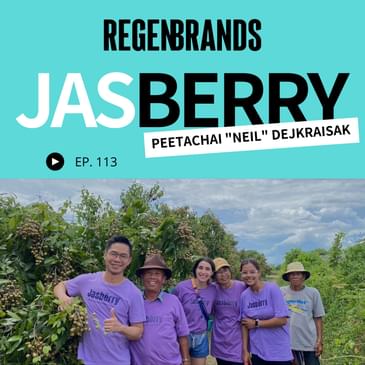
On this episode, we’re diving into the incredible origin story of Jasberry with the company’s Co-Founder and CEO, Neil.
You’ll hear how a life-changing high school friendship, a Google search for the world’s best rice scientist, and two years living in rural Thailand all led to a new superfood rice brand that you can now find on shelves at every Whole Foods nationwide.
We unpack Jasberry’s mission to tackle generational farmer poverty, the science behind their superfood purple rice, and why organic and regenerative rice farming is actually lowering costs and producing higher yields for their farming partners.
Neil also shares how Jasberry works with 2,500 rice farmers in Thailand who earn 14x more than the national average, why they're focused on expanding into foodservice for their next phase of growth, and how they’re dealing with a new, brutal 19% tariff.
Episode Highlights:
🌾 Superfood rice with 40x more antioxidants than brown rice
🌱 Rooting the mission in farmer poverty and social justice
👨👩👧👦 Living with farm families for 2 years to earn trust and understanding
📉 Confronting a system where farmers were earning just $0.40 a day
🥇 Fueling the brand with breakthrough genetics from Thailand’s top rice scientist
🌍 Working with 2,500 farming families across Thailand
💥 Increasing farmer incomes by 14x above the national average
💸 Taking 7 years to scale and land national retail distribution
🍽️ Focusing on foodservice and direct-to-consumer for future growth
🚫 Wrestling with a new 19% tariff on Thai imports
Links:
Northwestern Kellogg School of Management
If you find this content valuable, please consider donating to support our work
Follow ReGen Brands on LinkedIn
Subscribe to the ReGen Brands Weekly newsletter
Episode Recap:
ReGen Brands Recap #113 - Fighting Farmer Poverty With Regenerative Superfood Rice - (RECAP LINK)
Episode Transcript:
Disclaimer: This transcript was generated with AI and is not 100% accurate.
00:13
Anthony Corsaro
Welcome to the ReGen Brands Podcast. The place for brands, retailers, investors and other food system stakeholders to learn about the consumer brands supporting regenerative agriculture and how they're changing the world. I'm your host, AC. thanks for tuning in. Now let's get into today's conversation. On this episode we're diving into the incredible origin story of Jasberry with the company's co-founder and CEO Neil. You'll hear how a life changing high school friendship, a Google search for the world's best rice scientist and two years living in rural Thailand all led to a new superfood rice brand that you can now find on shelves at every Whole Foods nationwide. We unpack Jasberry's mission to tackle generational farmer poverty, the science behind their superfood purple rice, and why organic and regenerative rice farming is actually lowering costs and producing higher yields for the farmers they partner with.
01:12
Anthony Corsaro
Neil also shares how Jasberry works with 2500 rice farmers in Thailand who now earn 14 times the national average, why they're focused on expanding into food service for their next phase of growth, and how they're dealing with a new brutal 19% tariff. Let's dive in. What's up everybody? Welcome back to another episode of the ReGen Brands Podcast. Very excited today to have my friend Neil from Jazberry with us calling in from the early morning hours in Bangkok. So thank you Neil for making some time for us man and working with, working on time zone differences with me. I appreciate.
01:50
Peetachai "Neil" Dejkraisak
Has a pleasure to be here. Anthony.
01:53
Anthony Corsaro
Neil, for those that have not tried your incredible products just yet or aren't familiar with the brand, can you share what products y' all make today and where can people find them here in the States?
02:04
Peetachai "Neil" Dejkraisak
Well, our core product is called Jasper Superfood rice. So in this new variety of superfood rice. So basically what, yeah, what, why is it a superfood? Right. Because rice is just typically a commodity product. But this variety of rice is super special in that it has 40 times more antioxidant than brown rice, 7 times more than kale, and 4 times water in quinoa. It has approximately 30% higher protein content, high fiber. It's good for gut health. We actually done research on gut health as well. So it's just this delicious and nutritious purple rice. And you can find this Jasper's superfood rice at every whole food stores in the country, on Amazon, Thrive Market online and most organic and natural retailer around the country. Whether it's sprouse or Irwon or Mother's market giant and we are launching in Target in California in October.
03:11
Anthony Corsaro
Let's go.
03:12
Peetachai "Neil" Dejkraisak
So, yeah, that's basically Whole Foods is probably the biggest national retailer that we work with.
03:18
Anthony Corsaro
Yeah.
03:18
Peetachai "Neil" Dejkraisak
And then we have in both like soft top and Ready to Heat, so you can have it in, you know, uncooked and you have the race to heat where it's just 90 seconds and we have just the original and other things like coconut, 9 grams of green curry as well. Just to give variety to your dishes.
03:36
Anthony Corsaro
Yeah, yeah. I mean the product's phenomenal. I love the Ready to eat. It's ready so quick. I mean, I feel like I'm the average American consumer that's kind of hooked on convenience. So my girlfriend and I are definitely consuming a good amount of that in our rice rotation as we try and support all the various regenerative brands. And I, I buy it at Whole Foods just like you mentioned. So. Super cool. I, I think the. Neil, the website does a really good job of telling this story, but I would love for you to share with the audience here as well of why you guys started the brand. And it really kind of all comes down to trying to increase farmer livelihoods where you're from in Thailand. So tell us about that.
04:18
Peetachai "Neil" Dejkraisak
Yeah, there's probably a few way I can tell your story. Yeah, I think it's very personal to me because I was born here in Thailand, but I grew up in Australia. So I moved there when I was 14 years old and it was really difficult for me because when I moved there I didn't really speak English and I was the only Asian kid in a school, 1,000 kids in an all boys school. So as you could imagine, it was not easy to say the least that I look different than everyone and I didn't really speak the language very well. So I went through a really difficult time in my childhood adjusting to everything and as you know, young boys is a lot of bullying, a lot of racism, a lot of all the fun stuff, you know, fighting and whatnot.
05:17
Peetachai "Neil" Dejkraisak
So I definitely had a really difficult experience kind of growing up. But one of the boys became really close friend with me. His name was Duncan in Canberra, Australia. And we became really good friends. So Duncan is a really typical Aussie guy, you know, blonde hair, blue eyes, good at everything, every sport, you know, he's a surfer. Yeah, it's a very like typical Australian, you know, kid. And we just became really good friends over the next couple of years. And I remember and I'm sharing a story because one day were Going to an excursion at the Sydney Opera House. So we're sitting on a bus and were 16 years old. And I remember us talking and I asked him, I said, what do you want to do when you grow up?
06:06
Peetachai "Neil" Dejkraisak
And he said, I want to go to Africa and start a school for underprivileged children. Children couldn't afford to go to school. And he asked me, he said, what do you want to do when you grow up? And I was 16, and I said, I want to go back to my country and work in forest conservation to protect the rainforest in the country. And. And that's a good reason for that because growing up I had this idol who was conservationist, a Thai gentleman who grew up in a really poor family of farmers. He got a scholarship to England, came back to Thailand and worked for the government in the area of forest conservation. But because at the time there was a lot of illegal logging and, you know, just illegal extraction of natural resources, his work disrupted a lot of that.
07:00
Peetachai "Neil" Dejkraisak
And as it turned out, a lot of, I guess, capitalists were not happy with him and they killed some of his team members just to threaten him. And one day he wrote a letter. I think he was around 40 years old. He got a gun and shot himself in the head. And just to protect his family, because they threatened to kill his family. But his death started the biggest environmental movement in Thai history. And now we have the largest UNESCO protected rainforest in Southeast Asia because of him. And he saved, you know, probably billions of wildlife, right? Animals. And so growing up, he was kind of my idol. And, you know, I really look up to people like him in particular, but even like Martin Luther King, Jr. Gandhi. And I was really fascinated by people that were really driven by purpose.
08:01
Peetachai "Neil" Dejkraisak
And I was like, man, if I could one day wake up every day and do something that I believe in so much that I'm willing to give my life for, I think that would be something, like, amazing. So that was, as a kid, that was kind of how I was driven and. And Sub Nakhasutian is his name. Yeah, Sub Nakhasutian is his name. He's actually one of the. Well, he is the most famous environmental conservationist in our history. But also now, as I mentioned, we have the largest UNESCO protected rainforest in Southeast Asia, which is home to billions of animals. And that's just, you know, through his work and his death. And I think that was just something very inspirational to me. So I told Duncan, look, I'm going to go home, I'm going to do what he did.
08:55
Peetachai "Neil" Dejkraisak
I'm going to try to continue his work. And his foundation still exist. And I'm glad to say, actually, Jasper had a chance to collaborate with his foundation as well, which is awesome. But unfortunately I never got to meet him because he, he passed away when I was quite young. But, but yeah, like fast forward 10 years. I was 26 and I was an investment banker. Okay. So not forest conservation. Not forest conservation is, you know, I, I, I went to a top university in Australia. And then, you know, life happened, right. You get a good job. And I remember I got a newsletter from my school and this was my high school. And you rarely look at a newsletter, right? Like they send it twice a year to you, and it's mostly asking for money on donation of some sort.
09:57
Peetachai "Neil" Dejkraisak
So, you know, I graduated high school a long time ago. And then for some reason I look at this particular magazine and then I opened it and it had an alumni section where they interview alumni. And I saw a photo of Duncan and I recognized him straight away. We haven't spoken for literally since we graduated, which was like eight years ago. And back then we didn't have Facebook or any way to keep in touch, so we had lost touch. And I saw an article of him, the same guy, like straight away I saw, you know, kind of blonde hair, blue eyes, he was surrounded by African kids. So I started reading this article and he actually went to university to study education, became an educator and got a scholar, a national government scholarship, and he moved to Africa to pursue his dream.
10:57
Peetachai "Neil" Dejkraisak
And he, and he did it. And so the next day, I quit my job. Wow. And I left, you know, my job and I kind of went back to really try to find my purpose in life. And I guess that origin story is important because when we say, like, why we do what we do, I think a lot of it, you have to thank Duncan. And he doesn't notice. Cause we've lost touch. We haven't. I don't know where he is today, but he reminded me, like, what's really important in life and what's important to me in particular. So Jasper was a continuation of that purpose. And instead of, I guess, you know, working with the forest conservation, I now work with farmers.
11:53
Anthony Corsaro
Yeah, dude, we gotta get this podcast recording in Duncan's hands in his ears so he could know the, the effect he's had on you. Man, that's an incredible story. So you had that realization, you quit the job and you moved from Australia to Thailand, correct?
12:13
Peetachai "Neil" Dejkraisak
Yes. So at the time that I did investment banking. It was an international position. So I was moving a lot between Tokyo and Hong Kong, various different countries. I already moved out of Australia at that point.
12:26
Anthony Corsaro
Okay, so how did you land on working with farmers and starting jazzberry once you were back in Thailand?
12:34
Peetachai "Neil" Dejkraisak
Yeah, so I was studying a lot of different environmental and social issues in the country, and I was looking at the biggest one, like waste management, and I realized how corrupted it was. So it was actually, it was funny because I ran into the same problem that my idol ran into, and I didn't necessarily want to die at an early age, I suppose, but. But yeah, I had. I. One of the biggest thing was that Thailand was the world's number one rice exporter. About 17 million people in Thailand are farmers. It's 25% of the country. A one in four person. And I didn't even know that because growing up in Bangkok, it's a pretty big metropolitan city like Los Angeles or New York. You know, you're. Yeah. You're not really aware of the rest of the country. Yeah, right.
13:30
Peetachai "Neil" Dejkraisak
And then you realize that, wow, there are just many farmers and our farmers among the poorest in the world, earning just 40 cents a day, or six times below the poverty line. So, like, the UN define extreme poverty as anything less than $2 per day. So 40 cents per day is definitely very low by any standard. So when I came across this issue, it just fascinated me. So as at the time, I was doing my MBA here in Bangkok, which is actually a joint program with Killer in the United States, in Northwestern. So I did part of my program at Kellogg, and it's. It's. It's, you know, a chance for me to explore something. So I went to the northeastern part of the country, which is the most impoverished region in the country.
14:25
Peetachai "Neil" Dejkraisak
And I just went to see these farmers and I said, hey, I'm a student and I want to do a research in organic farming. So I wasn't totally honest with them because I wanted to be a social entrepreneur and I wanted to start a social business that would help change their lives. But I imagine if I was a kid going to this community and saying all these things, they would think I'm crazy, right? I had no credibility. So I said, look, I was a student and I'm doing this research on the impact of organic farming on their communities and on their lives. So I started going to these farmers who were already pioneers in doing organic farming in the country. And in fact, the very first farmer I worked with, and this is 10 years back, is the leading regenerative farmer in the country.
15:17
Peetachai "Neil" Dejkraisak
He's been doing regenerative farming for like 40 years. So he started this whole regenerative before you even have regenerative in the west. Right. This guy did way beyond right hand diversity, biodiversity in the field, how to measure that, like just you know, non GMO seeds breeding. So it was a lot of knowledge and that was already being implemented. So basically yeah we, I started there and I started to learn about their lives and you know, how the, I guess the systematic poverty was created for generation because these farmers debt has tripled over the last 10 years. So it's gotten worse and the average age is over 60 years old. So also you know, you're looking at the future, right?
16:16
Peetachai "Neil" Dejkraisak
Like the sons and daughters don't want to become farmers so they go into the city to drive taxi or do labor work which caused even more social issues. So yeah, basically all that I was able to live with the farmers really for the first two years I just live with the community. An interesting fact is that they also don't speak a regular Thai language. They have their own dialect. So I had to learn another language just to fit in with the community. So if there wasn't difficult enough they speak a different language than let's say an average Thai person definitely in Bangkok. So you have to learn this additional language. And so I spent those years learning the language so that when I sit and talk with them I could speak like them and you know, like a local person.
17:17
Peetachai "Neil" Dejkraisak
And so it was definitely the start because a lot of that knowledge and the feedback and what I learned from the community became how we build a business model at Jasper. Because it was always important for me. Like I saw a lot of social entrepreneurs at the time right there would let's say go from Europe to Africa and they start something but they didn't speak the local language, they didn't understand the local culture. And for us, for these farmers we said like rice is life. They grow this for subsistence living to feed their families. First and foremost. It wasn't even for economic reason because really honestly at 40 cents a day there's not much economic probably consideration right being put into their lives. But, but rice was something that they grew up with that their grandparents, their parents grew up with.
18:18
Peetachai "Neil" Dejkraisak
And it's what they eat. So first and foremost is for survival. And there's a big component of the cultural fabric in all of this. It wasn't just a matter of hey we want a better life or it's also about the culture itself and how rice is so intertwined into their everyday life, into their families, even their religious ceremony. They use rice in that religious ceremony. So it's very different than someone who comes from Bangkok. Right. Who just never seen the rice field. So I think it was important for me to have those two years to be with them in their home, to work in the field with them, and just for them to tell me about their life.
19:09
Peetachai "Neil" Dejkraisak
And I think that gave me the foundation of the understanding of how I want to build this business in a way that is nurturing to them and their community as well as the planet.
19:25
Anthony Corsaro
And you were able, Neil, during that time to kind of be amongst farmers that were organic and regenerative and also maybe ones that weren't and see kind of like some sort of stark divide between the two.
19:37
Peetachai "Neil" Dejkraisak
Yeah, definitely. It was almost like a cult of some sort. It was a way of life. I mean, because. Because even I worked, I started visiting many local cooperative in all in the northeastern region. Some was like a. Had a Christian ethos. So, like, no alcohol, no gambling. Like, they had this whole structure around the cooperative. So it wasn't just regenerative farming. It was a way of life. It's a belief system. How you treat the earth, how you treat the soil, how you treat the animals, it was very, like, philosophical. Whereas the people who use chemicals, like, had bought into that system. Well, organic is never going to work. It's going to have low yield. Right. You know, and you need to put in more and more chemical fertilizer to get a better output.
20:34
Peetachai "Neil" Dejkraisak
So there was all these different belief system, especially a divide between the chemicals and organic farmers. So really, a lot of my, like a lot of funny story, I would go and sit with the farmer.
20:47
Anthony Corsaro
Yeah.
20:48
Peetachai "Neil" Dejkraisak
And I'll be like, okay, can you break down the cost of what you do? And of course, none of them know the cost. Right. I graduated as an engineer, so I was very, like, logical. And literally after, I think, like four hours of sitting down with them and them, like, telling me, like, a million things, I still don't know the cost of their farming, you know, so it was like, very challenging to understand it economically because they'll be like, okay, I put all this in and I'm like, okay, so how much do you put in? And. And how often. And. And they were like, forget. They be like a few times a month, you know, like, and. And so. And so it was definitely. It took me some time to really understand the economics of it.
21:41
Peetachai "Neil" Dejkraisak
But to kind of long story short, the organic farmers Had a much lower cost and over a period of time had a much higher yield. Not, not for the first, you know, two years probably because the soil was still being, let's say recovering we call like salty soil. When you put a lot of chemical fertilizer in and the soil become very hard, which then prevents any living organism from living in the soil like worm, earthworms and so forth and all kind of bacteria. So basically we saw that long term these organic farmers were enjoying a much better economic output. And we also started to learn a different technology of different type of organic fertilizer that can be used to enhance that.
22:39
Anthony Corsaro
Okay, so you have basically this focus on the farmers and poverty issues in the country. You have this really deep experience in community with those folks, learning about them, learning a whole new language, seeing the differences in their livelihoods and way of lives. If they are kind of more of this organic regenerative approach. When does the opportunity for the specific superfood rice that y' all have, when does that come in? And when does, hey, I'm going to start a food brand and sell it in the US like how did both of those things come about?
23:15
Peetachai "Neil" Dejkraisak
Yeah, I had this very simple concept about starting this which is that I needed a world class innovation, something that would add value to people's lives. Because I saw a lot of local community even back then trying to sell organic rice is still a commodity. People look at it like, oh it just rice, I mean Grant is organic and maybe they'll pay 10% more, which you know, really doesn't cover all the costs even of converting to organic in the early years. And I explained to you the higher yield doesn't kick in like until the third year. So really it's economically challenging and I'm a big believer in the free market. So I, you know, I looked to social entrepreneur at the time, Muhammad Yunus, whom you know, I had a pleasure to meet who created Caribbean bank like band for the poor.
24:17
Peetachai "Neil" Dejkraisak
So he wrote a whole book about their social business. And I think that for me we needed an innovation that's gonna add so much value to consumers life. And so I, at the time I was a student and I remember talking to my friend, I said well, what if we have the best rice innovation on the planet? And we look at it and they look at me like, you mean like from where? And I said well. And I said well, just, just a simple thought, right? The best rice innovation on the planet would come from the best rice Scientists on the planet. It would make sense. It would be the smartest. Right. Scientists on the planet. And they were like, well, how are you going to find this person? And I said like Google. And it was like, you know, almost 10 years back.
25:13
Peetachai "Neil" Dejkraisak
So I Google a bunch of rice scientists and I found my guy. I was like, okay, this guy, he's like the equivalent of the Nobel prize winner, right? Scientist. That's awesome. That's awesome. Which is, which is super funny. And lucky for me, he's Thai and not Brazilian.
25:31
Anthony Corsaro
There you go.
25:33
Peetachai "Neil" Dejkraisak
It makes sense because we're the biggest rice country that we would have. Right. Rice researcher. And he specializes in genomics, which is natural cross breeding of rice variety. So he would naturally cross breed different variety, which could take up to like 10, 15 years because it takes a long time because it's not gym or you know, rice breeding. So I remember I asked one of my friends to send him a letter to his university for a meeting and we didn't get any response after weeks. And I said, well, okay, why don't we just call him? And, and at the time they were like, what? You have his phone number? And, and me being an investment banker, I googled building and I got his mobile number. I was good at finding information.
26:26
Peetachai "Neil" Dejkraisak
And I call him as an MBA student and he picks up the phone and again, this is one of the most distinguished researcher on the planet, especially in the field. Right? He is at the time. He's been doing it for more than 30 years. And I call him and I gave him a 30 second pitch. I called him and he's like, who's this? And I said, I'm like, I just need a few minutes of your time. Yeah, it is really important. Like it's life changing. And I need just a few minutes. And he's like, I'm in a meeting and I like, just a few minutes. Can you step out of the meeting and cheer me up? So we ended up just talking for maybe five minutes. Cause he was in the middle of meeting.
27:25
Peetachai "Neil" Dejkraisak
And the next day I drove three hours to his house and we spent five hours together at his house the very next day.
27:33
Anthony Corsaro
Wow.
27:34
Peetachai "Neil" Dejkraisak
And basically to cut a long story short, this genus scientist told me about kind of all his research which blew my mind. You know, he bred rice that are resistant to flooding, resistant to drought for diet rice for diabetic people. Like he just had all these like rice lying around and rice mad scientist.
28:01
Anthony Corsaro
Man, I love it.
28:02
Peetachai "Neil" Dejkraisak
Yeah. And I, and I was like, wow. And then, and then he said. And then I told him what it's like. He's his greatest innovation. And he said, I have this rice that is the healthiest rice in the world. Right. The nutrition is off the chart. So I said, okay, let me try to eat it, because if it doesn't taste good, like, no one's gonna eat it. Right, Right, right. Thai people are really big on food, as you can imagine. So we. So I ate the rice and this dark purple rice, and it was delicious. It was aromatic, it was soft. Despite being okay, like, man, I want to eat this. I want to eat this rice every day. Like, why, why don't we have this rice in the world? Yeah. And he said, well, I'm a researcher. Like, I just.
28:45
Peetachai "Neil" Dejkraisak
I just do research. Right. My, My. My job is it's not to bring it. Right. I don't know how to bring it to the world because.
28:54
Anthony Corsaro
Yeah.
28:54
Peetachai "Neil" Dejkraisak
And I said, well, what is your goal in life? Like, you already, like, accomplished everything as a researcher, so what is that left for you? I mean, you're the best of what you do. Like, what are you trying to accomplish? She said, well, I hope that one day my innovation can help farmers have a better life.
29:14
Anthony Corsaro
Wow.
29:15
Peetachai "Neil" Dejkraisak
And I hope farmers not just in Thailand, but around the world. And I said, you know what? I'm going to start a social enterprise. This one day is going to help millions of farmers, but also for the consumers eating your rice, their life is also going to be transformed as well. Right. And so that's kind of how it started. And the funny story was that this particular rice research, one of the biggest agricultural conglomerate in the world had approached him. This is like 10 years back. Right. Offer him $5 million to buy this research.
29:56
Anthony Corsaro
Wow.
29:57
Peetachai "Neil" Dejkraisak
And. And he said, no.
29:59
Anthony Corsaro
Wow.
30:00
Peetachai "Neil" Dejkraisak
So. So. And he's not a wealthy guy before.
30:04
Anthony Corsaro
He met you, Neil, or after.
30:06
Peetachai "Neil" Dejkraisak
Before he met me. Wow. And it was literally like six months before he met me. So he told me this story. When I asked him, why does he do what he do and what he wants to accomplish in life? He told me his story, and he said, well, like, money is. Is not important to me. Like, what is important to me is impact and the change I can make in the world. But as a researcher, he had no idea about the business and commercialization and all that. So that's where I came in. And really, it was a pairing between this incredible research and the local community and building the bridge between technology or earth science, the local, let's say, supply chain, system, value. Value chain, and the whole agriculture piece and putting the two together.
31:03
Peetachai "Neil" Dejkraisak
Then the easy part of building a world class brand, easy part, which I at the time, my vision was to build the Patagonia of food. The concept was simple, to build a world class brand that would be able to transform consumers, health, farmers, life and the planet. And that's really at the heart of Jasper, why I created it. But this backstory that I told you, starting with my purpose, the innovation, the community, this all came together, which is all. And I was like, okay, this is what I'm going to do with my life. And so I started, you know, working on all of those dimensions at the same time. But this whole scientist thing was just crazy because I just googled him and literally like, who's the best right scientist on the planet?
32:00
Peetachai "Neil" Dejkraisak
Like I googled this and Google at the time wasn't this smart or we didn't have, you know, chatgpt, so I actually had to do a lot of reading. So like Google didn't just spit out the answer to me, right? I had to do a lot of personal research to find out more. But yeah, it's really, when I look back, it was just a very simple question. And me being an entrepreneur, social entrepreneur, my role was more of creating a platform in which everything can thrive. Yeah, I'm definitely not smart enough to invent a rice or nowhere near his intellect level. But yeah, I'm just a lucky recipient of this great opportunity to bring something amazing to the world.
32:55
Anthony Corsaro
Well, brother, I'll tell you what, when you are ready to write a book or make a movie about all of that, I will definitely be buying it. Tuning in. And if we ever get the ReGen Brands Netflix series like I want to one day, we definitely have a slot for that story. When you got there and you found the scientists and you had the variety, when you started thinking about commercialization, did you think about kind of the agronomic piece and how to grow it and is there enough seed or did you immediately go to the brand side and start thinking about commercialization? Do you, did you do both at the same time? Like, what was the journey to actually get to package one of Jasberry Superfood rice again?
33:36
Peetachai "Neil" Dejkraisak
I had a really funny story for this because I was like, okay, if I'm going to go and talk to all this community and they already trusted me at that point because I told you I was living with them for like the first two years. But I needed to make sure that there's a market for it, right? Like, so at the time I didn't have a product, Nothing, right. I just had this idea and this innovation. And so what I did was I want to take this to Whole Foods, but I had like, nothing. So I remember I, again, I Google someone at Whole Foods. And funny story, he's still working in the industry. Not. Not in Whole Foods anymore. He was a buyer. His name was Dwight Richmond. And she said his name. So Dwight was the global buyer at Whole Foods.
34:37
Peetachai "Neil" Dejkraisak
I think he works for a retailer now called Town and Country, something like, don't quote me on that, but in the Nashville getting retailer. So I remember I emailed him and I called his office. He's like, hey, can I get like half an hour with you or something? And no response, right? And I don't know how many emails I sent him, but probably a lot. And then I lost count. And then I call and I left phone messages because he never pick up my call. So I would leave these four messages to him. And I remember I went to the US And I went to the Whole Foods headquarter in Austin right his way back. I was still a student and I just started this project.
35:32
Peetachai "Neil" Dejkraisak
And I remember going into the Whole Foods reception at the headquarters and I said, I'm here to see, you know, Dwight. And they're like, do you have an appointment? Say, no, I don't have an appointment, but you know, I'm here to see him. And then they're like, you have to step out of the building or we're going to call security. Like, you know, you can't just come in and meet people. And I said, okay. So I remember I was standing outside of building and I call him again, and for the first time I pick up my call. Wow. Just serendipity. And. And I said, hey, Dwight, I'm. I'm like, I flew all the way from Thailand just to see you. It's really important. I just need like five minutes.
36:23
Peetachai "Neil" Dejkraisak
As you can imagine, I have this thing going on with like asking people for five minutes or.
36:27
Anthony Corsaro
Yeah.
36:28
Peetachai "Neil" Dejkraisak
Or two minutes or whatever it is.
36:29
Anthony Corsaro
You got a good batting average. It's working out well for you so far.
36:33
Peetachai "Neil" Dejkraisak
And then, and then, you know, he thinks about it. He's like, okay, meet me like outside the building, 7am tomorrow morning. Wow. I'll give you. I'll give you like a few minutes. And I remember I cooked the rice, right? I brought like the rice so he can try it and I even made some cold, solid dishes with it. So. So yeah, we met the next morning. And he edited and he's like, wow, this is amazing. I've never seen anything like this. I mean, just the test and the color and the texture and everything. And I started telling about the project and everything, and he's like, yeah, this is, this would be a good favorite at Whole Foods, you know, and he's like, show me your packaging. And I had this like, mock up packaging that I got my designer friend to do for.
37:25
Peetachai "Neil" Dejkraisak
For in like a week. Yeah. So it was not like the best. And I kind of show him I had no prota. Right. Like, nothing. But I just show him this image and he's like, yeah, it looked pretty good. You know, you had to do a bit more work on it and everything. And. And he's like, so when do you think you'll be ready? And. And I'm like, do you have organic certification? And. And, well, probably. Probably gonna take another year to get ready and everything. Yeah. But he was so nice. Like, he sent me all this document. He's like, okay, these are the checklist, right. You have to make sure you have, you know, organic certification, all this kind of thing.
38:09
Peetachai "Neil" Dejkraisak
So he was like, really instrumental in helping me understand how to get into Whole Foods when I didn't have a product or, you know, brand or anything. So then I came back to Thailand with the confidence now that I'm like, okay, now I can get all this community to start learning how to grow this rice. And then, you know, one day we're gonna be in Whole Foods. I didn't know that it would take me seven years later to get there. I thought it would take a few years. But, you know, as it turned out, there were a lot of challenges in growing his rice because it's a new breed and it's not like Jasmine or let's say Basmati or this kind of regular rice that we see. So. So yeah, but basically Whole Foods was the origin story of the brand piece.
39:08
Peetachai "Neil" Dejkraisak
And then, you know, fast forward seven years. We launched in Whole Foods nationwide, was our first major retailer in the United States. So it kind of came back full circle.
39:19
Anthony Corsaro
Wow, that's incredible, man. I do want to talk about the specific agronomics, right. Because you just mentioned there were some challenges and this is a different variety. So kind of a two part question, what were slash are some of those challenges? And other than just being everything that goes into organic, what specific practices are the farmers doing that maybe is different than just regular rice farming?
39:47
Peetachai "Neil" Dejkraisak
Yeah. So I think the first piece is their organic piece, which is that we follow. We started following the USDA organic standard in the European Union standard for organic. So that was the minimum threshold for us. So obviously no use of chemicals in at any point in the farming. But as I mentioned before, one of the very first co op that I worked with was a leader in regenerative farming at the time. And so we also implemented that practices which was beyond the organic farming. It was more focused on the biodiversity in the field, having a variety of crops in the field, crop rotation. So after you have its rice, what do you grow to nourish the soil and to nourish their living organism in the soil. So we actually implemented their wisdom into the practices since basically beginning. So were doing regen organic.
40:49
Peetachai "Neil" Dejkraisak
I guess before we had regen organic we didn't know what it was called because I remember like when I was talking with this farmer, they were telling me about like the importance of the biodiversity to their, to the environment, to the soil, to the plant. Even the plant would have high nutrition. It would taste better. Right. So, so there was all this knowledge that they're working on. That's the first piece. The second piece is what you ask is how to grow this new type of rice. Yeah, we should start purple. And they used to growing white rice. So even from a color perspective it's very different. There are many variety of the purple black rice, but this one is obviously unique and there were some inherent diseases that came with the rice, one of which made the rice grow really tall and die.
41:43
Peetachai "Neil" Dejkraisak
Basically there's a word for that disease. But so we had to find a way to combat that. So we ended up using like a bacteria to mix with the seed at the very beginning before planning. And this particular bacteria actually kills this DNA, I guess of the disease. So well, thank God we had this scientist who was a genius and he's like, what disease? And then we say, okay, this is the disease. Oh, I know the DNA of that disease. Let me find the bacteria. So yeah, we had the right guy to help us understand how to treat the rice, the seed and how to breed the seed. So the scientists helped teach the farmers both how to grow the rice and how to breed the seed for themselves for the future as well. So this took about three years actually this process.
42:45
Peetachai "Neil" Dejkraisak
So it was not a short process because at the time we only grow rice once a year.
42:51
Anthony Corsaro
Right.
42:51
Peetachai "Neil" Dejkraisak
So it wasn't like you, it's not like coconut where you grow it every 45 days and you know, you get a new crop and it grows throughout the year. Rice is a very seasonal crop. So basically a lot of the part of the country they only grow once a year and if they have irrigation, they can grow up to twice a year. So typically this is. Takes longer time. Right. It takes four months to grow to rice and then you have to prepare. Right. The seed beforehand. So it's basically like half a year, let's say. So yeah. It took us three crop to get to a place where we had high yield. But by the third year, the yield of the jasmine soul food rice was higher than your jasmine or any white rice you can think of.
43:39
Peetachai "Neil" Dejkraisak
So we got to a point where the yield was higher, the cost was lower. Yeah, but that entire process that you talk about their, their economics, part of it is it took us three years to really master.
43:55
Anthony Corsaro
Yeah, thank God you had the Thai. Reisenstein is what I'm going to call your rice doctor to help you through all that.
44:05
Peetachai "Neil" Dejkraisak
It was so funny. Like, and one of the other thing is that he does not speak the local dialect. I told you the language.
44:12
Anthony Corsaro
Yeah, yeah.
44:14
Peetachai "Neil" Dejkraisak
And because he's a scientist and I remember I brought him to meet all these farmers and he would speak to the farmers and they'll be black. Like what's he talking about? You know, he's very technical and he was explaining the rice like genomics to them and I realized after a while that I had to be the one who talked to the farmers because otherwise, like nothing was, would get through from the communication standpoint. So in some way I became a bridge between him and the farmer as well from, let's say the more scientific standpoint of the rice itself. And that was very important, I think, for the farmers to really understand that.
45:03
Anthony Corsaro
Yeah. And I, I don't have the stats up in front of me, but I want to just take a second to highlight the impact you are having on the farmers and kind of come full circle back to that. You mentioned the average. They're making 40 cents a day in Thailand. And I believe on the website it said the farmers y' all work with make 14 times what the average farmer does. Is that's okay. You're giving me a head nod. And then there was some other impact stats like share all that's with, Share all that with us, please.
45:31
Peetachai "Neil" Dejkraisak
Yeah. So from, you know, 10 years ago when I started with a few families, we work with 2,500 farmers family now that's over 12,000 people. And their income from just 40 cents a day through growing the jazz musical food rice, they're earning almost $6 a day, which is 14 times higher than. And I know that $6 doesn't sound a lot maybe to our audience, but it goes a long way if you live in rural Thailand. It does.
46:06
Anthony Corsaro
Compared to $0.40, it sounds like a hell of a lot, so.
46:08
Peetachai "Neil" Dejkraisak
Sounds amazing. You can send your children to school, you can do things, you know, send your students to school, have health care and all that. It's enough for that. So yeah, it's very one of their story I share because when we talk about impact is one of the farmer we work with. For example, her name is mama and just three years ago she had $10,000 earning 40 cents a day, having $10,000 of debt. She used chemical in her farm and she has six acre of land. And three years later she paid off all her debts. Her land has now doubled. She has more than 13 acres of land now. Her land is certified organic. And she had three children. They were working at a minimum wage factory near Bangkok.
47:01
Peetachai "Neil" Dejkraisak
They're now back on the farm working with her because for the first time in their life they have hope for a brighter future. So this is the kind of impact to each family, right? So the children can come back and work on the farm with them. You bring back the community and the family. As I mentioned before, right, the younger generation don't want to be farmers. So by having this kind of project, it really beyond just the economic improvement and the elimination of poverty, it really also brings back community and family. And I really feel very strongly about that because when you're an old farmer and you never see your children, it's heartbreaking. You know, you work your ass off, you earn nothing and you lose your family.
47:52
Peetachai "Neil" Dejkraisak
Your, you know, your children might come and see you once a year because they're driving taxi in Bangkok or a motorbike taxi or their labor, you know, workers at a factory. It's so it's really the impact is very personal to me because they kind of became my family. So there's 2,500 families. I mean, I don't know every one of them anymore because it's a bit too many people. But when I first started, you know, I knew like every family. And really it just incredible how sometimes nowadays when I go and visit some community, they come up to me. They never met me, but they know, oh, this is like the Jasper guy. And they come to me and they're like, tell me about their daughter graduating in a nursing school because of this project. Now she's a nurse.
48:50
Peetachai "Neil" Dejkraisak
You know, like, it's such an incredible thing for me to hear this and some of them will come to me and be like, you're like my son. Wow. And I'm like, you know, what did it do for you? He said, well, without you, like my children wouldn't have gone to school. And you know, I'm kind of getting emotional talking about this because they're such kind, wonderful human beings, these farmers. They just, they're just the nicest people. Right. For them, I think they perceive the world in a very different way to us.
49:26
Anthony Corsaro
Yeah.
49:27
Peetachai "Neil" Dejkraisak
And, and it's just so much, I think light and positivity and hope. And I think that is something that I learned a lot from them and what they taught me and what the impact they've had on my life. Right. Arguably has been bigger than the impact that I've had on there. So it's a two way street.
49:48
Anthony Corsaro
It's beautiful. Man. Farmers are the best. They're, they're amazing. I want to segue. I mean, I think it's a good segue because we're answering how come, how can Jasberry have more impact on those lives of those farmers when we answer this question? And that's future growth. I mean I'm sure the household penetration for this rice is still very low. Right. There's a ton of opportunity for you to just drive more distribution from a doors perspective and more awareness from a marketing perspective. What is your plan for that? And you know, are you super focused on distribution? Are you super focused on marketing? Are you got some really fun product innovation in the pipeline? Like where's the growth strategy at and what can you share that isn't too proprietary on that front?
50:35
Peetachai "Neil" Dejkraisak
Yeah. I think for us, as I mentioned before, we want to be the Patagonia of food. So there's two pieces. The first is the distribution as you said. And in the retail. I feel like we're in where we want to be. Shout out to Wegmans. They're still taking their time, but hopefully we get to Wegmans soon. Come on Wegmans.
50:59
Anthony Corsaro
Come on.
51:03
Peetachai "Neil" Dejkraisak
Yeah. And they know, they love the product. We'll just see. But I think for us we want to have more people consume it because it's going to change their life. Right. Even their gut health, their like just general energy and well being. So for us we are driving a lot in the food service. Right. We are available now in Holy Bayfield which is a restaurant in Los Angeles. They Have a few stores down in la, a lot of restaurants approaching us. So we're gonna start driving the food service to get into restaurant university. I know that some university inquire about like using our rice schools. So really for us like food service very important because a lot of people don't have time to cook.
51:51
Peetachai "Neil" Dejkraisak
And just the convenience piece of it being able to go to a restaurant and having it in different ways because the Jasmine soul food rice is very versatile. So that's really what I'm working a lot on. And the E Commerce, which is direct to consumer as well. So I think that from a distribution standpoint we're not going to just keep going retail a lot because as you're well aware of, it's very expensive and not financially, let's say sustainable. Especially for a social enterprise like ours. So this is what we're working on and hopefully by the end of this year we'll be in like 30, 40 restaurant in the LA Los Angeles area. And you know we already soon gonna have a local distributor in the area for the food service. So that's like the first piece.
52:44
Peetachai "Neil" Dejkraisak
I just wanted people to experience it, to try it. To your point, you know, most people never, probably never heard of this. So I think it's really important that they understand. Wow, I can eat a superfood rice which is like better than all my kind of staple food. Right. It can be a foundation of your diet. It doesn't matter if you're an active person. You're. You're in, you know, athlete, you're, or you're just a regular person who have bad gut health. So. Or you know, leaky gut affects 90 of American consumers. So it's. Yeah, you know, go on and on. It's so important.
53:17
Peetachai "Neil" Dejkraisak
We did a research on the leaky gut, you know also it took us six months and now we have scientific proof that the chassis soul food rice help with the gut lining and the microbiome in the gut which is amazing. You know you may hear of drinks like Olipop, this prebiotic soda that is coming up. This is whole food stove. This is just rice and water. No, no additive, right. No chemicals. So I think it's pretty groundbreaking. On the second part we say that we are your everyday superfood. So you have the superfood rice and we're working on a few project like superfood ramen so that you can eat your ramen and you can have the same superfood benefit snack. So we work on a few categories where we Bring the very same concept.
54:12
Peetachai "Neil" Dejkraisak
And the foundation of those products are based on this Japanese whole food. Rice as a raw ingredient.
54:18
Anthony Corsaro
Yeah.
54:19
Peetachai "Neil" Dejkraisak
So everything is purple.
54:21
Anthony Corsaro
Yeah, look. Well, I'm looking forward to seeing those when they come to market. And I can see the Tick Tock girlies now posting their videos about the superfood rice. So I love kind of the food service play, especially in those key markets that you probably have retail distribution to kind of help those feed off each other and grow awareness and grow consumption and help people feel better and help farmers make more money. I mean, that's a win, win. So I love that. Neil, I'm curious if this whole tariff situation has greatly affected your business. I would assume it has. And if it's not a super fun conversation, feel free to move us to the next topic. But I do think it's important to talk about if you're willing and open to it.
55:08
Peetachai "Neil" Dejkraisak
Yeah, absolutely. I mean it's affected the whole world. I mean, for us, we are exporting from Thailand to United States. We produce the rice here in Thailand and we got hit with an extra 19%. So whatever tariff were paying is additional 19%, which would wipe out most businesses, by the way, in food because you just don't have much margin. So you have options. You pass the cost on to the consumer, right. And then you pass it on to the distributor like Unfi Keha, and they pass it on to the consumer and then the cost of living will go up by like not 19. Because when people think about it, 19 is just at the point. Then everyone else, like Unfi adds their own margin. So it's multiplied. So by the time it hit the shelf, I'm probably talking at like a 35% increase.
56:06
Peetachai "Neil" Dejkraisak
And do I want to do that to the consumer right now? No. So I work with our importer and we're taking a financial hit right now because we want the American consumers to keep being able to buy something affordable. Not that rice as a product, even our product is still cheap compared to other categories like coffee, you know, quinoa. We talk about other superfood, right? Like share seeds and whatnot. But. But it's still like, I'm a really big believer that as a brand we want health to be, is health, is, should be people's. Right? Yeah, right. Consumers shouldn't have to suffer by eating something healthy and delicious. Right. Like that. If you have to go to McDonald's to save money, there's something wrong with the world. Right. Like I'm a big believer because you are what you eat.
57:11
Peetachai "Neil" Dejkraisak
So, so it affects us in so many ways. And if we end up getting cancer or diabetes, it ruin our quality of life. Right. Not just the economics of it, but the quality of it. And I feel really strongly about like having that, giving the opportunity to consumers to consume something affordable that is amazing for their health and that is delicious. And in the, so in the meantime with the tariff, we're doing the best that we can to hold this price. And you know, I'm probably soon going to get on a call with Whole Foods to discuss kind of the future. Inevitably though, if the tariff doesn't go away, then no. No one will have a choice but to increase.
57:57
Anthony Corsaro
Right.
57:58
Peetachai "Neil" Dejkraisak
And for us, we definitely not doing that this year. But as a small company, how much financial, you know, hit can we take? So it, yeah, it's just one of those things where I'm very sad for the American consumers because it's just one of those things where it's not needed. You know, like, for example, you guys don't grow enough rice anyway. And then you also don't grow, by the way, the rice that you grow in the United States is subsidized by the government. So the government subsidizes industry for what? Right. Just to be semi competitive. Now you have other crops that you grow well late because of the weather. So, so people should focus on growing what is good in the soil, in the environment. Right.
58:50
Peetachai "Neil" Dejkraisak
And, and because different countries like Brazil is good with coffee and now they're getting hit with 50% tariff coffee, I mean to United States. And you're going to see that in Starbucks and everywhere. So I think just as conceptually with a tariff for us, we try to do the best we can, but I think long term, I don't think it's sustainable for the ring and economy. And at some point something has got to give. I don't think consumers will be happy paying. I don't know what the number was. $3,000 more for grocery per year and average people who shop in Walmart. And I'm like, wow, that's a lot of grocery that, you know. So I think that I, I still have a belief that the tariff will not sustain long term.
59:41
Anthony Corsaro
Yeah.
59:42
Peetachai "Neil" Dejkraisak
For the, for the economy.
59:45
Anthony Corsaro
Well, I'm sorry you're dealing with that. I appreciate you sharing very transparently with us about it. And it sounds like you're being very intentional and thoughtful about how you're handling it. And it's. I'M sure it's a giant challenge. So, yeah, I mean, it's disappointing to see the effect. It's happening just overall and also in the industry with the people that we work with, like yourself, and hopefully it is remedied sooner rather than later, like you said. I, I do want to ask specifically about this whole regenerative thing and how you and the company are thinking about that. I don't believe there's any certification on products or any product claims. It sounds like what you're doing is very clearly regenerative. Do you see that as an opportunity? Is that not something you're really interested in exploring?
01:00:30
Anthony Corsaro
Do you think the term is kind of a worthwhile marketing claim that's going to have real consumer demand? Have retailers asked you about adding it? Like, where are you sitting with this whole regen thing right now?
01:00:44
Peetachai "Neil" Dejkraisak
Yeah, well, first of all, we've been doing regenerative organic for the last 10 years, so. So for us, it's a natural, I guess, extension, I guess. You said you can say certification. Yeah, it just comes down more to the economics of it. And so we had a conversation with Whole Foods since last year because they asked us, like, are you gonna be. Are you gonna do regen? And I'm like, we are regen. I mean, you mean you want us to do a certification? And the. Yeah, yeah, that would be good. So we reach out to the regenerative organic certified, like the certification body. And we actually did. Already did initial testing with their. They have this test on biodiversity in the soil and whatnot, and we pass all the tests. So.
01:01:31
Peetachai "Neil" Dejkraisak
Which is not, you know, I guess a big surprise, but because of all the paperwork and the audit that needs to be done, we will complete the certification probably the second half of next year. So we are in the process of being regenerative organic certified, but it. Just because we only grow once a year and you know, like all the paperwork that needs to go into. But we already prepared the farmers for it and we have already started doing documentation and giving the data or, you know, getting the data that they need from us. And yeah, we did some soil sampling, some biodiversity tests that they already look at that data and that there's really no concern for us. So, yeah, it just added, I guess, more paperwork to the, To. To the process. But I think in practice, it's not.
01:02:31
Peetachai "Neil" Dejkraisak
I think I made. It was only one practice that they asked for that I guess wasn't implemented 100%, which was more to do with the Barrier like they wanted more kind of free barrier between certain crop and yeah. So I think overall next year we will be regenerative organic certified at some point, probably later in the year and then we'll start using the logo on the products. Nice, love that.
01:03:03
Anthony Corsaro
Well, excited to see that. And I also like you said, I know the administrative and just the financial cost of that while you're dealing with trying to grow a young brand, while you're dealing with tariffs, while you're dealing with commercializing a brand new varietal of rice. So like I appreciate your willingness and commitment to that and it further I think validates our work to try and make that claim and this term more valuable for all of the businesses like yours so that it's all worthwhile and it actually has some real roi. So good segue into our final question, which is the one we kind of wrap every episode with. Neil, what do we need to do to have ReGen Brands have 50% market share by 2050?
01:03:55
Peetachai "Neil" Dejkraisak
Well, I guess a simple one word answer would be branding. Because ultimately and I think storytelling, I think with TikTok and inside a platform, we need people to tell the story. But why we, why should we care? Because one of the ways that, you know, we say a Jasper big shame starts with a tiny grain of rice. Like consumers have so much power nowadays, right? They get to choose what they buy, right? Because they can buy online, they can buy anywhere they have access 10, 20 years ago. And I really believe that a lot of people care. And I think one of the feeling that we have as a society today is just hopelessness. We see what's going on in the world, we see the war, we see this political turmoil, we see poverty and sometimes we feel helpless.
01:04:51
Peetachai "Neil" Dejkraisak
But I think this regenerative movement can be something where consumer can say, you know, what if I just make my daily choices right with regenerative brands, that's my part in changing the world. And I think that people don't understand how important that is. And I think that story, the right storytelling, whether it's through TikTok or something, where it can reach the more masses of people in a way that resonates with people emotionally would be really important because just we need to get people to understand and care about this. And we have seen that kind of, I guess campaign throughout history, you know, whether it was with their dairy, milk industry, whether it was all kind of things.
01:05:37
Peetachai "Neil" Dejkraisak
So I think that there's definitely an opportunity there just for this generation, the people under the age of 30 who are growing up with a very different world with AI and everything really to understand this is one of the core future of humanity. This is as important as AI is to our future. Agriculture for me is more important because it's our lives, is what we eat. We're not going to eat AI I hope not. And I hope I don't know how we would be making my food. Yeah, right. So as much as you know, we want to ignore, I mean food is the foundation of our lives, is the foundation of communities. 500 small scale farmers in the planet. 500 million, sorry. 500 million small scale farmers still exist on the planet. Most of which live in deep poverty. So we can't ignore that.
01:06:41
Peetachai "Neil" Dejkraisak
I think the regenerative movement is so important because it connects the consumer to the family and the planet. And it nourishes all three. Right. It changes all three for the better. And I think if we don't have that alignment to your point, hopefully 50% by 2050, then we're looking at a planet that is going to be heavily damaged, which will cause degradation to the air quality, to the water quality, to other things that is going to affect us, which is already affecting us. So I think it is one of those things where how do we make that more just tangible to people? And I think that's a challenge for the storyteller.
01:07:29
Peetachai "Neil" Dejkraisak
And we, and we need more I think of those people in this area where they're just great storyteller that to your point, right, Via Netflix documentary with you know, Chris Hemsworth or someone of that caliber that really cares. Right. We need also whether it's a celebrity or I don't want to use the word influencer, but yeah, like it has to be this collective understanding of where we're heading because ultimately as a race, right. Humanity we have much more in common. And as much as we fight about, right. What we see today, whether it's politics or war or power or money, ultimately like food connect all of us. And it's agriculture, I mean the soil, it connect us. And I think it's something that with regenerative is very important. That is that connection back to our root.
01:08:34
Peetachai "Neil" Dejkraisak
And I think it without that alignment then the future generation will face a really bleak future when it comes to food and agriculture and, and that they won't be able to fix that quickly. Yeah, right. Because it's not like technology. If you destroy the soil, right. It take years, you destroy the environment of biodiversity, it takes decades. So it really, you know, like it's not a quick fix and that's why there has to be a long term plan. But also I think for consumers they have to wake up too about what they eat and the impact of what they choose to eat. Right. And the products they choose to buy the brand they choose to support because ultimately that's the capitalism. Right. Like you need, like brands like us need to survive and the only way we survive with consumers.
01:09:34
Anthony Corsaro
Yeah.
01:09:35
Peetachai "Neil" Dejkraisak
It's as simple as that, you know.
01:09:37
Anthony Corsaro
Yeah, I love that answer man. It's a perfect full circle answer because you were an incredible storyteller. This whole app, this whole episode. So the fact that you led with storytel telling I think is accurate and just a good microcosm of the episode overall. And I think like what you were saying, I couldn't agree with more. We've, we've done a decent job of like telling the world or trying to tell the world why this matters. In the macro we're moving into I think the two more important steps or the two next logical steps which are why you, the individual person should care what's in it for you and what you actually can do.
01:10:17
Anthony Corsaro
Like I think those three steps is kind of where we've struggled so far and where we have the greatest strides to make and also where the greatest effect of outcome in terms of like ROI for the people that are doing the work both on the ground and in the brand and all the other facets that bring those products to market. And I agree with you on the like places we're showing up, we need to show up more in the most public, most visible, highest audience and most viral places which I'm even thinking about that for our platforms and what we're doing because I don't know if we've done an amazing job of that to date but especially on the consumer facing side with what we're doing with the trade association and the coalition and all of the brands and their individual marketing.
01:11:01
Anthony Corsaro
I'm looking forward to the first big viral thing that's regenerative because it's going to happen soon and we need to make sure it happens. So yeah man, this has been great. Really appreciate the time. Thanks for carving out some time in a very early morning where you're at and just appreciate all that you're doing and thanks for spending some time with me.
01:11:22
Peetachai "Neil" Dejkraisak
I really appreciate it. Keep doing what you're doing. We always behind the regenerative movement and anything that we can do to help we will man. Thank you so much for having me on the show. Really appreciate it.
01:11:37
Anthony Corsaro
Thanks Neil. Appreciate it man.
01:11:39
Peetachai "Neil" Dejkraisak
Thanks Anthony.
01:11:44
Anthony Corsaro
For transcripts, show notes and more information on this episode, check out our website regen-brands.com that is regen-brands.com you can also check out our YouTube channel ReGen Brands for all of our episodes with both video and audio. The best way to support our work is to give us a five star rating on your favorite podcast platform and subscribe to future episodes on Apple podcasts, Spotify and YouTube. You can also subscribe to our newsletter the ReGen Brands Weekly and follow our ReGen Brands LinkedIn page to stay in the know on all the latest news, insights and perspectives from the world of regenerative cpg. Thanks so much for tuning in to the ReGen Brands Podcast.
01:12:23
Anthony Corsaro
We hope you learned something new in this episode and it empowers you to use your voice, your time, your talent and your dollars to help us build a better and more regenerative food system.
01:12:32
Anthony Corsaro
Love you guys.